

Japanese scientists have used AI deep learning to discover a new geoglyph in the arid Peruvian coastal plain north of Peru’s Nazca Pampa.
This research has been ongoing since 2004 by a team from Yamagata University led by Professor Makoto Sakai. Yamagata University is conducting a geoglyph distribution survey using satellite imagery, aerial photography, aircraft-scanning LiDAR, drone photography, etc., in order to survey the vast Pampa region of Nazca, which covers more than 390 square kilometers.
The Nazca Lines are believed to have been made over the centuries, beginning around 100 BC by the Nazca people of what is now Peru. They were first studied in detail in his 1940s, and about 30 were identified before being declared a World Heritage Site by UNESCO in 1994. Remarkably well-preserved for its age, thanks to the desert’s dry climate and sand-blasting winds, it has been obscured by floods and human activity.
Archaeologists have discovered 142 new designs in the desert over a decade by using aerial photography and field surveys to manually identify them. Next, in collaboration with researchers at IBM Japan, we used machine learning to search for design data that previous studies had missed.

To conduct a thorough survey of the region in 2016, researchers used aerial photography with a ground resolution of 0.1 m per pixel. Over time, the research team has identified a large number of geoglyphs, but the process is time-consuming, so they turned to AI deep learning to analyze the images more quickly.
In a study published in the Journal of Archaeological Science, we used this new method to develop a training data labeling approach that identifies similar subpatterns between known and new geoglyphs. A new Nazca line has been discovered.
Four new geoglyphs depict a humanoid figure, a pair of legs, a fish, and a bird. The humanoid geoglyph is shown holding a club in its right hand and is five meters long. The wide-mouthed fish geoglyph is 19 meters long, the bird geoglyph is 17 meters long, and a pair of legs is 78 meters long.
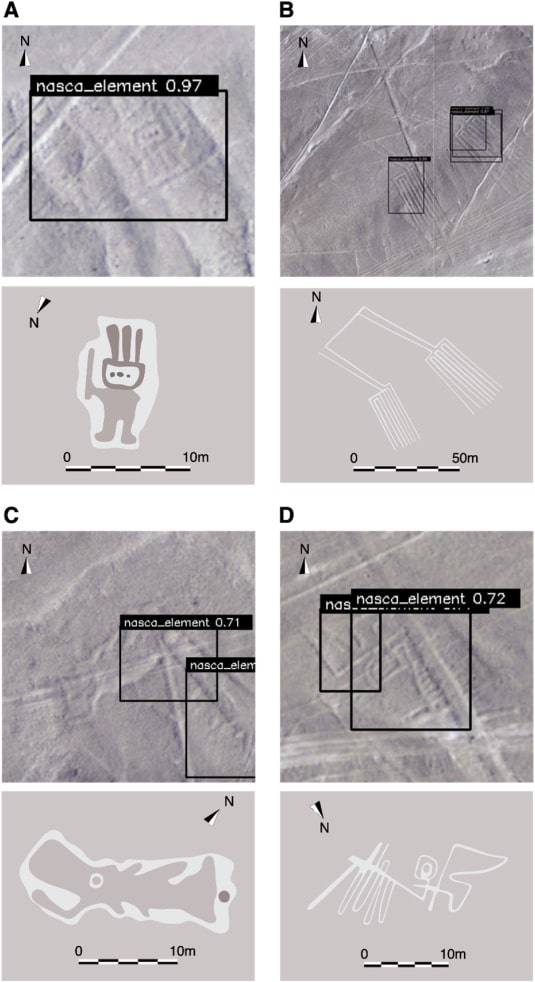
“We developed a DL pipeline that addresses a frequently encountered challenge in the task of archaeological image object detection,” the study authors wrote. Our method enables previously unattainable target discovery by allowing DL to learn representations of images with better generalization and performance. Moreover, our approach speeds up the survey process by introducing a new paradigm that combines field surveys and AI, resulting in more effective and efficient surveys and advancing archaeology.
These results serve as another example of how machine learning can help scientists, especially when tackling tasks involving large datasets. Like humans, algorithms can learn to sift through specific types of data and look for patterns and anomalies. Writing these tools can be difficult, but once trained, such algorithms are tireless and consistent.
Cover photo: Yamagata University/IBM Japan
https://doi.org/10.1016/j.jas.2023.105777


