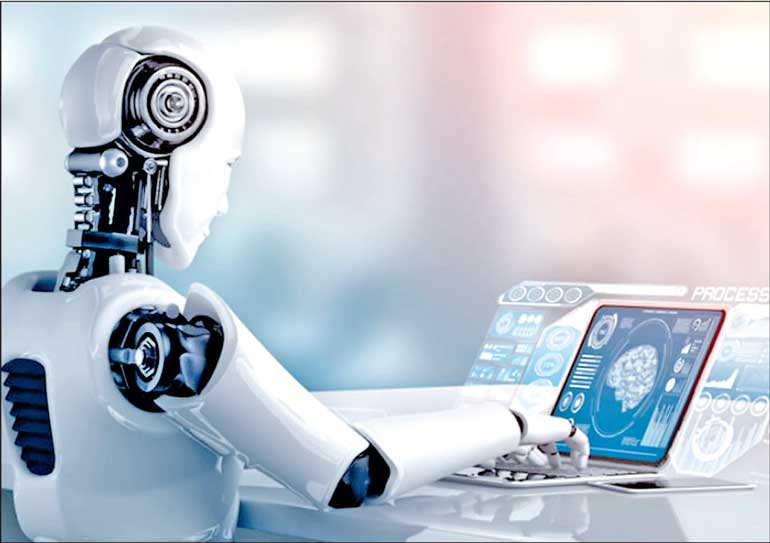
AI technologies, programs, and advanced computing algorithms must be harnessed to identify meaningful patterns in data to enhance decision-making and improve lifestyles.
 preamble
Political and social media are buzzing with buzzwords such as artificial intelligence (AI), augmented reality, virtual reality, machine learning, and many others. Therefore, it stimulates the mind of the audience who have no idea what you are saying, and it is an opportunity to learn. And explore the wonders of technology.
These IT technologies have evolved in the past without establishing clear operational boundaries. Humanity is at risk if there is no acceptable regulatory and ethical governance framework to prevent disasters. An urgent and thorough evaluation is needed, and a globally acceptable treaty similar to a nuclear disarmament treaty needs to be formulated. Renowned historian and scientist believes that unethical applications of AI may redefine humans as ‘no longer mystical souls’, but hackable animals, once hacked He warned that it could be easily manipulated without being aware of it. There is now a race to become an AI superpower among the developed nations. Surprisingly, the brains of celebrities will be harvested post-mortem and the information collected over their lifetime will be collected to enhance the database for AI decision-making.
What is AI?
AI has multiple meanings depending on the industry sector in which it is used. In general, briefly understood, AI is an advanced, data-driven technology that stimulates human intelligence through machines, supercomputers, databases and algorithms and programs. AI can generate output in an instant that would take humans hours to process. The speed of technology development and diffusion has outpaced ethical foundations by leaps and bounds. Second, world leaders need to rethink the resulting disturbing aspects that permeate every aspect of human life. Some scientists speculate that humans will merge with technology and be redesigned to become Homo Deus, leading to transhumanism. It will be interesting to see how human capabilities are enhanced, augmented and improved by cybernetic organisms, including both biological and technological components, in the future.
Advantages and disadvantages of AI
AI technology is now being used in many areas of business, such as promoting products and services, increasing efficiency and productivity, diagnosing the causes of disease, and for law enforcement purposes. X-ray recordings are read in seconds and the cause of the disease is interpreted and identified with reasonable accuracy. For accuracy of interpretation, the database used for the analysis contains millions of his past X-ray records and powerful algorithms that filter out irrelevant facts and can be run on a supercomputer. must be There are many other applications that are beneficial to humanity if used ethically, rather than being used for destructive purposes that do not violate people’s basic rights and human rights. It leads the easy way to repressive regimes.
China’s credit system is designed to track individuals and businesses based on their behavior, habits and purchases, providing a score that measures their trustworthiness. Credit scores go up and down based on an individual’s actions and activities, just like a person accumulates “KUSAL and AKUSL” over a lifetime. Data is captured in real time using his 400 million his CCTV cameras across the country to build a massive database, big data. A new generation of cameras can identify age, gender, face shape, and more.
Additionally, AI may be able to extract information beyond physical appearance. Individual privacy is also believed to be at risk, as the system can profile persons illegal to the government. This is called the “new credit-based” supervisory mechanism and is designed based on big data and AI for early warning of risk factors that require special regulatory attention. The system can distinguish between high-performing people and companies without being blacklisted, or “redlisted” people and companies. The Red List allows citizens and institutions to restrict access to certain privileges that may affect their lives.
On the downside, based on the negative reputation of the person or institution in question, we may be forced to: [a] travel ban, [b] school ban, [c] limit employment possibilities, [d] Increased scrutiny – subject to audits or government inspections, [e] Public shaming.
To put it into perspective, similar systems operate elsewhere. Australia, Germany, India. India’s system “Aadhaar” is somewhat consistent with China’s big data social credit system, but it is not centralized. Is the state-owned credit system violating basic HR and FR?
The Current Stage and Risks of AI
AI is still evolving, and many countries are investing millions of dollars in AI development.
Many risks arise as you develop and explore new areas of application. In the transportation sector, self-driving vehicles naturally pose the greatest risk of impact, especially in terms of safety. It is therefore imperative that we do not overlook the risks that may arise from their use and the concerns that the complexity of AI technology may pose to the general public. In the context of social welfare, the use of AI can physically and mentally violate privacy and undermine human rights. Public trust will be a key factor before deploying AI-driven technology. All AI decisions and outputs depend on the algorithm used and the suitability of the database.
The increasing use of data-driven technologies is creating new cybersecurity risks beyond the mere digitization of individual systems, and data collected by machine learning can provide new opportunities for adversarial attacks by thieves. It opens many roads. So evaluate them closely and prevent them. Selling data has become a good business and must be monitored closely and increased by administrators to prevent hacker intrusion.
Conclusion
In 1984, the famous novelist George Orwell described it in his book, “Big Brother is watching you.” This futuristic commentary shows how the government seeks to monitor and control the people by suppressing their will. In modern times, this has become a reality, evolving in violation of ethical norms. People’s privacy is being violated through machine learning. The question to be asked is how much privacy must be sacrificed and given up for national security. People need to realize that their entire lives are being controlled by invasions of privacy, ostensibly for the sake of a healthy society. In the situation of Sri Lanka, we learned that the president wants to appoint a task force to boost AI development and apply the technology to various industrial sectors to gain an edge over West Asian countries. Sri Lanka, while appreciating its initiative and urgency, should not be inclined to obtain technology transfer from India or China, especially on the basis of her BOI tax concessions. Sri Lanka’s AI should be homegrown and should immediately target the healthcare, commercial business and service delivery sectors.
Furthermore, producing 10,000 engineers each year is not the answer. We need to produce quality and competent engineers while avoiding a rush of supply. With every indication that governments are heading towards autocratic and authoritarian states, it is vital to urgently put in place ethical safeguards and governance that prevent privacy invasions. The ATA bill before Congress and the president’s recent allegations are non-AI processes that show clear signs of repression to speak out against the demonstrations. China’s AI system is centralized and aims to catch those who criticize the CCP despite harsh criticism from the West.
On the positive side, AI technologies, programs, and advanced computing algorithms must be leveraged to identify meaningful patterns in data to enhance decision-making and improve lifestyles. AI in this context should aim to help government agencies reduce costs, free up labor time for more important tasks, and deliver better, more targeted services. The Sri Lankan government needs to rethink its state-owned enterprise restructuring strategy aimed solely at increasing productivity in public service delivery.
It is also proposed to explore its potential application in the field of legal litigation to shorten the waiting period for judges to make quick and accurate decisions.
This requires building a database of all past cases and putting them together. Additionally, the availability of courtroom audio and video recordings could further enhance the clarity of the data for AI applications through machine learning. If Sri Lanka had the skills to manually build from paper records of historical data rather than wait for machine learning to be developed and utilized, partial implementation in litigation could start soon.
Cricket enthusiasts know how the decision-making process of giving LBW has been enhanced to help the third umpire sit away from the cricket pitch. This is a typical narrow AI application.
Source:
https://www.youtube.com/watch?v=17bzlWIGH3g&t=1240s&ab_channel=John Anderson
https://www.gov.uk/government/publications/ai-regulation-a-pro-innovation-approach/white-paper
https://nhglobalpartners.com/china-social-credit-system-explained/