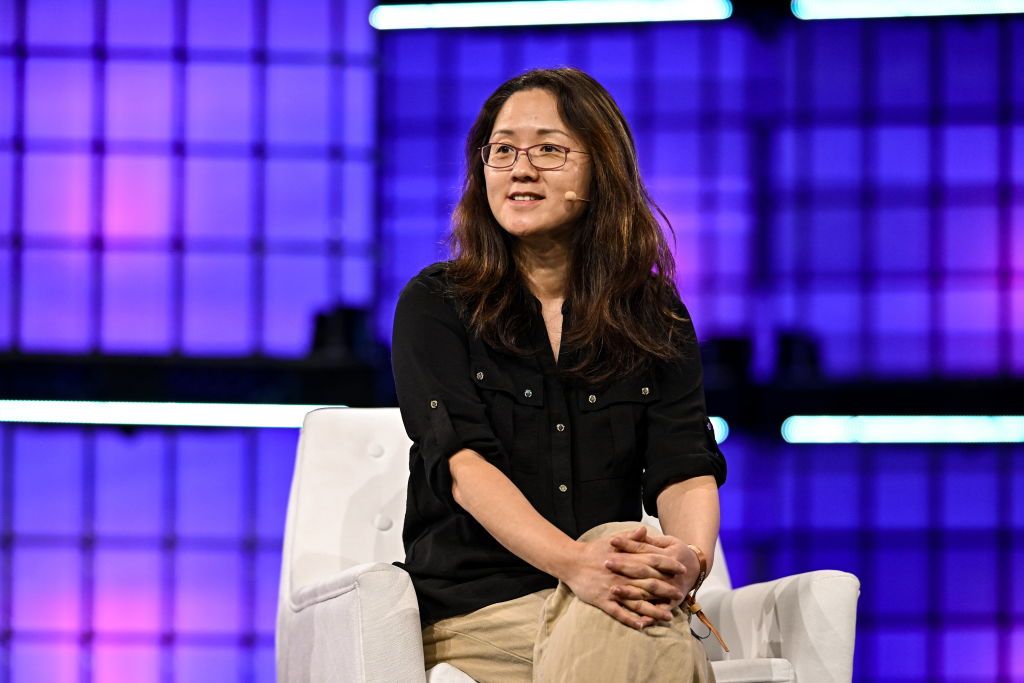

The surge in demand for AI has created a new category of digital utility companies that sell computing power, access to models, and developer infrastructure. Among the leaders in this pack is Fireworks AI, co-founded by Lin Qiao, a former Meta executive who led the creation of PyTorch, a popular open source machine learning framework, and a team of engineers from Meta and Google.
Fireworks AI is a platform that allows developers to use open source models to build products faster and at lower cost than proprietary models. You have access to many of the most capable open source models on the market, including Meta’s Llama series, Mistral, Qwen, and DeepSeek. Companies can also upload their own data to train and fine-tune these models. Customers include Cursor, Harvey, Uber, Shopify, and more.
Lin describes Fireworks as a “specialized intelligence platform” rather than general intelligence. Specialized intelligence was what AI researchers primarily relied on before general intelligence became a reality. “Before generative AI, there was no underlying model that summarized the world’s knowledge. GenAI changed that,” Lin explained to Observer. “The underlying model now learns from the public internet and large labeled datasets, creating a deeper and more generalized knowledge base that can be used directly as a black-box API.”
But with an abundance of public data and common intelligence models, Lin believes, counterintuitively, that the most valuable uses of AI will come from specialization.
“Because the underlying model doesn’t have access to private data that is locked away within the application or enterprise,” she says. “The vast majority of data is private, locked within the company as its own IP and information, and never shared outside the company.”
Training and fine-tuning the model using that private data creates an ongoing need for Fireworks services. “This is a continuous process as applications continue to evolve, data distribution changes, and the basic model continues to improve,” Lin said. “We have customers who tune once a week, once a day, and sometimes once every few hours,” she predicted, predicting that this tuning process will soon be fully automated.
Once your model is fine-tuned, Fireworks helps you optimize inference speed and cost. The company offers the industry’s fastest inference (the speed at which its AI generates a response). For example, Cursor’s code editor uses Fireworks speculative decoding to provide code suggestions up to 13x faster than traditional setups.
According to the latest public data, Fireworks processes over 30 trillion tokens in daily inference traffic (excluding training), which is more than OpenAI and Google’s Gemini.
The company makes money by charging users a flat fee per million tokens. Tokens are the basic unit of data that AI reads, processes, and produces. In English, a token is about four letters, or about three-quarters of a word.
“We offer one platform that covers the entire end-to-end spectrum of model development, from quality to speed to cost. The end result is that our customers experience improved quality, significantly increased speed, 5 to 10 times lower costs, and the ability to quickly move to large-scale production,” Lin said.
new moat
These days, AI executives like to talk about “moat,” or the competitive edge that allows a company to stay ahead of its competitors. Thanks to AI coding tools, it’s easier than ever to turn ideas into applications, eliminating traditional product moats.
“It’s a moat because data cannot be copied,” Lin declared. “The data collected to understand user intent, user preferences, and user engagement – what works, what doesn’t, and where needs to be optimized – is all proprietary information, and that creates the asymmetry needed to compete. Anyone who can turn this data into proprietary intelligence can build on it. And it can become even more complex.”
Fireworks competes with both closed model providers (such as OpenAI, Anthropic, and Google) and infrastructure platforms such as Together AI, Replicate, and AWS Bedrock. Its differentiation lies in its focus on open models while tightly integrating training, fine-tuning, and high-performance inference into a single system.
“You don’t need a Ferrari to go grocery shopping.”
Besides data moats, another argument for open models is unit economics. Platforms like Fireworks allow developers to choose from a wide range of open weight models, allowing them to fit the most cost-effective level of intelligence to each task. This flexibility will become increasingly important as companies seek to deploy AI at scale. Using a single state-of-the-art model for all tasks quickly becomes cost-prohibitive.
“You don’t have to drive a Ferrari to go grocery shopping,” Lin says. “There are so many tasks we solve every day at varying levels of complexity. Some tasks are extremely difficult, requiring superhuman intelligence to solve, while others are less difficult. Having a vendor that can automatically select the best model to solve a particular task can help you get the quality you need at the lowest cost.”
When Lin founded Fireworks two years ago, the company initially focused on inference and treated it as a “one size fits all.” Now, driven by the open model’s rapid pace of improvements and releases, training has also doubled. The quality of the open model significantly narrowed the gap with the closed model and accelerated release cycles from monthly to weekly. New models frequently outperform benchmarks and approach front-line performance.
“This makes training especially attractive. With personal data and a little tweaking, you can always stay on top of your game,” says Lin.
She went on to conclude, “While we believe that specialized and generalized intelligence will coexist, the world will not be dominated by a few generalized models. There will be millions of specialized intelligence models, one for each use case.”