
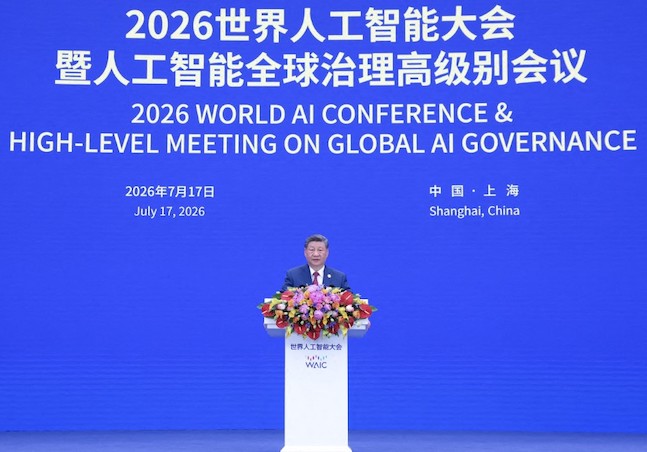
Chinese President Xi Jinping said AI should not be dominated by any one country and called for international cooperation in the development of artificial intelligence.
At the opening ceremony of the World AI Conference in Shanghai, President Xi said, “AI development should not be a solo performance by one country, but a symphony of international cooperation.”
China’s AI models have overtaken the most powerful US products and are attracting users around the world with lower costs. But with growing concerns about the introduction of military AI and its use by hackers and terrorists, the question of how to govern this field has become a key issue.
Related article: Taiwanese chip giant to invest another $100 billion in Arizona factory
“We should jointly oppose overextending the concept of national security in the field of AI and prioritizing the security of one country over the security of another,” Xi added.
The United States and the European Union have restricted technology exports to China, citing national security concerns, but a dispute between the U.S. government and a U.S. AI lab has raised questions about who controls top technology.
“China is trying to take the lead not only in terms of technology development, but also in terms of AI governance,” said Shengyun Lu, an AI entrepreneur and founder of Shanghai-based consultancy Praxis Advisory.
Lu told AFP he believed AI should be regulated “in the same way that nuclear power is regulated”.
President Xi says regulations are needed
The four-day WAIC was attended by more than 1,000 Chinese high-tech companies, officials, researchers, and industry participants.
About 3,000 products are on display, from powerful semiconductor systems for AI computing to smartphones that run apps autonomously.
But attention first focused on Mr. Xi’s vision for how the world should deal with the potential impact of AI.
“Laws and regulations, technical oversight, early warning and emergency response systems need to be in place to ensure that AI is always under human control,” Xi said at the conference, calling for a “human-centered” approach.
On Thursday, Foreign Minister Wang Yi and representatives of 29 countries, including Russia, Pakistan and Indonesia, agreed to establish an intergovernmental AI cooperation group.
The Shanghai-based World Cooperation Agency for Artificial Intelligence aims to ensure the “healthy and orderly” development of AI, state media reported.
“It’s understandable that Western countries are not joining this effort, because Europe already has its own AI laws in place, and the United States already has regulations in place,” Lu said.
Arun Sundararajan, a business technology professor at New York University, said that while “recent small signs of cooperation between Presidents Xi and Trump” are encouraging, “it is hard to imagine that there will be a single approach to AI governance on a global scale.”
Mega AI consumption
Leaders such as UN Secretary-General António Guterres, Cambodia’s Hun Manet and Thailand’s Anutin Charnvirakul are attending WAIC, which showcases the latest in Chinese technology.
Early Friday morning, Beijing-based startup Moonshot AI released Kimi K3, a powerful new flagship model that it says “has demonstrated frontier-level performance.”
Other highlights this year include MiniMax’s M3 model and Huawei’s Atlas 950 “supernode,” an AI architecture for learning and inference.
“The main theme will be the transition from AI models to systems that can be implemented at scale in daily life,” said Poe Zhao of analysis publication Hello China Tech.
Daily consumption of “tokens” (AI-powered industry units) in China has increased 1,000 times over the past two years, state media reported, citing officials.
In contrast to the closed systems of major US companies such as OpenAI and Anthropic, foreign companies such as Siemens are increasingly adopting China’s open source AI model, attracted by its performance, low cost and customization capabilities.
Both of these US companies had to temporarily hold back on releasing their latest AI models due to government concerns that the latest AI models could help hackers break into critical online infrastructure.
“Models these days are controlled by very few people,” so more collaborative governance could expand access to them, Mike Ruan, 34, who works at the AI Institute, told AFP outside WAIC.
China condemns President Trump’s claims of interference in US election
Meanwhile, the Chinese government on Friday accused U.S. President Donald Trump of “manufacturing,” saying China interfered with U.S. election data and revived long-standing claims of voter fraud, which many consider baseless, ahead of midterm polls where many expect Trump to refute them.
In a speech at the White House on Thursday, President Trump urged lawmakers to introduce new restrictions on voting, saying the U.S. election system is at risk, despite little appetite for the measures even within the Republican Party.
The US president also said he would declassify information purportedly showing China illegally obtained 220 million voter files.
Asked about President Trump’s recent claims, Chinese Foreign Ministry Spokesperson Lin Jian said at a press conference: “The relevant claims by the US side have long been proven to be completely fabricated, malicious slander, and baseless statements.”
“China… has no interest in U.S. elections and has never interfered,” Lin said.
“The international community is very clear about who habitually interferes in the internal affairs of other countries.”
“We call on the U.S. side to reflect on its actions, stop baselessly slandering China, refrain from making China an issue in elections, and make more efforts to benefit China-U.S. relations.”
President Trump’s claims that the 2020 election was “rigged” have so far been unsubstantiated. More than 60 lawsuits failed to establish any wrongdoing that could have changed the outcome, but recounts, audits and the Justice Department found nothing, according to AFP.
Asian stocks fall, crude oil rises
In business news from Asia, Tokyo and Taipei stock markets led fresh losses in technology stocks on Friday, with growing concerns that the sector has been overbought in recent months.
Oil prices rose as the United States and Iran exchanged new attacks, with international benchmark Brent crude above $85 a barrel.
“It’s not just the decline in technology stocks that is deteriorating the market mood,” said Ipek Ozkardeskaya, senior analyst at Swissquote Bank. “The situation in the Middle East is deteriorating by the minute.”
Stock markets in Asia and Europe were affected by Wall Street, with the Nasdaq falling more than 1% on Thursday with sharp declines in Nvidia and Amazon.
Netflix, meanwhile, warned that revenue growth would slow in the second quarter, and shares plunged more than 9% in after-hours trading.
As South Korea enjoys a holiday on Friday, Tokyo and Taipei, also heavy on tech stocks, were at the forefront of Asia’s latest selloff heading into the weekend.
Nikkei Stock Average falls 4%, chip makers sink
Japan’s Nikkei Stock Average ended the day down 4%, with shares of semiconductor testing company Advantest, Tokyo Electron and tech investment giant SoftBank each falling more than 7%.
Semiconductor maker Kioxia has plunged 16%, losing about half its value since briefly becoming Japan’s largest company by market capitalization last month.
Taiwan’s Tyex fell 6.5% by Friday’s close, and chipmaker TSMC fell more than 7% a day after it reported record second-quarter profits and said it would invest an additional $100 billion in the US state of Arizona.
While Bangkok, Manila and Mumbai rose, Hong Kong, Shanghai, Singapore and Sydney also saw significant declines.
All major European stock markets were in the red, but London held out reasonably well as the UK prepared for new Prime Minister Andy Burnham.
Main figures around 1045GMT
Tokyo-Nikkei 225: down 4.0% to 64,141.12 (closing price).
Hong Kong Hang Seng Index: down 2.1% to 24,505.38 (closing price).
Shanghai – Overall: down 3.0% to 3,764.15 (closing price).
London – FTSE 100: down 0.1% to 10,567.55 points.
New York – Dow: 0.2% lower at 52,552.97 (close).
Brent crude oil: up 1.6% to $85.55 per barrel.
West Texas Intermediate: up 2.0% to $80.53 per barrel.
Dollar/JPY: fell from 162.42 yen to 162.38 yen.
- Additional editing and input by Jim Pollard, Agence France-Presse
See also:
China steps up attacks on Taiwan, President Trump says ceasefire with Iran is over
Chinese missiles seen as a challenge to the Pacific ‘peace zone’
China imposes ‘national security’ provisions on overseas investment
Technological rules needed to keep the world from losing control of AI: China
Yen falls to 40-year low as conflict with China intensifies


