
The Philippines has condemned the “inhuman and racist” portrayal of the country by the United States and Japan as cowardly monkeys with powerful weapons to attack China in the South China Sea.
Last week, China Daily posted an AI-generated video featuring a monkey wearing a Filipino shirt. Screams erupt as arms holding Japanese and American flags are pushed onto a rickety karaoke stage set up on a boat.
After being scolded for singing the wrong song, he pulls out a sheet that says “South China Sea Arbitration Award.” He is then thrown into the sea and detonated with a water cannon.
Tense standoffs and occasional violent clashes between Philippine and Chinese vessels in the disputed waters have escalated in recent years.
At the center of tensions between Manila and Beijing are the Spratly Islands and Scarborough Shoal (known in China as Huangyan Island), just over 100 miles (160 kilometers) from the Philippines and 500 miles from China.
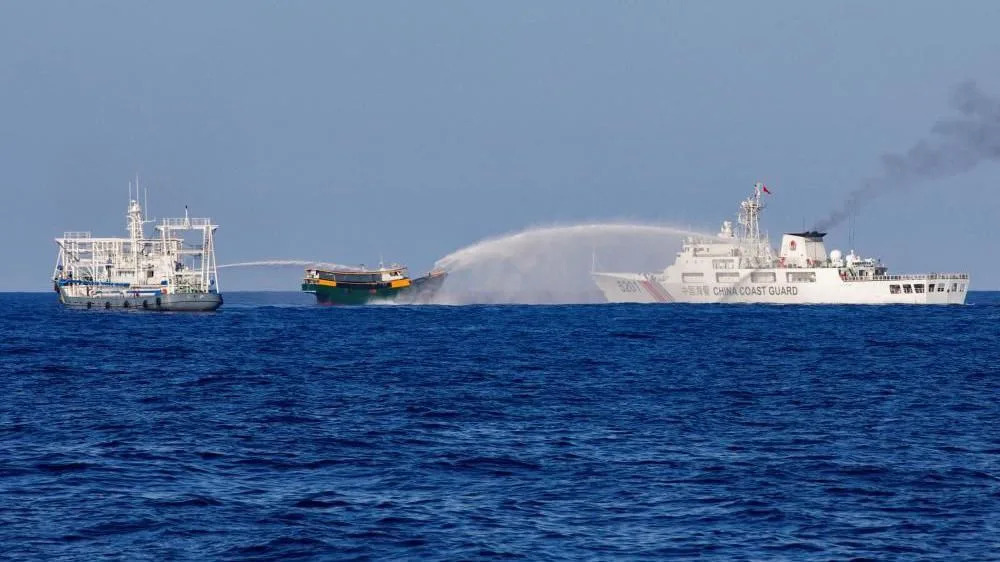
China’s Coast Guard routinely uses high-pressure water cannons against Philippine vessels in disputed shallow waters, resulting in damage and injuries.
Manila’s Ministry of Foreign Affairs said in a statement that “differences over legal and political issues do not justify relying on disturbing images that are inappropriate for the public debate of a responsible nation” and demanded that the video be removed.
It added: “Such images and misinformation will only spread mistrust between the Philippines and China.”
The Philippine Department of Defense called the video “despicable propaganda” and said it “reveals the moral and intellectual bankruptcy of China’s propaganda machine.”
Secretary of Defense Gilbert Teodoro said, “The Chinese Communist Party’s recent spate of schizophrenic actions is too obvious to ignore or ignore.”
The video, posted on July 10, remains on China Daily’s Facebook page at the time of writing.
Last week marked 10 years since the Permanent Court of Arbitration in The Hague ruled in favor of the Philippines, concluding that China’s extensive claims in the South China Sea had no legal basis under international law.
The Chinese government has ignored the ruling, arguing that the court lacks jurisdiction.
Tensions between China and Manila have escalated sharply in recent years due to overlapping claims between the two countries, with both sides accusing the other of provocations and altercations at sea, including the use of weapons such as swords, spears and knives.
In June, the Chinese government installed a floating barrier at the entrance to Scarborough Shoal, but it was removed after the Philippines filed a formal diplomatic protest.
Also in June, China banned Manila’s Defense Secretary Teodoro and his immediate family from entering mainland China, Hong Kong, and Macau.
The caption to China Daily’s monkey clip post reiterates Beijing’s position.
“Ten years later, the so-called South China Sea arbitral award remains not a remedy for peace but a source of conflict disguised as law,” the newspaper said.
“By clinging to external powers and causing problems in the South China Sea, [the Philippines’ is] We are turning our country into a pawn in someone else’s geopolitical game,” the caption added.
The monkey clip is one of a series of clips and cartoons posted by China Daily on Facebook in the past few weeks mocking the Philippines’ actions in the South China Sea. These include depictions of Manila as a clown and a snake.
Chinese authorities have not responded to the Philippines’ rebuke.


