According to CoreSite, increasing demands for computing power, power, cooling, and low-latency connectivity are forcing organizations to reevaluate where they run AI applications.
While public clouds continue to support experimentation and rapid deployment, colocation is increasingly being used for workloads that require predictable performance, dedicated infrastructure, or proximity to cloud services and enterprise data.
More than half of organizations have adopted or upgraded AI technology, an increase from the previous year. Generative AI, chatbots, predictive analytics, and agent AI are being deployed in many organizations’ production environments, showing that AI adoption is moving beyond pilot projects.
While hybrid environments have become the place of choice for AI and machine learning workloads, interest in on-premises deployments continues to decline. Colocation is emerging as a suitable environment for AI workloads that require additional power capacity and direct connectivity to cloud platforms.
“The level of computing required for AI is new that enterprises are grappling with to effectively manage,” said Juan Font, president and CEO of CoreSite and SVP of American Tower.
“Although AI tools are effective, CIOs may not currently have accurate reports on how widespread their usage is within their organizations. The use of large language models is increasing, and token usage, and therefore cost, is also increasing. So when IT leaders are shown the actual bill associated with the use of these tools, they will streamline and prioritize projects with a high ROI for AI spending.”
Collocation is becoming more popular
Companies are expanding the role of colocation facilities within their infrastructure. These environments deploy a broader range of applications, including web applications, human resources systems, security workloads, and augmented AI applications.
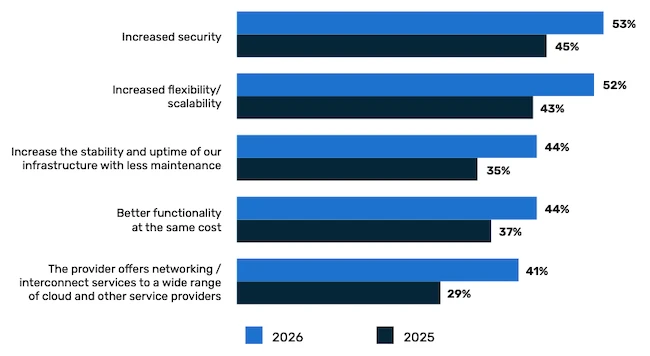
Key technical factors for moving workloads to colocation environments (Source: CoreSite)
Organizations increased their public cloud adoption of mobile applications, websites, chatbots, and content delivery services compared to the previous year. As organizations reevaluated workload placement based on performance, security, and infrastructure requirements, some workloads were migrated out of the public cloud.
Organizations prioritize security, uptime, and predictable performance when choosing a colocation provider. Enterprises are focused on direct connectivity to cloud platforms, scalable infrastructure, and support for high-density power and cooling requirements for AI systems.
Connectivity is a priority
Direct connectivity between enterprise infrastructure and major cloud providers has become a key requirement for hybrid deployments.
79% of IT leaders say native direct cloud connectivity is a very important feature for colocation providers. These connections provide low-latency access to cloud services, reduce dependence on the public Internet, and simplify data movement between enterprise environments and cloud platforms.
Organizations are increasingly evaluating provider ecosystems that combine cloud platforms, network carriers, AI services, security products, and managed services to support workloads across multiple infrastructure environments.