

Microsoft’s latest round of layoffs has become a familiar corporate ritual.
The software giant announced last week that it would cut about 4,800 jobs and make further cuts as it maintains profits and invests heavily in AI.
Similar layoffs have rippled through the tech industry over the past few years, from Amazon to Meta, while many of those same companies have amassed huge AI budgets.
Cloudflare cut more than 20% of its workforce in May. In response to the layoffs, CEO Matthew Prince wrote in an op-ed for the Wall Street Journal that he has never seen any other publicly traded U.S. company make such drastic layoffs while growing more than 30%.
“But what we did will probably become the norm next year,” Prince said.
Other companies appear to have gotten the memo as well. In May, Cisco reported record earnings for its fiscal third quarter and announced it would cut nearly 5% of its workforce. In announcing the cuts, CEO Chuck Robbins said the companies that will win in the AI era will be those with the discipline to “continue to shift investments” to areas with the greatest long-term potential.
Rather than wait for certainty, many companies are making waves of layoffs to see how AI will reshape their businesses.
For employees, impending layoffs are no longer a recession-era concern, but are becoming an everyday phenomenon of working in the technology industry.
“Continuous tuning”
Companies increasingly talk about layoffs, especially in the name of technological advances. According to AlphaSense’s analysis of industry-wide conference calls, the number of mentions of layoffs alongside AI in corporate conference calls has increased from less than five per quarter in 2022, when ChatGPT was launched, to more than 100 per quarter this year.
Microsoft said the cuts are not related to AI. Amazon similarly said that the majority of its reductions over the past two years were not due to AI.
A Meta spokesperson referred to a statement the company released regarding layoffs in May, in which it said the changes vary by team and include relocating thousands of employees to other priorities.
Some companies in the information sector, including technology and media, are making cuts after high levels of hiring during the pandemic. Also, some degree of restructuring can help companies run more efficiently, as AI helps automate some tasks. These savings, in turn, can be channeled into expensive AI investments.
Joseph Fuller, a professor at Harvard Business School, said some companies are making deep layoffs as they try to chart a path forward, but companies are unlikely to announce across-the-board layoffs unless they face serious financial difficulties or other obstacles.
Overall, Fuller expects many companies to make small, iterative adjustments, or what he calls “continuous tuning.”
One reason, he said, is that companies have cut costs relentlessly over the past quarter century, leaving relatively little fat to cut.
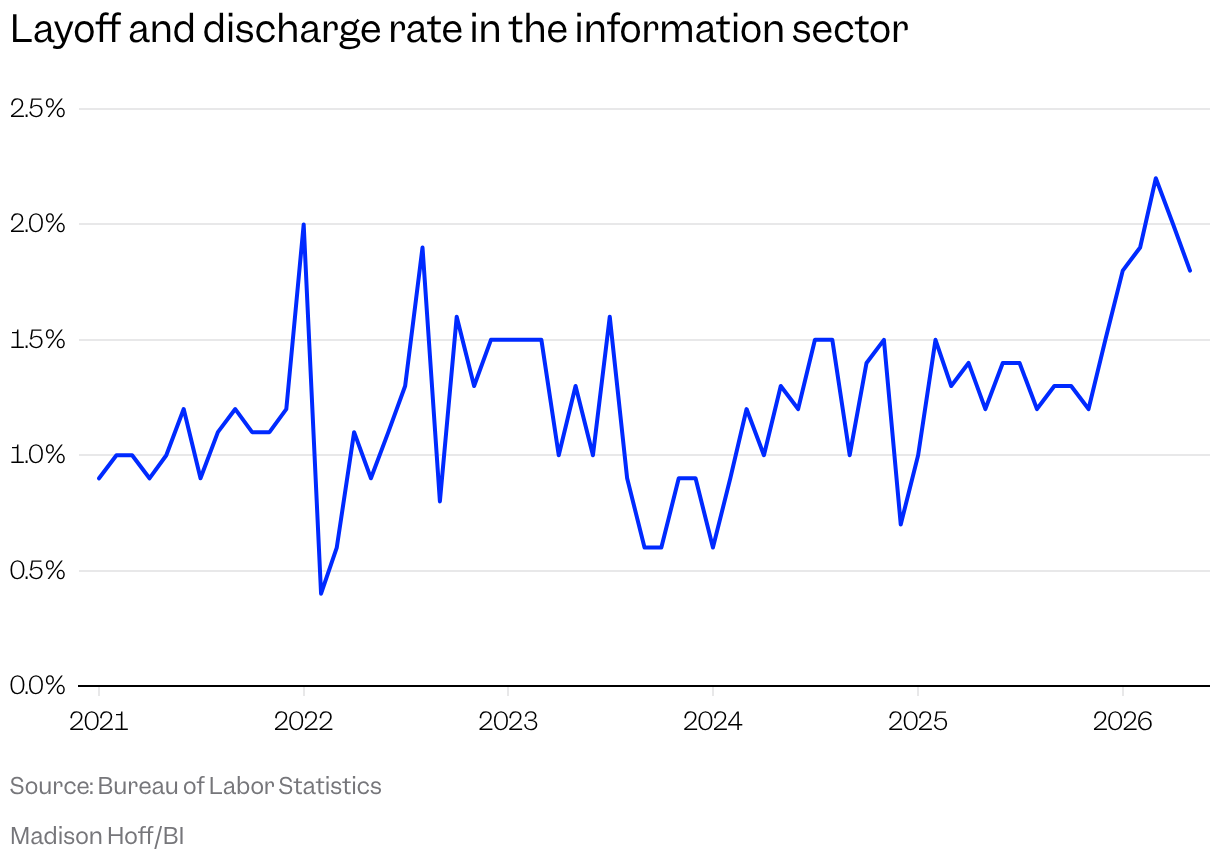
The other is uncertainty. Companies still don’t know how AI will unfold, he said, and while there’s a lot of talk about companies recruiting agents to take on a lot of the work of their employees, not much has changed because many tools are still in development.
At the same time, CEOs’ concerns about rivals create a need for “constant reassessment,” Fuller said. “If they continue to do things incrementally and have a major contender that goes all in, you could wake up one morning and be down 21 points and nothing by kickoff,” he said.
This competitive pressure forces management to make decisions about its employees. “I think this uncertainty tends to skew toward layoffs,” Fuller said.
Discovering rare AI talent
Carol Chan, CEO of Andera, which connects AI engineering talent to companies, said layoffs are often not because employers are completely replacing workers with AI. Instead, many boards are increasingly putting pressure on executives to demonstrate productivity gains from AI without significantly increasing spending on things like tokens, she said.
But few large companies have reached the point where AI allows them to operate with significantly fewer employees, she says.
Rather than assuming that AI will immediately replace employees, companies can often provide better service by helping existing employees learn how to use technology effectively, Chan said. In part, she This is because it is difficult for companies to hire the human resources they want.
“True AI-native and AI-savvy workers are incredibly rare and incredibly expensive to find,” she says.
Whatever the cause, workers are feeling the effects of the looming pink slip. Meta announced in April that it would lay off employees about a month after the data leak, with one worker describing the interim period as “28 days of hell.”
Moyang Chen, a data scientist who was laid off from Meta as part of May’s layoffs, previously told Business Insider that when the layoffs he’d been dreading finally arrived, “it was more of a relief than a pain.”
cost of permanent cut
Smaller teams can reduce inefficiencies and layers of middle management. But some companies realize that’s over. They had to rehire for the roles they eliminated, hoping the AI would do the job.
Jeffrey Pfeffer, a professor at Stanford University’s School of Business, said repeatedly firing and replacing employees can be an expensive cycle, considering the costs of severance, hiring, training and additional contractors.
He said companies may be underestimating what they are giving up if repeated layoffs remain a business strategy rather than a recession measure.
Pfeffer said repeated layoffs create persistent uncertainty within an organization, encouraging top talent to leave while weakening the relationships and institutional knowledge that make a company efficient.
When companies rehire people, “coordination and communication is going to be different than if they’ve been working together for a while,” he says.
Harvard University’s Fuller said that as AI takes over more jobs, companies will need more, not fewer, people with deep contextual understanding of company processes, markets, competitors, customers, suppliers and industry regulations.
“We need to retain people who know what they’re talking about,” he says.