The risk of students using AI to cheat has been getting a lot of attention, and for good reason.
Students can simply copy and paste a prompt into a chatbot and receive an answer for a polished paragraph, five-paragraph essay, lab outline, or reading almost instantly. In that case, teachers may wonder if the work reflects the students’ thoughts and actual work, or if it was generated by a chatbot.
An estimated 84% of high school students surveyed said they would use generative artificial intelligence in their studies in 2025, according to the nonprofit College Board, which administers the SAT and AP exams.
As an assistant professor of school psychology who studies artificial intelligence in K-12 education, I think the question is not just whether students are using AI to cheat, but whether there is evidence that learning is actually occurring.
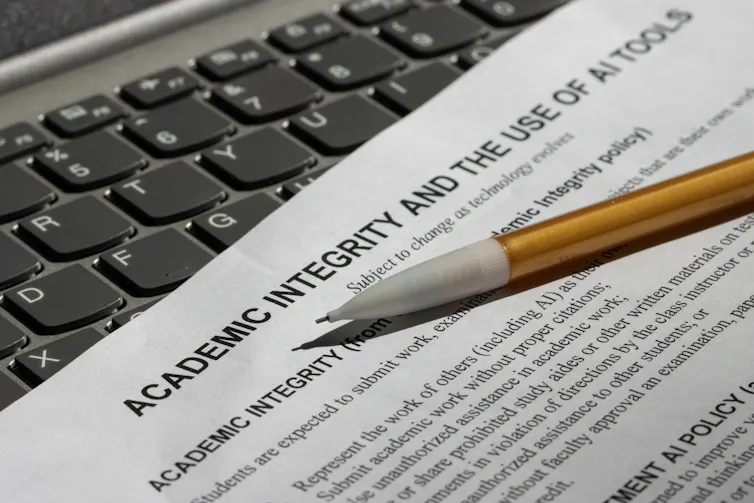
Hapabapa/iStock/Getty Images Plus
Cheating and plagiarism are common problems
To better understand the answer to this question, I recently surveyed public school educators and administrators about how generative AI is impacting their schools.
My study, conducted from spring 2025 to spring 2026, included 303 educators and other school professionals in Wisconsin, including teachers, administrators, IT staff, technology directors, and school psychologists and counselors. I also surveyed 132 other professionals from schools across the country.
While the results are not nationally representative, they provide a snapshot of how some K-12 experts are thinking about AI and student learning.
While many respondents were concerned about AI bias, misinformation, and data privacy, the most common concerns were academic fraud and plagiarism.
In Wisconsin, approximately 65% of respondents cited these issues as a concern, compared to 74% at the broader national level.
However, respondents also pointed to deeper issues. When AI can generate essays, summaries, and math steps in seconds, how do teachers know what students actually understand?
In the Wisconsin sample, 47% of respondents to this question said “difficulty assessing student learning when using AI” was a concern.
This number increased to 53% in the national sample.
When asked, “Have you noticed how AI is impacting student behavior, mental health, or engagement?” respondents select from a list of options provided. Of these options, 29% of respondents in Wisconsin and 40% of respondents in the national sample selected “increased student reliance on AI,” and 19% and 33%, respectively, selected “decreased critical thinking and problem solving.”
Finished work becomes difficult to interpret
Teachers have long known that the work completed by students is not complete evidence of learning. Parents may help too much. Students may copy from friends. A student may complete an assignment but not understand it well enough to explain it later.
Generative AI makes that problem more visible and more complex.
Consider a typical homework assignment, such as writing a sentence that explains the theme of a short story. Previously, teachers would look at students’ writing, read the story, think of a theme, and decide whether they could explain it in writing.
Now, this kind of homework prompt can produce results that look organized, precise, and polished. However, it is becoming increasingly difficult for teachers to understand whether students actually understood the story, identified the theme, and articulated it independently, or whether students were simply inputting prompts into an AI tool.
Some teachers are using AI detection tools to determine whether student work is original.
In a 2025 national survey of public school teachers in grades 6-12, 43% reported using these types of apps regularly, and another 27% had tested or experimented with them.
However, these tools can make mistakes in both directions. One study of 14 different AI detection tools found that some had false positive rates as high as 50% and false negative rates as high as 100%. The same study found that approximately 20% of AI-generated text is misclassified as written by humans. This rose to about 52% when text written by AI was manually edited, and to 71% when paraphrased by a machine. Other researchers found that the detector incorrectly flagged non-native English sentences as AI-generated an average of 61.3% of the time.
I don’t think that means schools should completely abandon writing assignments and homework. However, educators may need to be more intentional about what they measure in each task.
Some teachers have already made such changes, such as asking students to show or explain the process, including oral elements in their compositions, or asking them to write more in class.
Some teachers give students paper-and-pencil assignments when they need to check their students’ independent thinking.
If the goal is to write fluently, the teacher may need to watch the student write. If your goal is reading comprehension, you may need students to explain, apply, or defend their ideas.
SDI Production/Stock Photo
Clear assignment rules may help
Many schools have yet to decide how to approach AI. In my survey, only 33% of respondents in Wisconsin and 29% of respondents nationally said their district had a formal AI policy.
Teachers and students alike can benefit from clarity on how and when AI can be used.
Researchers who developed the Artificial Intelligence Rating Scale, a tool that helps educators explain when and how they can use AI in assignments, argue that educators need to identify what level of AI use makes sense based on the learning outcomes being measured.
This idea is useful because not all assignments are the same. Some assignments may require the teacher to review independent passages, so there may be no need to use AI.
Another system might allow AI to brainstorm, but require students to submit original notes and final thoughts. Another student might ask you to critique the AI-generated answers and explain what is accurate, incomplete, or misleading.
better question
The educators in my research weren’t simply rejecting AI; Many reported using AI themselves for planning, communication, documentation, differentiation, administrative tasks, and student support activities.
Their concerns were more specific.
They were concerned not only about academic dishonesty, but also about assessment, student trust, critical thinking, misinformation, and privacy. These concerns illustrate the practical challenges schools currently face: how to preserve meaningful evidence of learning when AI can produce sophisticated academic work.
The goal is not to detect every possible misuse of AI. That’s probably not possible. The goal is to design learning tasks that allow teachers to answer the most important question: What does this student actually understand?