
Key Takeaway
The artificial intelligence revolution has fundamentally transformed investment strategies in 2026, creating unprecedented opportunities for both institutional and retail investors. AI-driven trading algorithms now execute approximately 70% of all trades in US markets, leveraging machine learning to identify patterns and execute decisions with speed and precision impossible for human traders alone. The AI semiconductor sector continues to dominate market headlines, with companies like Nvidia and AMD experiencing explosive growth as demand for AI infrastructure accelerates across industries. Meanwhile, AI-powered portfolio management tools have democratized access to sophisticated investment strategies once reserved for hedge funds and institutional investors. Understanding how to leverage these technologies while managing their inherent risks has become essential for modern investors seeking competitive returns in an increasingly AI-driven financial landscape.
The convergence of advanced machine learning, big data analytics, and cloud computing has created a perfect storm for AI investment opportunities. Investors who position themselves strategically across AI trading technologies, semiconductor leaders, and portfolio management platforms stand to benefit from what many analysts consider the most significant technological shift since the internet revolution. However, success requires more than simply buying AI-related stocks; it demands a nuanced understanding of how these technologies work, where value is actually being created, and how to navigate the risks that accompany rapid technological change.
The Rise of AI Trading Algorithms in 2026
How Machine Learning is Revolutionizing Quantitative Finance
AI-powered trading has evolved from an experimental technology to the dominant force in modern financial markets. Machine learning algorithms now process vast datasets encompassing historical prices, economic indicators, news sentiment, and even social media trends to identify trading opportunities invisible to traditional analysis. These systems employ sophisticated techniques including natural language processing to interpret earnings calls, deep learning models to detect complex market patterns, and reinforcement learning to adapt strategies in real-time as market conditions evolve.
The algorithmic trading market is projected to grow at a remarkable 91% compound annual growth rate, driven by firms recognizing machine learning’s ability to generate alpha in increasingly competitive environments. This explosive growth reflects both technological maturation and mounting pressure to automate decision-making as human-only approaches lose ground to faster, more data-intensive competitors. ML-enhanced strategies now achieve success rates of approximately 75%, compared with 60-65% for purely traditional methods, particularly in dynamic conditions where asset relationships evolve quickly.
Large language models have further transformed research workflows at quantitative firms, reducing literature review and code generation tasks from hours to minutes. Researchers can now process academic papers, identify relevant methodologies, and extract key insights in a fraction of the time required just a few years ago. This productivity enhancement allows quantitative teams to focus on strategy logic and innovation rather than infrastructure and documentation.
The Impact of AI Trading on Market Dynamics
The proliferation of AI trading systems has fundamentally altered market microstructure and price discovery mechanisms. High-frequency trading algorithms execute thousands of micro-trades in milliseconds, capturing fleeting price movements that human traders cannot perceive. During the January 2026 geopolitical shock, AI-driven high-frequency trading systems capitalized on volatility by executing rapid trades in gold as prices tested $5,500, demonstrating the technology’s ability to navigate turbulent markets.
However, this transformation brings both benefits and risks. On the positive side, AI trading has increased market liquidity and reduced bid-ask spreads, making markets more efficient for all participants. The technology has also democratized access to sophisticated trading strategies, with retail platforms now incorporating AI-powered features such as automated portfolio rebalancing, risk analysis, and trading signal generation.
On the risk side, the concentration of AI trading systems creates potential systemic vulnerabilities. When multiple algorithms respond similarly to market events, volatility can amplify rapidly. The “black box” nature of deep learning architectures also complicates transparency and regulatory oversight, raising concerns about market manipulation and unfair advantages. Additionally, model risk remains significant, as algorithms achieving impressive backtested results may fail when deployed in live markets due to overfitting or regime changes.
For investors seeking to leverage AI trading technologies, consider using Intellectia’s AI Screener to identify high-conviction opportunities through systematic analysis and real-time valuation scans.

AI Semiconductor Stocks: The Infrastructure Play
Nvidia: The Uncontested Leader in AI Infrastructure
Nvidia’s dominance in the AI semiconductor market remains unchallenged as we move through 2026, underpinned by cutting-edge GPU platforms and strategic partnerships that extend far beyond hardware sales. In the third quarter of 2025, the company reported revenue of $57.01 billion, representing a staggering 62.5% year-over-year increase that far exceeded analyst estimates of $55.45 billion. This growth was driven primarily by surging demand for the company’s Blackwell and GB300 GPU platforms, which have become the industry standard for training and deploying large AI models.
Nvidia’s competitive moat extends beyond raw performance metrics to encompass a comprehensive software ecosystem. The CUDA platform and related development tools have created significant switching costs for customers, while the company’s Omniverse platform is emerging as a critical infrastructure layer for industrial AI applications. Strategic partnerships with major cloud providers ensure that Nvidia silicon powers the world’s largest AI training clusters, reinforcing its position as the essential infrastructure provider for the AI revolution.
The company’s data center segment now accounts for the majority of revenue, reflecting the shift from gaming-focused sales to enterprise AI infrastructure. With AI model sizes growing exponentially and training costs reaching hundreds of millions of dollars per model, demand for Nvidia’s highest-end chips shows no signs of slowing. The company’s introduction of new architectures on accelerated timelines demonstrates its commitment to maintaining technological leadership in a rapidly evolving market.
AMD: The Challenger Gaining Ground
Advanced Micro Devices has emerged as a credible challenger to Nvidia’s dominance, leveraging its CPU expertise and aggressive pricing to capture growing share of the AI accelerator market. AMD unveiled an ambitious strategy targeting a compound annual growth rate of over 35% in overall revenue and 80% in the AI data center segment over the next three to five years, signaling management’s confidence in the company’s competitive position.
The company’s turnaround has been bolstered by strategic partnerships that validate its technology roadmap. A landmark deal with OpenAI to supply 6 gigawatts of MI450 chips over five years represents a significant endorsement from one of the most influential AI companies. Additionally, Oracle Cloud Infrastructure’s plan to deploy 50,000 AMD AI chips by 2026 underscores growing enterprise adoption beyond the hyperscaler segment.
Analysts have revised upward their revenue forecasts following these partnership announcements, projecting $16 billion in data center revenue for 2025 and $22.9 billion in 2026. Despite facing Nvidia’s 90% market share dominance, AMD’s next-generation MI450 and MI500 GPUs, coupled with its Helios rack-scale systems, position it to capture significant AI infrastructure demand. With a market capitalization of approximately $327.88 billion as of late 2025, AMD’s valuation appears compelling relative to its growth potential.
TSMC: The Invisible Engine of AI Manufacturing
Taiwan Semiconductor Manufacturing Company serves as the indispensable foundry partner for virtually all leading AI chip designers, making it a critical infrastructure play on AI growth regardless of which specific chip architectures prevail. In the third quarter of 2025, TSMC reported revenue of $33.1 billion, a 30.3% year-over-year increase, with 57% of this attributed to high-performance computing applications including AI and 5G.
Advanced 3nm and 5nm process nodes now account for 74% of TSMC’s wafer revenue, powering AI workloads for clients including Nvidia, Apple, and AMD. The company’s manufacturing technology leadership creates a durable competitive advantage, as competitors struggle to match its yield rates and transistor density at advanced nodes. TSMC’s capital expenditure has surged to $40 billion for 2025, reflecting its commitment to expanding advanced manufacturing capacity to meet insatiable AI demand.
With a market capitalization exceeding $1.4 trillion and shares trading near $288, TSMC represents a more conservative way to invest in AI infrastructure growth without betting on specific chip architectures or customer relationships. The company’s role as the foundry of choice for the world’s most advanced semiconductors ensures it will benefit from AI growth regardless of which specific applications or companies ultimately dominate the market.
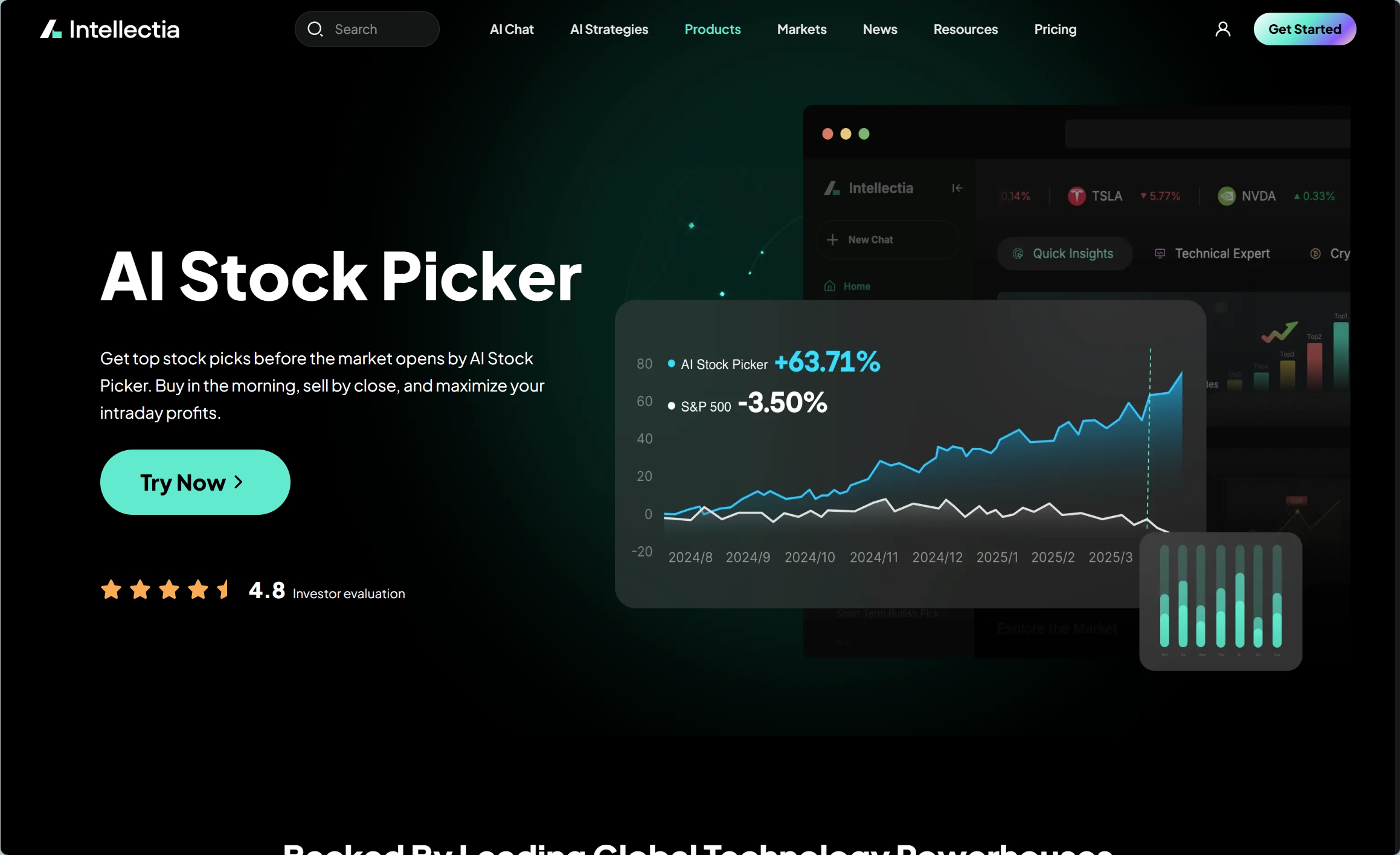
For investors looking to identify the best opportunities in AI semiconductors, Intellectia’s AI Stock Picker provides data-driven recommendations based on comprehensive fundamental and technical analysis.
AI-Powered Portfolio Management Tools
The Democratization of Sophisticated Investment Strategies
AI-powered portfolio management has transitioned from experimental technology to essential infrastructure for modern investors. These platforms leverage machine learning algorithms to analyze vast datasets, identify patterns, and make informed predictions about asset performance and risk. The evolution of natural language processing techniques now allows AI systems to interpret news articles, earnings calls, and social media sentiment, providing a nuanced understanding of market dynamics that informs investment decisions.
The benefits of AI portfolio management extend beyond raw performance to encompass improved efficiency, reduced human error, and enhanced ability to respond to market changes. Automated rebalancing ensures portfolios remain aligned with target allocations without requiring constant manual intervention. Tax-loss harvesting algorithms minimize tax liabilities by intelligently selling securities that have lost value. Risk assessment models continuously monitor portfolio exposure and alert investors to potential vulnerabilities.
Predictive analytics represents another significant advancement, with AI systems forecasting future market movements using historical data and advanced statistical techniques. While no prediction method is perfect, these systems can identify regime changes and trend shifts earlier than traditional indicators, giving investors valuable time to adjust their positions. The ability to process alternative data sources, including satellite imagery, credit card transactions, and web scraping, provides insights unavailable through conventional financial analysis.
Leading AI Portfolio Management Platforms in 2026
Several platforms have emerged as leaders in the AI-powered portfolio management space, each catering to different investor needs and experience levels. Wealthfront stands out as a premier robo-advisor employing AI to deliver personalized investment strategies with automated portfolio rebalancing and tax-loss harvesting. The platform’s user-friendly interface and low fees make it accessible for beginners while providing comprehensive financial planning tools for retirement and college savings.
Betterment offers a robust platform combining human advice with AI-driven insights to create customized investment plans. Its Smart Deposit feature automatically invests spare cash, while goal-based investing tools help users align their portfolios with specific financial objectives. The platform’s tax-coordinated portfolio feature optimizes asset location across taxable and tax-advantaged accounts to maximize after-tax returns.
For more sophisticated investors, platforms like Aladdin by BlackRock provide institutional-grade risk analytics and portfolio management capabilities. These enterprise solutions leverage machine learning to offer insights into portfolio performance and risk exposure, enabling asset managers to make data-driven decisions at scale. The integration of AI across the investment workflow, from research to execution to reporting, has become standard practice for competitive investment firms.
Retail-focused platforms like Prospero have gained attention for straightforward design and transparency, displaying past recommendations clearly so users can judge real performance rather than relying on marketing claims. These platforms provide stock ideas, sector-level insights, and performance tracking tools without overwhelming users with complex data, making AI-powered investing accessible to a broader audience.
Selecting the Right AI Investment Tool
Choosing the appropriate AI portfolio management tool requires evaluating several factors including compatibility with existing accounts, data security practices, user interface design, and the level of human support available. Investors should consider their own experience level, with beginners potentially benefiting from simpler platforms that automate most decisions, while advanced investors may prefer tools offering greater customization and control.
The degree of automation varies significantly across platforms, allowing different types of investors to choose systems matching their risk appetite and involvement preferences. Some investors prefer fully automated solutions that require minimal ongoing attention, while others want AI-generated insights that inform their own decision-making without fully automating execution. Understanding these trade-offs is essential for selecting a platform that aligns with individual investment philosophy and time availability.
Cost structures also vary widely, from free platforms earning revenue through payment for order flow to premium services charging basis points on assets under management. Investors should evaluate total cost of ownership, including management fees, trading costs, and any hidden charges, against the value provided by AI-driven insights and automation.
To explore how AI can enhance your portfolio management, visit Intellectia’s pricing page to find a plan that matches your investment needs.
Risks and Opportunities in AI Investing
Understanding the Risk Landscape
While AI investing offers compelling opportunities, understanding the associated risks is essential for making informed decisions. Model risk represents perhaps the most significant concern, as AI systems may fail to perform as expected due to overfitting, data quality issues, or regime changes in markets. Algorithms achieving 80% accuracy on historical data may collapse in live trading when confronted with unprecedented market conditions. Rigorous out-of-sample testing and walk-forward validation reduce this risk but cannot eliminate it entirely, making skepticism toward perfect backtests essential for long-term survival.
Systemic risk emerges when many AI systems respond similarly to market events, potentially amplifying volatility and creating flash crashes. The concentration of similar machine learning models across the industry creates correlated behavior that can destabilize markets during stress periods. Regulatory uncertainty also poses challenges, as policymakers grapple with how to oversee AI trading systems and ensure market fairness without stifling innovation.
Data quality and integration challenges affect AI system performance, making effective data management a top priority. The “black box” nature of deep learning architectures complicates transparency for both investors and regulators, raising concerns about accountability when things go wrong. Cybersecurity threats targeting AI systems present additional risks, as compromised algorithms could execute harmful trades or leak sensitive information.
Long-Term Investment Considerations
The true potential of AI may not be fully realized for several years, requiring investors to adopt a long-term perspective when allocating capital to this theme. Companies with solid fundamentals and clear paths for AI integration are likely to outperform those merely riding the hype cycle. Diversification across different AI sub-sectors and applications helps mitigate the risk that any specific technology or company fails to achieve its potential.
Rapid technological advancement creates both opportunities and risks, as today’s leading AI technologies may be rendered obsolete by tomorrow’s breakthroughs. Investors should focus on companies with sustainable competitive advantages, strong research and development capabilities, and management teams with proven track records of navigating technological transitions. The AI landscape will likely see significant consolidation as winners emerge and losers fall by the wayside.
Ethical considerations surrounding AI development and deployment are increasingly important factors for investors to evaluate. Companies prioritizing responsible AI development, transparency, and fairness may benefit from regulatory tailwinds and improved brand reputation, while those cutting corners risk regulatory penalties and consumer backlash.
Conclusion
AI investment strategies in 2026 represent a transformative opportunity for investors willing to understand and navigate this rapidly evolving landscape. From AI trading algorithms executing the majority of market transactions to semiconductor companies building the infrastructure powering the AI revolution, to portfolio management tools democratizing sophisticated strategies, artificial intelligence has become inseparable from modern investing.
Success requires balancing enthusiasm for technological potential with realistic assessment of risks and limitations. The winners in this new era will be those who embrace AI while maintaining clear understanding of its limitations. Human judgment, ethical considerations, and risk awareness remain as important as ever. AI is a powerful tool, but it is ultimately just that: a tool to be wielded wisely in pursuit of investment objectives.
The future of finance is being written in code, and those who understand this new language will be best positioned to thrive in the markets of tomorrow. Whether through direct investment in AI leaders like Nvidia and AMD, adoption of AI-powered portfolio management tools, or integration of AI insights into existing investment processes, investors have unprecedented opportunities to leverage these technologies for improved outcomes.
Ready to harness the power of AI for your investment strategy? Sign up for Intellectia today and access cutting-edge AI tools for stock analysis, portfolio management, and market insights. Join thousands of investors who are already leveraging artificial intelligence to make smarter, data-driven investment decisions.