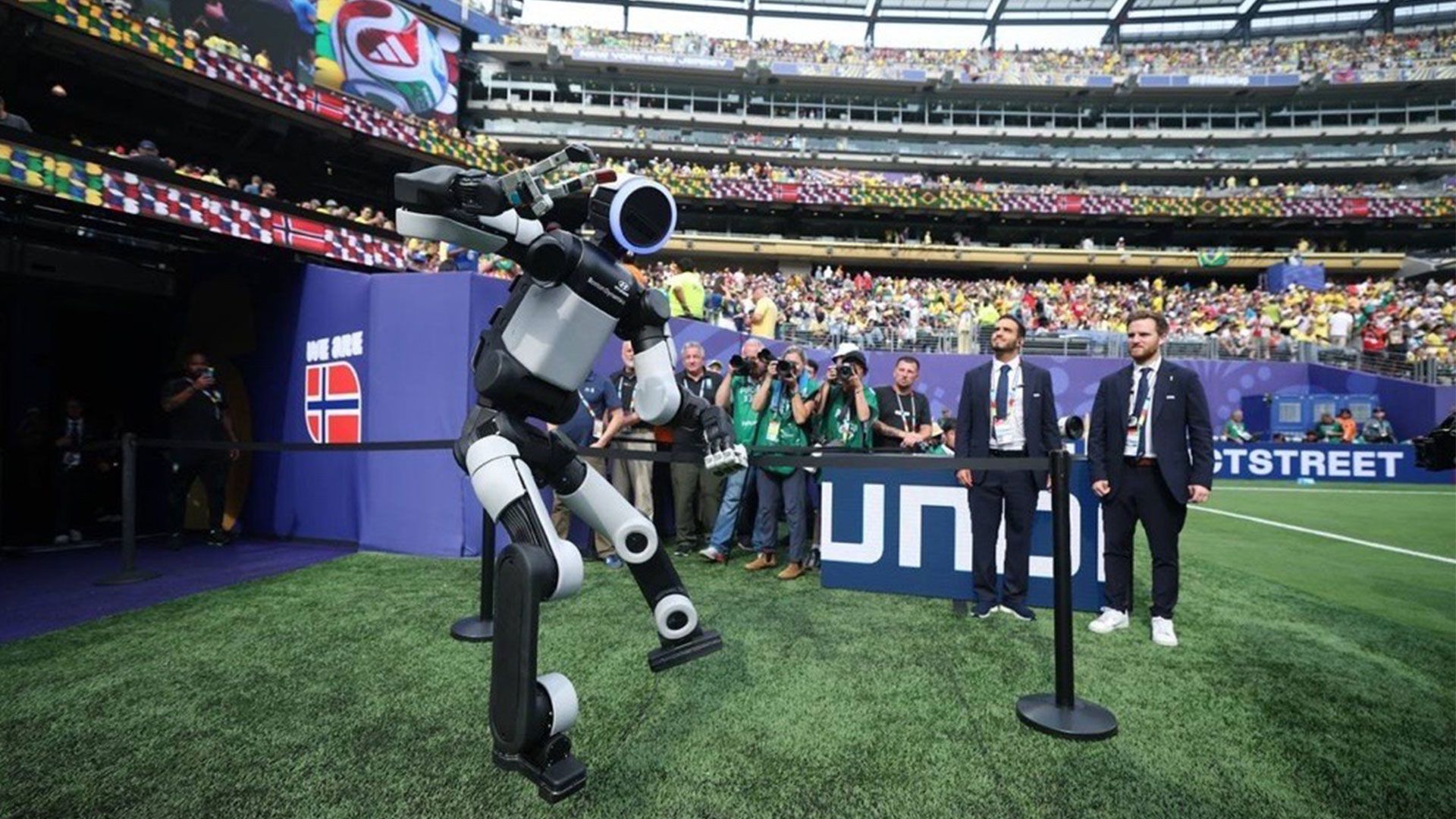
Humanoid robot Atlas made headlines at the 2026 FIFA World Cup, appearing on the pitch at halftime of the Round of 16 match between Norway and Brazil.
The robot emerged from the players’ tunnel and entertained fans by recreating popular soccer goal celebrations, including a goal by Norwegian striker Erling Haaland.
This performance was one of Atlas’ largest public showcases since its debut at CES 2026, highlighting the growing role of advanced humanoid robots at major global events.
Ahead of the Soccer World Cup, Boston Dynamics released a video showing Atlas studying soccer footage before accurately reproducing player movements such as ball control and passing during practice sessions.
Humanoid makes a pitch
Ahead of the 2026 FIFA World Cup, Hyundai Motor, a subsidiary of Boston Dynamics, launched the School of Football campaign featuring Boston Dynamics’ humanoid robot Atlas, demonstrating how advanced robotics can learn soccer-inspired moves through AI.
After that demonstration, Atlas finally made its live debut during halftime of the Round of 16 match between Norway and Brazil at New York/New Jersey Stadium, becoming the first humanoid robot to perform during a FIFA World Cup match.
Atlas emerged from the players’ tunnel and onto the pitch in front of a packed stadium and a worldwide television audience. The humanoid robot then performed a series of soccer-inspired celebratory choreographies, recreating some iconic goal celebrations made famous by major international players such as Harry Kane, Erling Haaland, Matheus Cunha and Heung-min Son. This routine highlighted Atlas’ balance, agility, and ability to accurately execute complex full-body movements in a live sports environment.
After the performance, Atlas retrieved the ceremonial game ball, carried it onto the field, and handed it to the referee to signal the start of the second half. Hyundai said all activations took place during a live FIFA World Cup match, demonstrating that the production version of the humanoid robot can operate reliably in crowded, fast-paced environments, performing precise, stable and coordinated movements.
The performance was also the first public demonstration of the production version of Atlas, which Hyundai and Boston Dynamics unveiled at CES 2026 earlier this year.
atlas masters motion
Boston Dynamics says Atlas’ football-inspired performance is powered by several core AI and robotic technologies.
This humanoid’s football-inspired performance was powered by a combination of retargeting technology, reinforcement learning, and whole-body control. Retargeting allowed the humanoid to translate human soccer moves and celebrations into movements appropriate for its robot body, while whole-body control allowed it to maintain balance and coordinated smooth movements throughout the routine. To develop these skills, Boston Dynamics trained Atlas through millions of hours of reinforcement learning simulations running on GPUs.
During training, variables such as object weight, grip strength, floor friction, and object placement were continuously changed, and the robot had to adapt to different conditions. This system also relies on proprioception, which internally senses your body’s position, balance, force, and resistance, to make real-time adjustments. Once the simulations proved reliable, they were transferred to a physical robot for real-world deployment.
Hyundai said the halftime activation was part of its broader Next Starts Now campaign, which combines soccer, robotics and AI to showcase the company’s vision of human-centered innovation. It’s also an expansion of Atlas’ earlier School of Football series, where you learn soccer skills and movements through AI-driven training.
“The way we trained Atlas to perform these fun movements in a match is similar to how we train robots in real-world industrial applications. This is a great way to introduce people everywhere to the incredible potential of today’s AI-enabled robots,” – Alberto Rodriguez, director of robot behavior at Boston Dynamics, said in a statement.