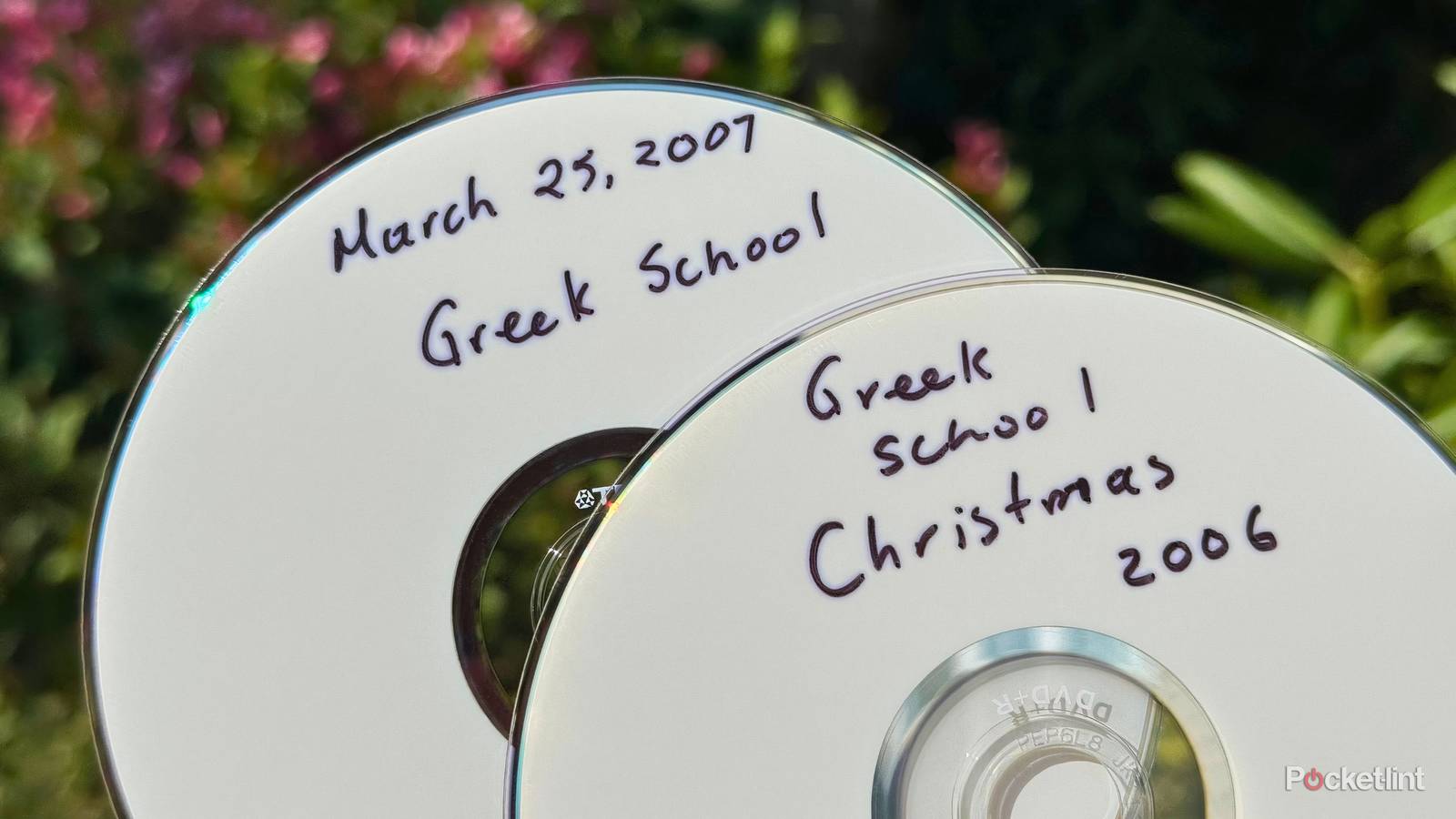
If you’re like me, you probably have a collection of DVDs stored somewhere in a drawer or binder. Each recordable or rewritable disc contains a home video (or dozens) from the 2000s. DVD archiving was the de facto way to store and play back home videos in the days of camcorders, before smartphones and virtual camera rolls became mainstream.
The problem is that in 2026, most computers won’t have optical disc drives, and fewer people than ever will have access to a home theater setup with a disc reader. Even if you have the necessary equipment, you’ll quickly find that your 480p standard-definition home video isn’t as sharp as you remember.
Fortunately, the wonders of modern software programming (and, of course, AI) come to the rescue. With the help of several free-to-use tools and a USB disc drive, you can easily upscale your disc’s content to 1080p Full HD as well as stunning 4K UHD resolution. From here, you can also place the upgraded video files onto Blu-ray discs for a modern media archiving setup.
How to enhance your old DVD collection using Topaz Video Enhancer
Examples of good use of artificial intelligence

There are many different programs and websites to choose from to improve your AI, but my go-to solution is Topaz Labs’ Video Enhancer. This free-to-use web application lets you choose from one of three different AI models with up to 4K output resolution and HDR support. There is also a frame interpolation option here. This is a video processing technique used to artificially insert frames into a video to increase the frame rate.
Elsewhere, Creative mode gives you “creative freedom to enhance details” with a creativity slider, a sharpness slider, and a prompt box to tell you the exact upscaling result you’re looking for. Creative mode lets you choose between two different AI models, giving you even more processing flexibility.
If you value your privacy or are wary of using online tools to get your work done, there is a separate locally-based Topaz Video desktop program for PC, Mac, and Linux. All rendering can be done locally, but the application is locked behind a subscription-based paywall via recurring payments.
To actually get a DVD disc into your computer, you’ll need an internal or external disc drive that can be connected to Windows, macOS, or Linux. You’ll also need a free program to facilitate the ripping process (transferring the contents of a DVD to another drive). My favorite program is HandBrake, which is free and open source (FOSS), but other options such as MakeMKV are popular and worth considering.
Once you’ve successfully ripped your DVD, just drag the file to Topaz Video Enhancer (or your favorite video enhancement software) and you’re off to the races from there.
How to transfer upscaled home videos to Blu-ray
Shall we burn an optical disc?

If you want to go a step further and save your upscaled home videos to Blu-ray for easier long-term storage or playback on your TV, this is easy, but not cheap. You’ll need a suitable external USB Blu-ray disc drive for your PC (which can be quite expensive) and a blank writable or rewritable Blu-ray disc (which is fairly inexpensive).
From now on, you’ll also need to physically burn the contents of your media to a blank disc using Blu-ray compatible burning software. Common software solutions include:
- DVDFab Blu-ray Creator
- IMG Burn
- CD burner XP
- Wondershare DVD Creator
- Anyburn
Home videos have never been more beautiful
AI-based video enhancement has come a long way

Overall, my long-time home video collection is much better after upscaling. With the help of Topaz Video Enhancer, I was able to improve the sharpness and clarity of my existing video library. We were able to do this in record time and without having to pay any cash.
Of course, it’s worth stipulating that AI-powered extension tools like Topaz are not 100% foolproof. Upscaled video is still artificially enhanced and will never reach the same level of sharpness as a freshly shot 4K UHD video to begin with.
Depending on the source material, the quality and consistency of upscaled video results will vary. For example, tape scanlines can be easily removed later, but color reproduction, saturation, flicker, banding, visual glitches, and other issues are complex and may or may not be improved satisfactorily.
Nevertheless, having the option to upscale old content in this way feels almost like a superpower, and is well worth a try if you want to see old memories in a new light. And if you’re willing to spend the extra time and money to transfer your converted videos to Blu-ray, you’ll be archiving your memories in a robust way that’s definitely better than a scratchy, low-resolution DVD collection.