
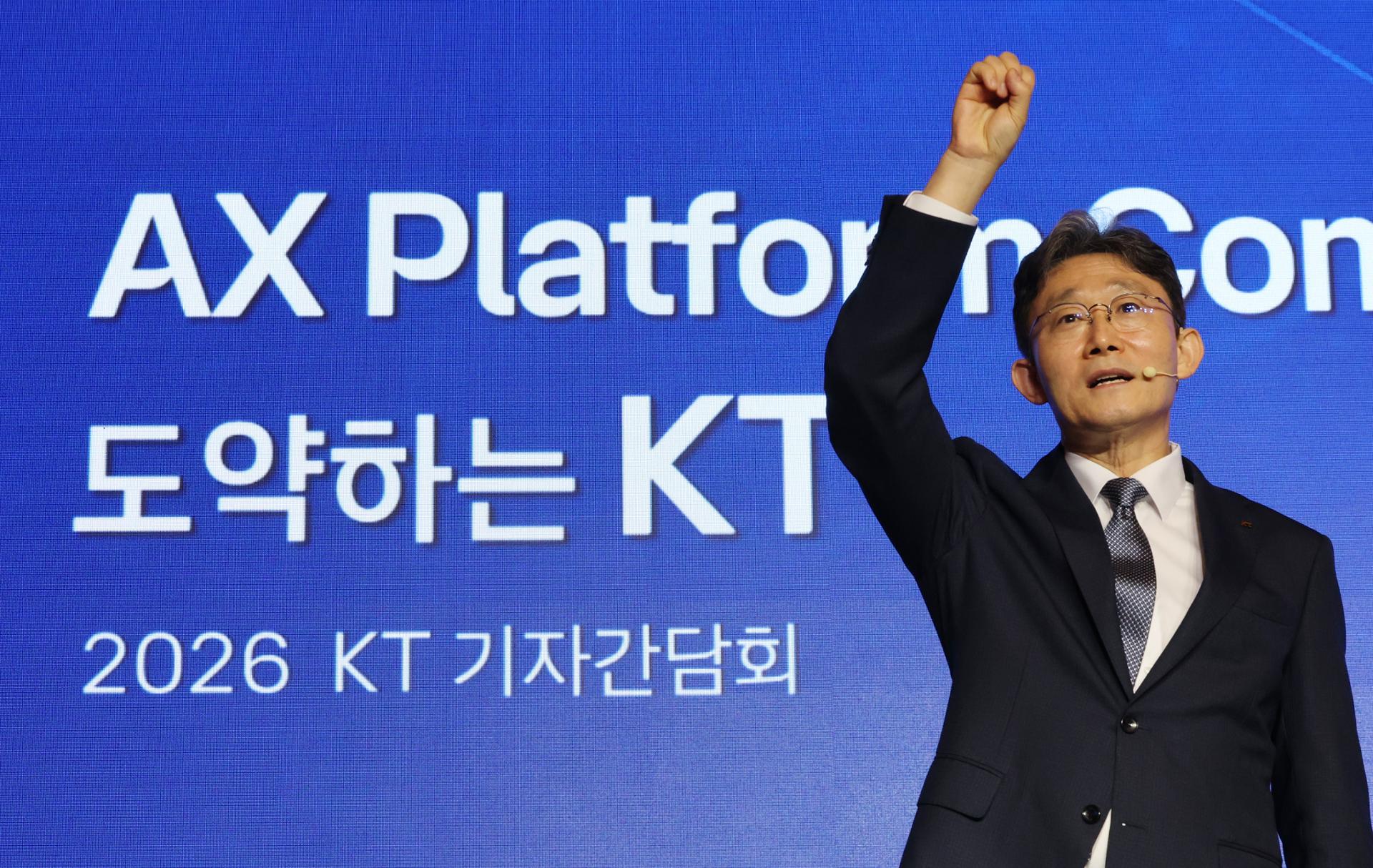
KT CEO Park Yoon-young gestured at a press conference on the company’s artificial intelligence transformation business plan in Seoul on Monday. United
KT’s new CEO Park Yoon-young on Monday pledged to invest 18 trillion won ($11.77 billion) in network security and artificial intelligence (AI) infrastructure as part of a plan to rebrand the carrier as an AI transformation platform company.
Park said KT aims to become an AI transformation platform company built on two core business pillars: telecommunications business and AI business including data center, cable and AI transformation services.
“Network business is the foundation of our company, and we need to strengthen that foundation so that we can build the company’s next stage of growth through AI transformation,” Park said at his first press conference in Seoul since taking office in March.
“Our vision is built on two pillars: strengthening our core business while driving our next phase of growth through AI transformation.
KT plans to invest 12 trillion won in information security, IT, and network infrastructure over the next three years to strengthen its communications business.
As part of the investment, 4 trillion won will be allocated to information security and IT innovation.
The company said the investment will be used to establish a Zero Trust security framework with around-the-clock prevention and response capabilities and accelerate the transition to cloud-native systems. We also plan to unify security governance across IT and network operations to enable faster and more transparent responses to cyber threats.
For the network business, KT will invest KRW 8 trillion over the same period to improve network quality and ensure leadership in next-generation network technologies such as 6G, satellite communications, and data center interconnection.
In terms of AI infrastructure, KT plans to invest 5 trillion won over the next five years to expand its data center business. The company also plans to invest 1 trillion won to add more than 90 terabits per second of underwater cable capacity.
Park emphasized that KT’s strategy is different from that of other data center operators because KT’s expansion plans are based on solid customer demand rather than speculative investments.
The company plans to build about 25 data centers across the country, with a total capacity of about 1 gigawatt over the next five years. In doing so, KT will leverage its network of more than 3,500 exchange buildings across the country to build data centers near industrial sites to reduce waiting times and improve service to business customers, he said.
KT CEO Park Yoon-young explained the company’s token factory business plan at a press conference in Seoul on Monday. United
For new growth momentum, KT said it is eyeing its token factory and stablecoin businesses.
Tokens are the basic unit that AI models use to process and generate information, and the AI industry uses the term token factory to describe data center infrastructure that generates AI tokens through large-scale computing.
Park said KT’s Token Factory will be a platform that allows customers to use AI tokens more efficiently by choosing the best underlying model for different tasks while optimizing cost, performance, and security.
“The carriers know better than anyone how pricing and rate plans work,” Park said. “Leveraging KT’s expertise in carrier billing, we will help our customers use AI tokens as efficiently as possible, choose the most appropriate underlying model, and manage security.”
He expects this business portfolio to help accelerate KT’s global expansion. He set a goal of generating 1 trillion won of revenue overseas from AI transformation, token factory and stablecoin businesses by 2030, and said KT is already providing AI transformation services in Thailand and Vietnam and plans to further expand across the Global South.
“We will further strengthen our telecommunications business, build on its foundation for solid growth, and help South Korea become a global leader in AI transformation,” he said.


