
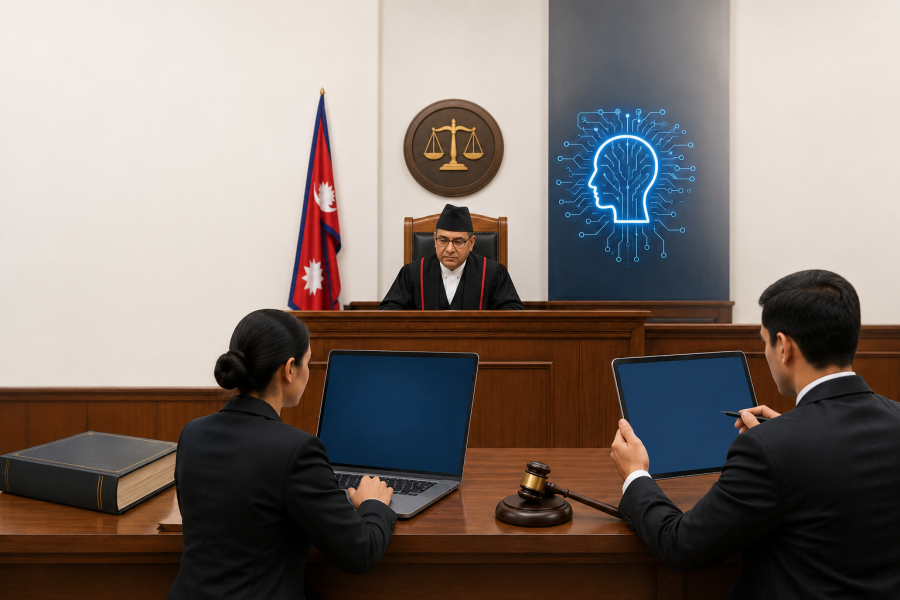
As an intern at the Supreme Court of Nepal, I had the opportunity to observe the daily life of the court up close. I observed how files move, how cause lists are created, how subpoenas and dates are processed, and how court staff work between old manual processes and new digital systems. These observations make it clear that the Nepali judiciary has entered the digital era but not yet into the era of artificial intelligence.
Public conversations about courtroom technology are often too loose. Online cause lists, scanned records, SMS notifications, virtual hearings, digital summonses, automated templates, and artificial intelligence are sometimes discussed as if they belong to the same phase of reform. it’s not. Scanned records are not automated. Video hearings are not artificial intelligence. The reference number template is not machine learning. If Nepal wants to have a serious discussion about technology and justice, it must first be honest about how the system actually stands.
Movements in Nepal’s judiciary have been gradual, uneven, and often out of necessity. Planned judicial reform began with the first five-year strategic plan in 2004, when court operations were still closely tied to physical files and handwritten records. Subsequently, the Long-Term Information Technology Master Plan for 2072-2082 provided clear direction for court networking, automation, and electronic services. The fourth and fifth five-year strategic plans continued this path through goals of IT-based case management, differentiated case management, technology-friendly services, and paperless courtrooms.
SC introduced automated case management in 2023 to increase transparency in case lists and reduce concerns about manual impact. Chief Justice Manoj Kumar Sharma’s reform agenda took the discussion further, including feasibility studies on e-courts, virtual hearings, electronic case files, live court proceedings, voice-to-text systems, artificial intelligence, blockchain and machine learning.
Digitization, automation or AI?
Digitization means making court information and services available through digital systems. The system will become more accessible as cause lists are uploaded online, official summonses are displayed digitally, old records are scanned, and case information is made available on websites.
Automation goes a step further. It begins when a system performs a repetitive task according to fixed rules. If a summons template automatically captures a reference number, if an SMS alert is sent for registration, pesi or tarek, or if periodic notifications are generated through a case management system, it is automation. There’s less manual repetition, but no thinking, reasoning, or judgment.
AI is different. That means systems that can analyze records, assist in legal research, transcribe hearings, summarize documents, translate court documents, or identify patterns under human supervision. In Nepal, this remains more of a future discussion than an actual reality.
Digitized, but not yet intelligent
The SC website provides a public application format and the timeline for registration of writs in courts has been tightened. Online case registration for writ petitions is also being discussed centering on the direction of e-filing in courts. Although these measures improve access, they are still administrative reforms.
The structure of internal courts also illustrates why full automation is difficult. Even where digital systems exist, operations still proceed through defined roles such as registration and application counters, court tribunals, and relevant departments and sections, including division heads and transaction clerks.
Court services related to NID are still a future possibility and not a complete judicial AI system. As Nepal’s widespread NID implementation itself faces legal and administrative delays, its use at the court level must be handled carefully, keeping in mind privacy, legality, and credibility.
Nepal’s judiciary is trying to digitize parts of its public services and improve administrative automation. It has not yet reached artificial intelligence in a full-fledged institutional sense.
More rigorous testing of coat technology
The hard part of digital transformation begins after the first tools become visible. Cause lists on websites, public CMSs, online forms, or scanned records can facilitate court services, but they do not by themselves make the system secure, complete, or crisis-proof. The damage suffered by the SC during the Gen Z movement has exposed significant weaknesses in judicial data protection and continuity planning.
For law enforcement officials talking about paperless courts, this was more than just a damage case. It was a warning about record protection, backup systems, and institutional continuity. It should also mean protecting your records in the event of building damage, server failure, or file loss. When courts need to recover and authenticate destroyed case files after a crisis, the recovery of records becomes part of justice itself.
For many litigants, a physical visit by a lawyer to a courtroom still feels like proof that work is being done. For many lawyers, the visible effort of going to court, asking for dates, following up on subpoenas, and checking files has traditionally helped justify professional services, even though true value should be measured in accuracy, strategy, and results. Technology doesn’t just change file systems. It changes the culture in which legal work is trusted, billed and accounted for.
This is also why Nepal needs to be careful about AI. AI tools require reliable data, clean records, and strong organizational controls. In Singapore, discussions have already shifted towards the responsible use of AI in court documents, allowing us to issue formal guidance on the use of generative AI tools by court users. Nepal’s concerns are even more fundamental: keeping files safe, ensuring digital services are consistent, and ensuring technology supports justice even in times of turmoil.
Nepal’s judiciary does not need to prematurely use the term AI to prove its progress. Online registration, reliable subpoena tracking, SMS updates, secure case management, digital access to orders, and improved record sharing between courtrooms are likely to benefit regular justice more than premature AI announcements.


