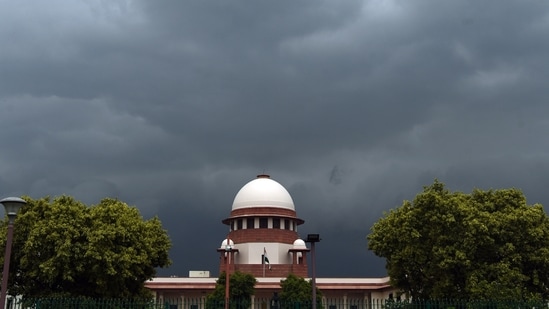
The debate over the veracity of artificial intelligence (AI) has reached the Supreme Court of India after the National Company Law Tribunal (NCLT) reportedly relied on fake precedents and precedents generated using AI.

The Supreme Court on Thursday stayed the NCLT judgment in the bankruptcy of Essel Infrastructure Projects, finding that the court had relied on “non-existent, fake and illusory judgments/precedents generated using AI”, news agency P.T.I. Reported.
A bench comprising Justices PS Narasimha and Alok Alade said: “Creating fake, non-existent hallucinatory material and using it as a legal precedent is like releasing methyl isocyanate into the realm of law and justice. It is invisible, insidious and by the time anyone notices it is disastrous. It not only pollutes but also takes away the very lifeblood of judicial decisions.”
Also read: Air India Express resumes flights to West Asia, Salalah, Kuwait, resumes operations
The court held that this amounted to misconduct on the part of the advocate.
“Courts need to adopt a zero-tolerance mode for creating, quoting or using AI-generated precedents without verification. Citing such judgments without verification is an offense on the part of advocates,” the court was quoted as saying.
The court said it was equally a “serious lapse” for judges to rely on such fake and hallucinatory AI-generated material as precedent to support their decisions.
“We have no hesitation in declaring that such a decision is not a decision from the point of view of the law, irrespective of whether such material directly or indirectly contributes to decision-making. Even if a large amount of false or hallucinatory material enters the decision-making process, such a decision would violate the sanctity of the judgment and should be disregarded,” it said.
Also read: AI, defense and healthcare: What was discussed in PM Modi’s meeting with Prime Minister Sanae Takaichi
The court said it was imperative to maintain integrity in decision-making.
The court also noted that the case highlighted widespread concerns about the use of AI in legal decisions, emphasizing that while AI can assist in the process, decisions must remain under the full and absolute control of human decision makers.
“Crucial to our decision-making is our determination to deploy artificial intelligence technology to assist in sentencing, while at the same time asserting and declaring complete and absolute control over sentencing over the humans in the loop at every step,” the ruling said.
Also read: What the name means: Why FSSAI criticized Sting maker Red Bull for its ‘energy drink’ branding
The court stated that simply declaring a prohibited act is not enough; there must be consequential action followed by accountability.
“As far as the liability of lawyers is concerned, we direct the Bar Council of India (BCI), the apex statutory body, to constitute a committee to deliberate on this issue of lawyers submitting such fake and hallucinatory materials to courts as if they were precedents,” it said.
The judgment stated that the Supreme Bar Association needs to take up this issue with the utmost seriousness, seriously consider it, and prescribe guidelines to prevent such situations, as well as disciplinary measures for violations of the code.
(With PTI input)