

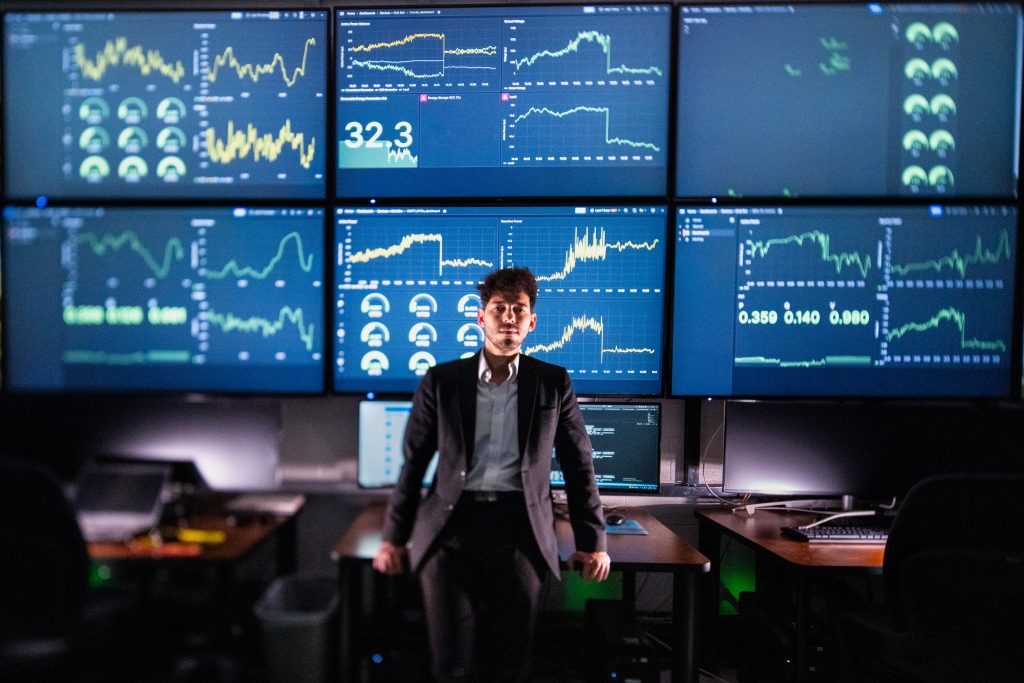
Utilities are facing new challenges as artificial intelligence drives rapid growth in data centers. It’s about maintaining voltage stability as electricity demand increases, changes rapidly, and becomes difficult to predict. As demand increases and more distributed energy resources such as batteries, rooftop solar, and backup generators come online, utilities have more moving parts to adjust and less margin for error in keeping voltages stable for critical loads.
The team at Sandia National Laboratories is working to support a resilient power grid with AI-driven controls that can help manage voltage and respond to fluctuations in power demand and supply in real time. Work moved from computer simulations to laboratory tests using actual grid hardware and field demonstrations at two locations in Lubbock, Texas. The same approach can also be applied to enhance the power resiliency of critical defense infrastructure.
“While the way we generate electricity and the loads placed on the grid are evolving, the backbone of the grid that connects them remains the same,” said Sandia engineer Rashid Darbari Zamora. “More control is needed to integrate everything into the grid in a more reliable way. The main goal is to keep the voltage within operating limits under ever-changing conditions.”
Reliable power is also a national security issue, especially for critical infrastructure at home and abroad.
“In a national conflict or war scenario, an adversary would target energy infrastructure to disrupt both military and civilian capabilities,” said senior manager Charles Hanley. “The DERMS system developed by Sandia helps defeat such adversarial attacks through the application of agile and secure technologies that adapt to real-time development and keep critical systems and mission capabilities operational. Sandia’s deep understanding of the associated threats, vulnerabilities and mitigations gives us the unique ability to design and test such AI systems in real-world environments, thereby providing technology solutions that address critical national security issues.”
Frequency is typically managed at the large-scale power system level, but power distribution networks require rapid local voltage regulation to maintain power quality for sensitive loads. For defense and other critical infrastructure, maintaining power quality is as important as maintaining power itself.
A new kind of grid control for resiliency and continuity
Traditionally, utilities managed voltage by installing or upgrading equipment such as capacitor banks and line voltage regulators.
“These are traditional, traditional devices that are more mechanical, turning on and off,” Darbari-Zamora said.
Sandia’s approach aims to provide more continuous and regulated voltage support using hardware and functionality already built into many grid-connected devices. These devices include inverters that connect resources such as solar panels and batteries to the power grid to provide more stable voltage and improved power quality. By coordinating many devices at once, the controller can quickly respond to failures, including those caused by intentional disruptions to the energy infrastructure.
“To provide these services, we leverage inverters already deployed on the grid,” he said. “This means utilities don’t have to make as many upgrades. It also reduces their reliance on slower mechanical switching when the grid is under load.”
The software platform is a distributed energy resource management system (DERMS) that predicts changes in power usage and availability, adjusts grid-connected devices, and automatically responds to failures to support a more resilient grid. AI helps controllers adjust device behavior in near real-time while respecting equipment limitations and operational constraints.
“Our team wanted to deliver something powerful and intelligent, yet practical for utilities to adopt,” said Darbari-Zamora. “AI can help us understand everything moving on a modern power grid and do it in real time.”
Testing AI controls against real-world disturbances at Sandia’s Distributed Energy Technology Laboratory
Darbari-Zamora said the team started with the basic premise that “one-size-fits-all grid control will not work everywhere.”
He said every location is unique, with different hazards, critical services and a mix of grid-connected resources.
To create a controller that can tune the device and adapt to local needs, the researchers first built and tested their approach in simulation before validating it on real hardware.
The next step was taken at Sandia’s Distributed Energy Technology Laboratory using a method called Power Hardware in the Loop (PHIL). This method allows researchers to connect real-world grid equipment, such as utility power inverters and battery hardware, to real-time grid simulations. This setup makes it possible to test how the control software behaves under realistic conditions without connecting to the real power grid. This type of testing and iterative validation is especially important in national security applications where control must be exercised through rapidly changing situations or hostile disruptions.
In laboratory experiments, the team linked AI-driven controls to off-the-shelf inverter hardware and other grid-connected devices, and a digital real-time simulator created varying grid conditions. This allowed researchers to assess how quickly the controllers can respond to rapid changes and disturbances, such as the kinds of voltage fluctuations that utility companies are working to prevent. This test challenged the controller in a rapidly changing scenario, allowing the AI to update adjusted settings as conditions change.
Lab testing served as a reality check before implementation in the field. Darbari-Zamora said computer simulations can miss communication problems that appear when software exchanges data with real equipment.
“Simulation captures dynamics, but it doesn’t really capture, for example, communication challenges,” he says.
By testing real hardware in the loop, the team was able to see if the controller would behave properly even when messages arrived late or the data link was slow.
“These experiments were extremely important,” said Sandia researcher John Berg. “These have enabled us to evaluate how the system will behave on real hardware, not just models. This has given us and our partners confidence that this technology is ready for real-world deployment.”
From the lab to field demonstrations
After validating the controls in the lab, the team tested the system at two sites in Lubbock: Sandia’s Scale Wind Energy Technology Facility, known as SWiFT, and Texas Tech University’s GLEAMM microgrid.
In SWiFT, researchers connected the DERMS controller to an operating device to see how the controller behaves under real-world conditions as system conditions change. Demonstrating performance with equipment in service helps build confidence for future use at mission-critical sites where extended downtime cannot be tolerated.
The team then deployed the software platform to the GLEAMM microgrid, which includes the data center. There, controllers could adjust grid-connected devices in real time to make voltages more stable and maintain power quality for critical loads.

To measure the impact, the team ran field tests in parallel with the controller turned on and off.
“I ran all day with a controller, and I ran all day without a controller,” Darbari-Zamora said. “When you compare these two voltage graphs, you can visually see how the DERMS controller improves the voltage in your system.”
Voltages are typically about 5% higher than normal on site, and the adjusted controls were able to bring them closer to the target values maintained by the utility company.
For utilities and microgrid operators, this type of control can help manage more complex power distribution networks without relying solely on slow mechanical equipment or large-scale infrastructure upgrades. For national security purposes, it can also provide an additional layer of resilience by enabling agile responses as conditions change during emergencies or deliberate attacks.
“These demonstrations prove that AI can meaningfully improve the way microgrids and distributed resources operate,” said Sandia researcher Miguel Jiménez Aparicio. “Field data confirms what we observed in the PHIL test. This technology can deliver real benefits to utilities, communities, and critical infrastructure.”
Accelerate your journey to implementation with Energy I-Corps
Now that DERMS has been successfully tested in the lab and proven in the field, the team is also working to move the software toward real-world use.
This project was selected for the DOE Energy I-Corps Phase II program. The program connects researchers with potential users to better understand operational needs and identify capabilities that make tool implementation practical.
Through interviews with utility companies, microgrid developers, and industry partners, the team gathered feedback on what organizations need most: tools that make it easier to coordinate grid-connected devices and integrate new equipment without adding significant operational burden.
Based on its progress, the project was recently accepted into Energy I-Corps Phase III, a competitive follow-on effort aimed at accelerating commercialization and supporting additional field deployments with partners.
“Our experience with Energy I-Corps makes the impact of this work even clearer,” said Sandia researcher Jorge Leon-Quiroga. “Utilities want to solve complex problems using intelligent tools. By combining Sandia’s technology capabilities and customer insights, we position this technology to drive meaningful change in the evolving energy landscape.”
This effort also reflects what DOE’s Genesis mission is designed to accomplish: applying AI to tackle the nation’s most complex science and technology challenges. By combining AI-enabled tuning, hardware-in-the-loop validation, and field demonstrations, the team is expanding repeatable capabilities to design and test agile grid controls that can break through chaos and keep critical systems running.
/Open to the public. This material from the original organization/author may be of a contemporary nature and has been edited for clarity, style, and length. Mirage.News does not take any institutional position or position, and all views, positions, and conclusions expressed herein are solely those of the authors. Read the full text here.


