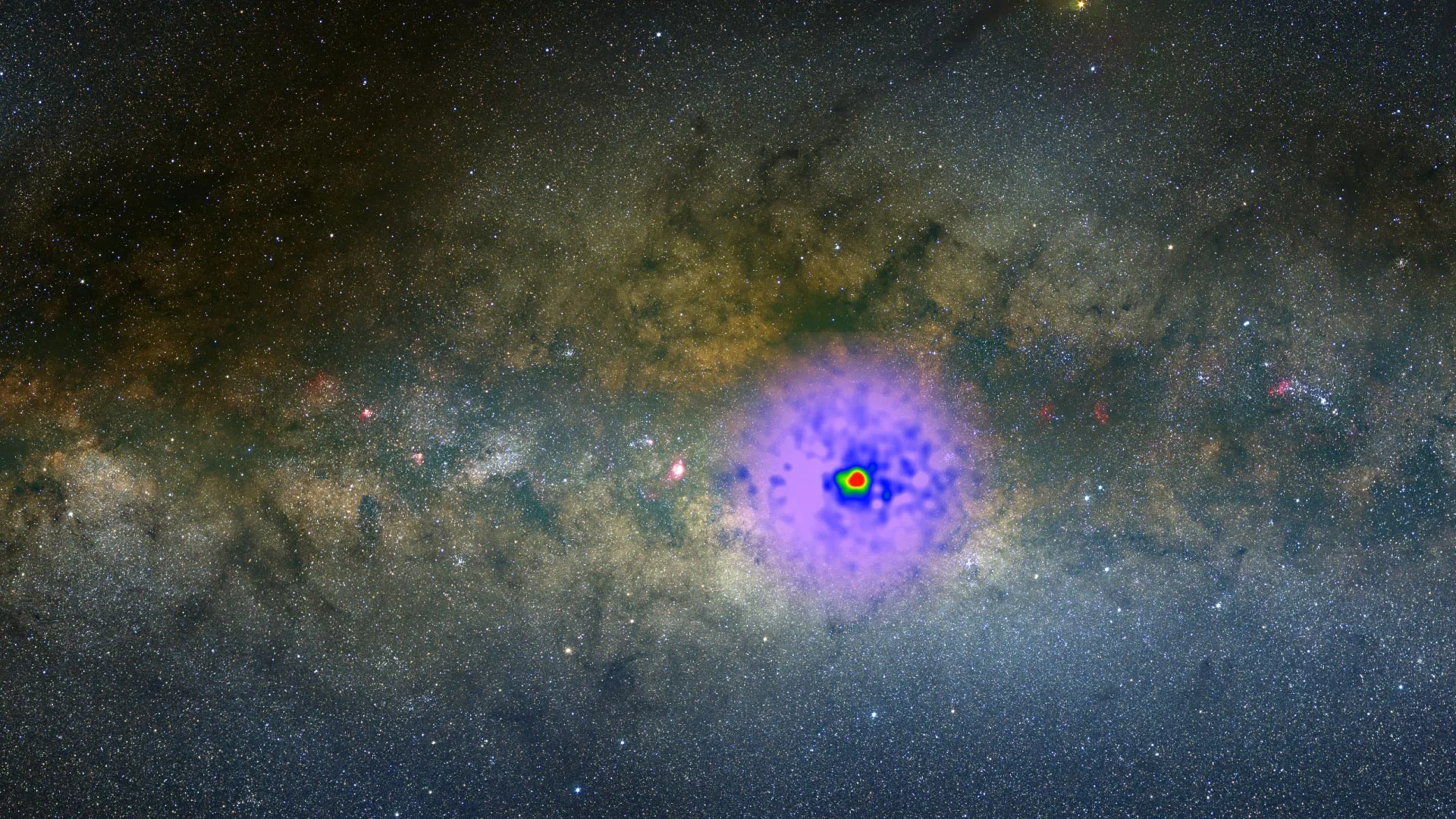
Researchers at the University of Vienna and Lawrence Berkeley National Laboratory turned to machine learning to take a new look at one of astrophysics’ most controversial mysteries. Their focus was on the Galactic Excess (GCE), the faint, nearly spherical gamma-ray glow that surrounds the center of the Milky Way. Scientists have been debating for more than a decade what is producing this unusual signal. New findings suggest that dark matter is still a viable explanation and cannot be ignored just yet. This research physical review letter.
The Galactic Center Excess (GCE) is a widespread glow of gamma rays that extends thousands of light-years around the center of the Milky Way galaxy. Researchers have proposed several possible explanations for its origin.
One possibility is self-annihilating dark matter. Dark matter is a hypothetical substance that makes up most of the mass of the universe but has never been directly detected. Another major explanation involves populations of millisecond pulsars, fast-spinning neutron stars that emit high-energy radiation.
Despite years of research, scientists have not reached a consensus on the cause of the signal.
“The signal is particularly difficult to interpret because the galactic center is a very bright and crowded region of the gamma-ray sky,” explains study author Florian List, a researcher at the University of Vienna.
Machine learning adds the missing pieces
Previous statistical analyzes generally supported the pulsar explanation. However, these studies overlooked an important source of information: the energy of each detected gamma-ray photon.
To address this limitation, the researchers developed a machine learning system trained on simulations of more than 1 million gamma-ray observations. In this way, for the first time, both the spatial distribution of the signal and the energy of individual photons were evaluated simultaneously.
The researchers say incorporating photon energy data makes a big difference in their results.
Previous research suggested that the signal comes from a relatively bright unresolved light source, often called a point source. New analysis shows that if such point sources are the culprit, they must be very dark.
“Our new analysis shows that the source must be so faint that it is almost indistinguishable from the emissions expected from dark matter annihilation,” said study author Nick Rodd, a scientist at Lawrence Berkeley National Laboratory.
This discovery also poses challenges to the explanation of pulsars. If millisecond pulsars are producing the glow, research suggests there must be at least 35,000 pulsars packed into the center of the Milky Way. This is much more than the hundreds to thousands of sources assumed in some previous studies.
Dark matter is still progressing
“The origin of the galactic supercenter is one of the longest-running debates in astrophysics,” says Florian List. “Our study does not show that dark matter is responsible for the signal, but suggests that it is still too early to rule out this possibility.”
The new results weaken one of the strongest arguments used against the dark matter explanation. Although this study does not provide direct evidence that dark matter is producing the gamma-ray glow, it does suggest that dark matter still has a reliable potential.
For now, the cause of the galactic supercenter remains unknown, and it is certain that it continues to be one of astronomy’s most enduring mysteries.