Newswise — Estimating leaf functional properties from reflectance spectra is the basis for remote sensing applications such as precision agriculture, forest monitoring, and climate change research. Physical radiative transfer models (e.g., PROSPECT) provide a mechanism-driven framework, but their accuracy is limited by spectral variability and structural uncertainties. Conversely, data-driven machine learning models are good at pattern recognition, but often require rich labeled data. This data is not always available across diverse ecosystems and sensor platforms. Hybrid approaches that bridge these two paradigms have emerged, but their relative performance and generalizability are still poorly understood. Based on these challenges, detailed comparative studies are urgently needed to establish flexible and data-efficient strategies for estimating leaf traits accurately and transferably across global optical property datasets.
Published May 7, 2026 (DOI: 10.34133/remotesensing.1050) Jdiary of Remote Ssensing (Volume 6, Article ID: 1050), a joint research team from China Agricultural University, Chinese Academy of Agricultural Sciences, and Inner Mongolia Cultural Technology Innovation Center addressed important challenges in remote sensing. It is about reliably estimating key leaf functional traits – chlorophyll (CHL), carotenoids (CAR), equivalent water thickness (EWT), nitrogen (N), and leaf mass per area (LMA) – from leaves. Reflectance spectrum (400-2400 nm). Accurate estimation of these traits is critical for optimizing crop management, increasing yield, and preserving the ecological environment, but traditional approaches suffer from a lack of data and spectral variation across global ecosystems. This study provides a comprehensive solution by comparing multiple modeling strategies and developing flexible selection guidelines.
In this study, we systematically compared physical models (PROSPECT-D and PROSPECT-PRO), data-driven models (TabNet, ResNet, Generalized Linear Model GLM), hybrid models (incorporating 20,000 PROSPECT-simulated points), and decision-level fusion across 26 global datasets. The most important finding is that the fine-tuned transfer learning approach, especially the GLM-based implementation, achieved the highest accuracy for CHL, CAR, N, and EWT estimation, consistently outperforming physical models. In particular, physical models outperformed source-trained models for EWT and LMA, and could outperform even the best data-driven performance on certain datasets. A model selection framework was developed with 97% accuracy to recommend the optimal method, and Bayesian model averaging (BMA) decision level fusion further improved the estimation accuracy of CHL, CAR, and LMA. This study also demonstrated that a small number of manual measurements (“target data”) were sufficient to achieve high accuracy with transfer learning, dramatically reducing the need for large-scale field sampling.
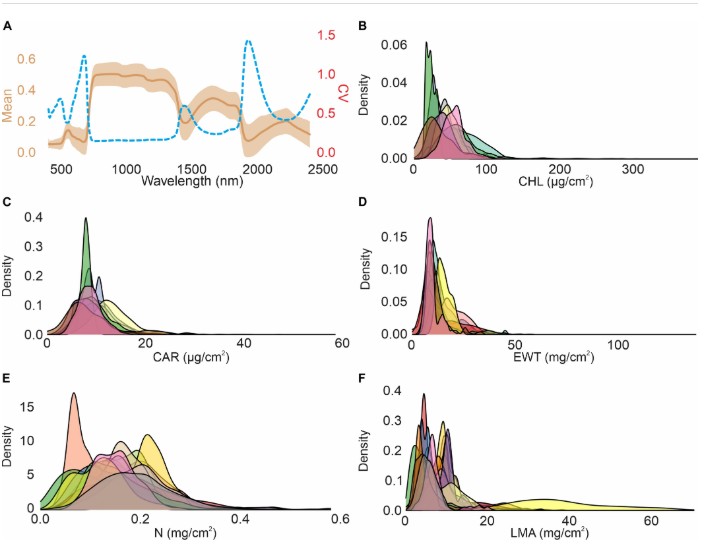
This study utilized a dataset of 26 leaf optical properties from the Ecological Spectral Information System (EcoSIS) spanning North America, Central America, South America, Western Europe, East Asia, and Australia. In total, these datasets included more than 30,000 trait and spectral combinations, representing more than 500 species of trees, shrubs, herbs, and vines. Leaf spectra were collected using ASD FieldSpec 3, SVC HR-1024i, and Spectral Evolution PSR+3500 instruments, normalized to the range 400–2400 nm with 1 nm resolution, and smoothed with a Savitzky-Golay filter. Five functional traits were targeted: CHL, CAR, EWT, N, and LMA. A leave-one-dataset-out (LODO) validation strategy was adopted to ensure robust cross-dataset evaluation. Four modeling strategies were implemented for the data-driven model: small sample training (SST), source only training (SOT), fine-tuned transfer learning (STFT), and combined source and target training (CSTT). The hybrid model replaced the source data with 20,000 PROSPECT simulated points. Decision-level fusion of physical and data-driven outputs was explored using four fusion algorithms. This is a new approach that has not been previously reported for leaf trait estimation.
“Our study demonstrated that transfer learning can achieve high-accuracy leaf trait estimation with surprisingly few field measurements,” explains the research team led by Shuaipeng Fei and Yuntao Ma. “While physical models remain valuable for traits such as water content, fine-tuning data-driven models on small datasets of interest provides a practical and resource-efficient route. The 97% accurate model selection framework we developed provides users with clear guidance tailored to their specific data and research objectives.”
The research team obtained 26 global leaf reflectance datasets covering diverse ecosystems and equipment from the EcoSIS repository. For physical modeling, we employed inversions of PROSPECT‑D and PROSPECT‑PRO. The data-driven model utilized TabNet, deep residual networks (ResNet), and generalized linear models (GLM) across four training strategies. The hybrid model replaced the source data with 20,000 radiative transfer points simulated in PROSPECT. Decision-level fusion was performed using four fusion algorithms. A leave-one-dataset-out cross-validation scheme and Bayesian model averaging (BMA) were applied for robust performance evaluation and ensemble enhancement.
This flexible modeling framework will accelerate the adoption of remote sensing technologies in precision agriculture, allowing farmers to monitor crop nutritional status and water stress at low cost and without extensive field campaigns. This guideline provides a data-efficient pathway to advance functional trait mapping across satellite missions for global carbon cycle modeling and biodiversity monitoring. The proven success of transfer learning from simulated PROSPECT data opens the door to fully synthetic training strategies, ultimately democratizing high-quality plant trait inference for resource-limited researchers worldwide.
###
References
Toi
10.34133/Remote Sensing.1050
Original source URL
https://doi.org/10.34133/remotesensing.1050
Funding information
This research was funded by the Inner Mongolia Grassland Technology Innovation Center Key Innovation Platform Construction Project (CCPTZX2023K03), the Key Project of Inner Mongolia Science and Technology Promotion Action (No. NMKJXM202303), and the Industrial Technology Innovation Program of IMAST (No. 2024RCYJ04004).
About remote sensing journal
of remote sensing journal, An online-only open access journal published in collaboration with AIR-CAS that promotes interdisciplinary research in the theory, science, and technology of remote sensing, as well as in the geosciences and information sciences.