

Artificial intelligence (AI) is often discussed in terms of innovation, productivity, and economic growth. But a new report from the United Nations University (UNU) warns that its physical area is becoming equivalent to that of an entire country.
The report, “The Environmental Cost of AI’s Energy Use: Carbon, Water, and Land Footprints,” says that the world’s data centers running AI could consume 945 terawatt-hours (TWh) of electricity by 2030. This is almost three times the annual electricity use of Pakistan, Bangladesh and Nigeria, countries with over 650 million people, combined.
- If AI data centers were a country, they would be among the top six in the world in electricity consumption by 2030.
The report argues that the impact of AI cannot be measured solely by carbon emissions. It also includes large and growing demands on water and land. These pressures are changing the way governments and businesses think about digital infrastructure.
Professor Kaveh Madani, director of UNU Inweh and leader of the study, said:
“This report is not a lawsuit against artificial intelligence, a technological transformation that will improve the lives of billions of people around the world. It is a call to use artificial intelligence responsibly and proactively address its unintended consequences to make it sustainable and equitable in our time. There is a narrow window to ensure that the roots of the technological revolution develop within global limits, and the communities that provide the essential minerals for the advancement of AI, as well as those that host its infrastructure and e-waste, are also among those who will benefit from artificial intelligence.” ”
Data centers already consume a nation’s worth of resources
The scale of AI infrastructure is already large and growing rapidly.
In 2025, data centers worldwide consumed approximately 448 TWh of electricity. This is more than the total electricity usage of countries such as Saudi Arabia. It also emits approximately 189 million tons of CO₂, equivalent to the annual emissions of Argentina.
According to the report, AI currently accounts for about 20% of total energy usage in data centers, but this could rise to 40% by 2030 as AI applications expand. Goldman Sachs predicts that data center power usage will increase by more than 160% by the same period.
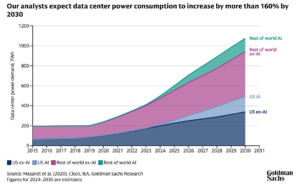
This change is primarily driven by ‘reasoning’. Inference is the continuous use of an AI system after it has been trained. The report estimates that inference accounts for 80-90% of total AI energy consumption, much more than model training.
A single widely used system illustrates its scale. ChatGPT processes approximately 2.5 billion prompts per day. This equates to approximately 383 GWh of electricity per year for just one application.
This report highlights an important trend: AI is no longer a training issue. This is a continuous global electricity demand system.
Triple burden: energy, water and land under pressure
One of the report’s central findings is that the environmental costs of AI are multidimensional. It’s not just about carbon emissions. By 2030, data centers are expected to use:
- 945TWh of electricity,
- 9.3 trillion liters of water, and
- More than 14,500 square kilometers of land.
Water use alone is equivalent to the annual basic needs of 1.3 billion people in sub-Saharan Africa. Its land area is approximately twice the size of the Jakarta metropolitan area, which is home to more than 32 million people.
These impacts arise from cooling systems, power generation, and infrastructure construction. The report warns that focusing solely on carbon can hide trade-offs. For example, switching to some low-carbon energy sources can reduce emissions but increase water and land use.
According to the report, this creates further complications. “Low carbon” does not necessarily mean “low impact.” Lead author Dr Miriam Akzel said:
“What surprised us most was that the options that seem to be the greenest from a carbon perspective are often worse for water and land. If we continue to judge the sustainability of AI in terms of carbon alone, we might think that renewable energy will make AI infrastructure cleaner, but while it solves one problem, it ends up creating another problem, often in places we don’t want it.”
Related: AI data center power crisis: Massive energy demands threaten emissions targets, latest delays signal market shift
Efficiency gains outpace AI growth
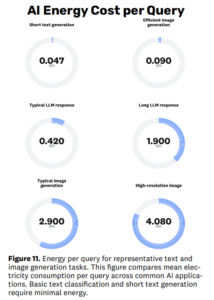
AI systems are becoming more efficient, but demand is growing even faster. A typical AI image query can use approximately 1,450 times more energy than a basic text classification task. One AI video can consume as much power as 200,000 simple queries.
Small design choices are also important. The report notes that changing output length, resolution, and model type can significantly change energy usage per request.
However, efficiency gains are often offset by increased usage. This is known as the rebound effect. As AI becomes cheaper and faster, people are using it more frequently.
The report warns that this trend could negate many efficiency gains unless stronger constraints and design rules are introduced. It also focuses on the growing issue of environmental justice.
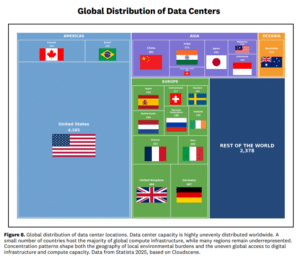
Only 32 countries host AI-specific data centers, and over 90% of the world’s capacity is concentrated in just two countries. More than 150 countries bear the environmental costs associated with mineral extraction and e-waste, yet have little or no access to AI computing infrastructure.
Here are the top 20 data center hubs and their distribution:
Global demand for AI is straining local resources
The impact of AI on the environment is not evenly distributed. The report shows that data centers can put significant pressure on local water and power systems.
It already accounts for 21% of all metered electricity use in Ireland, and in some areas exceeds household consumption. Authorities have suspended new approvals in parts of Dublin until 2028, citing grid constraints.
In other regions, the pressure is more direct. In Mexico and Uruguay, data center expansion has coincided with severe droughts, raising concerns about water access for local communities.
The report also warns of downstream impacts. AI infrastructure could generate up to 2.5 million tonnes of e-waste annually by 2030, much of which could be disposed of in countries with weaker environmental protections.
This creates a discrepancy. While the benefits of AI are global, many of the environmental costs are local.
Multi-factor AI governance demands
The UN report does not call for a slowdown in AI development. Instead, as Professor Madani said, better governance and measurement is required.
They argue that current environmental reports are incomplete because they mainly focus on carbon emissions. The report recommends tracking carbon, water and land emissions together.
It also suggests several actions:
- Governments should include AI infrastructure in their energy and water plans.
- Companies need to design models with efficiency in mind, not just performance.
- Data centers must consider local environmental restrictions when choosing a location.
- Investors should treat resource use as a financial risk factor.
- Users should be encouraged to reduce unnecessary computing load.
The key message is that AI must be built within planetary limits.
AI infrastructure is becoming a global resource system
The report concludes that AI is no longer just a digital technology. It is becoming a physical infrastructure system that consumes electricity, water, land, and minerals on a national scale.
By 2030, AI data centers will be able to use as much electricity as several countries in the world combined. At the same time, it will require water equivalent to the needs of billions of people and potentially generate large amounts of e-waste.
The UN framework is simple. The question is no longer whether AI will grow or not. That’s already the case. The real challenge is whether growth can be managed in a way that stays within environmental limits and distributes both benefits and burdens more equitably across countries and communities.


