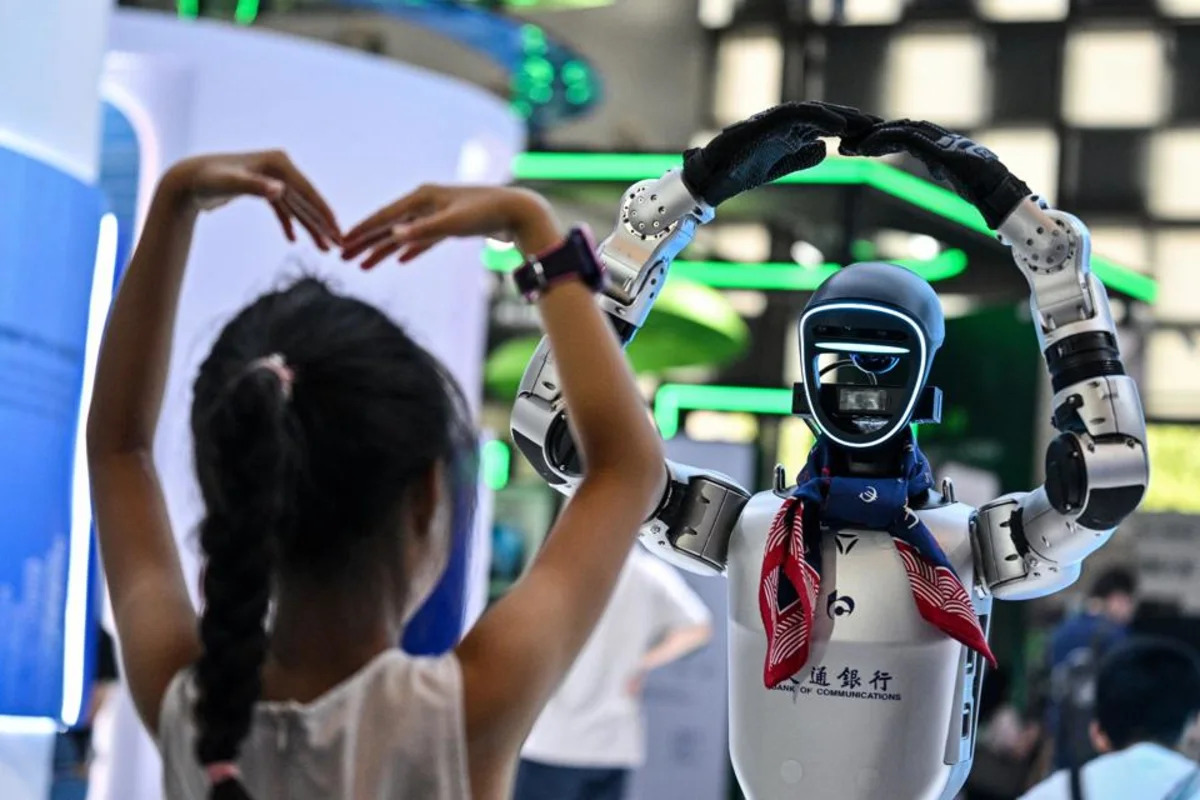
Top Shot – A girl plays with a robot during the World Artificial Intelligence Conference (WAIC) held at the Shanghai World Expo Convention Center in Shanghai, July 28, 2025 (Photo by Hector RETAMAL/AFP) (Photo by HECTOR RETAMAL/AFP via Getty Images)
On June 18, China’s Ministry of Commerce and seven other government agencies announced 17 measures to promote “AI-plus consumption.” The Chinese government wants households to try out AI products, local governments to support new smart devices, and companies to build service scenarios where AI goes beyond just answering questions. Essentially, government agencies want to expand the scope of AI applications, including consumer electronics, appliances, wearables, retail, tourism, restaurants, medical services, elderly care, and humanoid robots. In doing so, it incentivizes customers to purchase new products with AI capabilities. The Chinese government is asking whether AI can make people buy things again.
China aims to solve consumer problems
Timing is hard to ignore. China’s retail sales fell by 0.6% in May 2026, the first decline since December 2022, according to official data reported by Reuters. Industrial production rose 4.5% in the month, driven in part by global demand related to high-tech manufacturing and AI. If the economy is in a downturn, the best value model may be one where you can have someone replace your old air conditioner or other product.
China’s 618 Shopping Festival is normally a noisy e-commerce event that has shocked sales in the past, but this year demand has been sluggish. Platforms such as JD.com, Alibaba’s Tmall and Douyin have increased their focus on AI shopping tools this year, but shoppers remained subdued as the real estate downturn, trade concerns and discount fatigue dampened mood, Reuters said.
The World Bank says China needs to increase consumption to maintain growth, forecasting that growth will slow to 4.5% in 2025 and 4.0% in 2026. A World Bank study on China points out that weak working conditions, weak housing, high savings and cautious income expectations are holding back household spending.
Therefore, the goal and motivation of the Ministry is not only to obtain coupons as discounts on existing products, but also to provide consumers with a reason to upgrade their products. AI-powered appliances try to do things differently. Track, suggest, sync, order, learn and save time. At least, that’s what AI product vendors hope.
The plan is familiar from previous approaches to making consumer electronics smarter. The smartphone industry is already trying this. Apple, Samsung, Xiaomi, Huawei, Oppo, and Vivo are all turning to on-device AI or AI services to make their mature hardware feel new.
There’s a reason these companies are making their products AI-enabled. According to IDC, global smartphone shipments in the first quarter of 2026 decreased by 2.9% year-on-year, ending the continuous growth that had continued since mid-2023. In May, IDC predicted that global smartphone shipments would decline 13.9% in 2026, citing the memory crisis and pressure on vendors.
AI is a convenient answer to this depressed consumption cycle. Previously, new cameras boasted better screens, memory, or features, but the new pitch is intelligence. Your devices will know more, react faster, and integrate more into your daily life. The goal of this policy is that not all product features need to be deep, but there should be enough features to feel new. As with electrification and internet connectivity, China now wants AI to perform similar tricks.
Growth of humanoid robots
China’s plans go beyond incorporating LLM functionality into mobile phones and consumer electronics. It calls for a larger consumer robot market, with a focus on elderly care and companion services. For now, humanoid robots still live in a strange middle ground between useful machines and creepy guests. The Chinese government wants to move them from demonstration sites to homes, offices, hospitals and nursing homes, where they can handle day-to-day tasks that humans are unable or unwilling to staff.
The state is already investing money in this area. Reuters reported last year that China’s state procurement of humanoid robots and related technology increased from 4.7 million yuan (just $694,000) in 2023 to 214 million yuan (about $31.6 million) in 2024. Shenzhen has created a 10 billion yuan AI and robots fund, equivalent to about $1.5 billion at current exchange rates.
As well as cost, safety remains important. Home robots must be safe, convenient, robust, and inexpensive. To build trust and experience, Chinese companies are launching robot stores, testing programs, rentals, care centers and tourist sites where people can touch the machines before trusting them.
Services may be more important than gadgets
The Commerce Department’s plan will also push AI into the service sector, where China faces a difficult mix of high labor costs, uneven service quality, and difficult-to-standardize tasks. AI can help break down service usage bottlenecks caused by high labor costs and low standardization. This is important in sectors such as aged care, catering, tourism, accommodation and public services, where demand can grow faster than temporary staffing. In these industries, there are small frictions in daily spending that the Chinese government seems to believe will make services cheaper, more reliable, and easier to scale by removing them.
Alibaba recently unveiled a model that is part of a broader shift from chatbots to agents that can perform tasks. In the retail industry, Alibaba and others are testing AI shopping assistants, recommendation tools, and sales systems during large-scale sales events.
The Chinese government is not waiting for consumer AI to find its own market. The company pays for trials, guides product design, and trains consumers to expect AI in regular purchases. The plan hinges on a broader view of AI’s economic impact: chips powering models, powerful products are modeled, products drive spending, and spending supports growth. As part of this larger picture, China’s policies are directed toward consumers, who are perhaps the weakest link in this chain.