
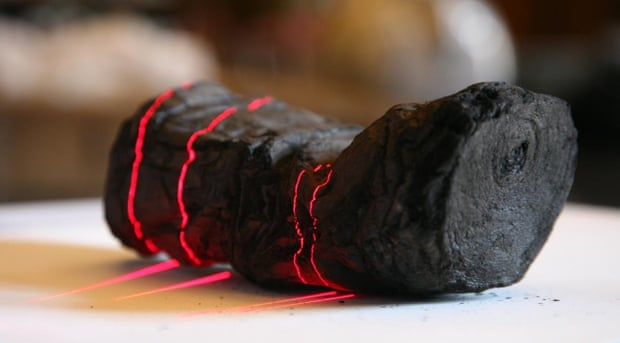

Fragments of an ancient scroll charred during the eruption of Mount Vesuvius nearly 2,000 years ago have been digitally unraveled and read using artificial intelligence (AI).
Azel News This was reported by citing the Guardian newspaper.
Researchers were able to uncover about 20 previously hidden columns of text spanning more than a meter of carbonized papyrus without physically opening the fragile manuscript. It is thought to be a discussion of Stoic philosophy, which focuses on topics such as ethics, art, and human behavior, and is thought to date back to the late 2nd or 3rd century BC.
The scroll, known as PHerc 1667, is believed to be one of the oldest of hundreds of papyri recovered from a luxurious Roman villa at Herculaneum. The settlement was buried in volcanic ash and extreme heat during the eruption of Mount Vesuvius in 79 AD, which also destroyed nearby Pompeii.
Over the centuries, this scroll has suffered significant damage. It reportedly snapped in two at some point, and previous attempts to physically spread it caused the outer layer to peel off, causing further deterioration. Currently, only about half of the original scroll remains, measuring approximately 8 cm in length and 2 cm in width.
Dr. Federica Nicolaardi, University of Naples Federico II, said that although the entire scroll does not exist, the success in virtually opening what remains is a major advance and demonstrates that such fragile artifacts can be studied without physical damage.
The findings will be presented at a conference in Naples and are part of the ongoing Vesuvius Challenge, which starts in 2023. The initiative is encouraging researchers around the world to use artificial intelligence and advanced imaging techniques to decipher the Carbonized Scrolls of Herculaneum. The project has already won numerous awards for its successful efforts to reconstruct and read ancient texts from high-resolution scans.
Much of the recovered Herculaneum library is associated with the Epicurean philosopher Philodemus of Gadara. However, the author of PHerc 1667 remains unknown. Based on linguistic and thematic analysis, researchers suggest that the work is a treatise on Stoic philosophy, possibly written by Chrysippus, a leading figure in Stoic philosophy. The text also mentions his nephew and disciple Aristocleon.
Image: Edu Lab


