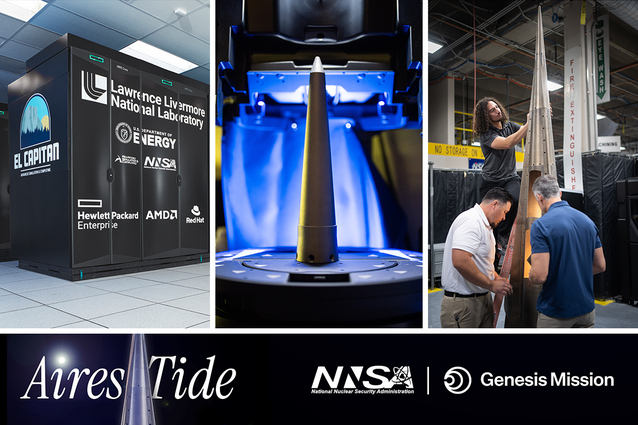
Lawrence Livermore National Laboratory (LLNL) is contributing its AI-powered payload optimization and advanced modeling and simulation expertise to Aires Tide, a collaborative National Nuclear Security Administration (NNSA) demonstration exploring new ways to design flight test vehicles.
Developed in collaboration with Sandia National Laboratories, Los Alamos National Laboratory (LANL), and the Kansas City National Security Campus, Aires Tide brings together expertise across design, manufacturing, and flight test into a single cross-company effort. This project is also an early hands-on example of the Department of Energy’s (DOE) Genesis mission, demonstrating how AI can bring these capabilities together in a more integrated engineering workflow for national security applications.
The project reached a major milestone on May 19 with the successful drop test of a half-scale Airestide vehicle at the U.S. Army Dugway Proving Ground in Utah. The flight data generated by this test will help the team evaluate performance, validate modeling and simulation results, and improve future designs.
LLNL’s projects are focused on using AI-driven optimization, physically-based modeling, and large-scale simulation to more efficiently evaluate payload configuration and engineering tradeoffs. In the project’s design workflow, LLNL researchers applied advanced computational tools to explore a complex design space and support a collaborative design approach in which components are developed as part of an integrated system rather than individually.
“Aires Tide reflects the type of mission innovation that Livermore and its nuclear security enterprise partners are advancing for national security,” said Institute Director Kim Budil. “For LLNL, this effort demonstrates how we can bring our advanced capabilities in high performance computing (HPC) and AI, design and engineering to this collaboration to accelerate development cycles and support future national security needs.”
Researchers say the project went from concept to construction of multiple prototypes in about five months, a process that traditionally took years. Through this collaboration, the researchers designed, built and tested several versions of this vehicle. This includes small-scale test items and an 11-foot-long prototype that will be on display as part of the Freedom 250 “Great American State Fair” event on the National Mall in Washington, D.C., later this summer.

The conical fuselage was printed as nested parts that could be separated and reassembled, significantly reducing manufacturing time and costs. The final display version was manufactured using laser powder bed fusion, an additive manufacturing (3D printing) process suitable for manufacturing complex, high-performance metal structures.
LLNL focused on optimizing payloads for different performance characteristics, and Sandia and LANL contributed complementary expertise in design and integration. This work helped the team evaluate how internal payload elements could be positioned to optimize performance under challenging flight conditions.
“One of the most important aspects of Aires Tide is its potential to accelerate the complete engineering cycle for strategic deterrence and stockpile modernization, from early design work to manufacturing and experimental validation,” said Brad Wallin, LLNL’s deputy director for strategic deterrence. “The ability to connect AI-driven optimization with simulation, manufacturing, and test data allows us to act faster while making better-informed decisions every step of the way.”
Researchers and engineers created Aires Tide as a concept demonstrator rather than a production system. For LLNL and its NNSA partners, this project is a concrete example of a broader goal of connecting AI-enabled design, HPC, advanced manufacturing, and experimental feedback in a closed-loop process that accelerates development across the national security enterprise.
/Open to the public. This material from the original organization/author may be of a contemporary nature and has been edited for clarity, style, and length. Mirage.News does not take any institutional position or position, and all views, positions, and conclusions expressed herein are those of the authors alone. Read the full text here.