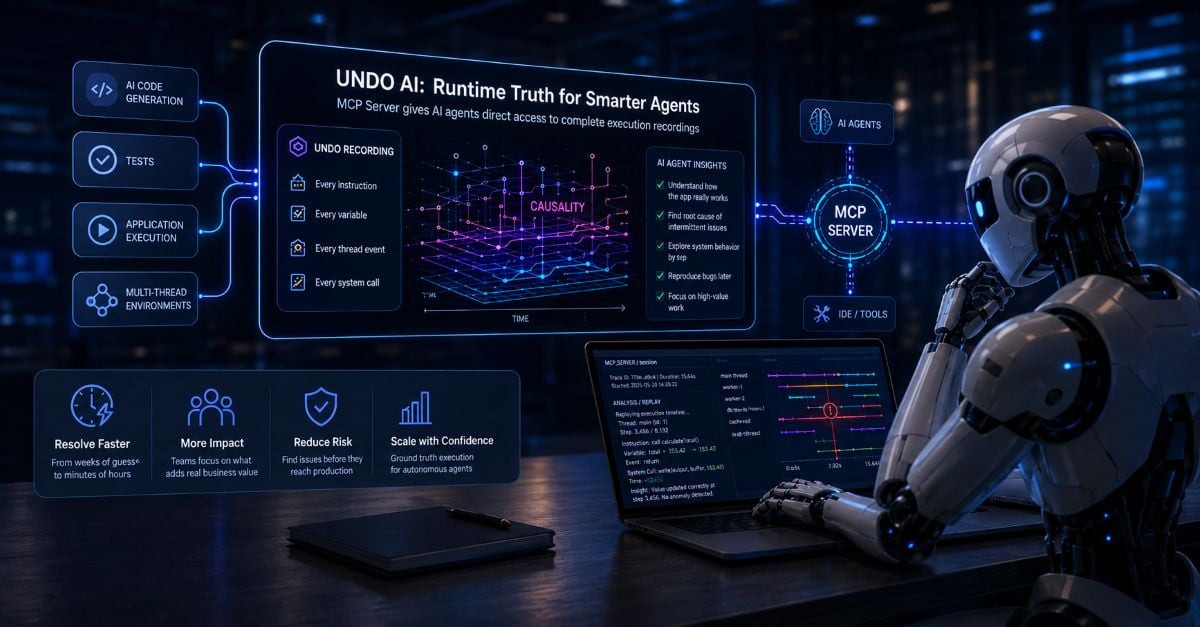
Undo today announced that its platform for recording interactions within applications can now be accessed by artificial intelligence (AI) agents via Model Context Protocol (MCP) servers.
The company’s CEO, Greg Law, says this Undo AI feature makes it easier for agents to discover the root cause of problems that would otherwise take weeks or months to discover.
This capability is more important than ever, he added, as AI tools generate large amounts of code that overwhelm humans’ ability to actually review it.
The Undo platform records the entire program execution, including all instructions, variables, thread events, and system calls. This approach captures causality in a deeper way than what can be diagnosed by relying solely on log analysis and tracing, Lo said.
He added that AI agents can query records in the same way they would infer static code to determine exactly how an application works. Armed with these insights, Lo says AI agents will be able to find the root cause of intermittent failures and state-dependent bugs hidden in complex multi-threaded, multi-process systems.
As a result, failed tests are resolved more quickly and application development teams can spend more time on tasks that deliver more value to the business. DevOps teams can also track the sources of bad data flowing through systems with many interacting processes.
In the AI era, application developers spend far more time reviewing code than actually writing it. However, the challenge they face is that if they don’t write the code from scratch, they often lack the context needed to effectively troubleshoot. You can use AI agents to review your code by giving them access to a platform that records how your application works.
Mitch Ashley, vice president and practice lead for software lifecycle engineering at The Futurum Group, said the debugging bottleneck is currently in runtime state that cannot be viewed in source code or logs. Because agents infer much better about static code than runtime behavior, an upper bound for autonomous diagnostics is whether it has access to ground-truth execution that cannot be inferred by the model alone, he added.
Ashley points out that teams overwhelmed by AI-generated code won’t be able to clear their review backlog even by adding more agents. Without conclusive proof of execution, reviewers end up inheriting assumptions they were supposed to eliminate, he added. According to Ashley, this layer of evidence is a prerequisite for delegating verification to agents at scale.
Each application development team must decide whether to review code using an AI agent embedded in the AI tool used to create the code, or to rely on another third-party AI agent to validate the code created by that tool. Regardless of the approach, the only way to effectively review code at scale is to rely more on AI agents to review code.
The amount of pressure being applied to review code more deeply will only increase in the coming months as organizations embrace the ability of advanced AI models to discover vulnerabilities and weaknesses in applications in minutes. If these same issues are left unresolved, they will be discovered within hours by cybercriminals using the same AI platform to reverse engineer their exploits. Like it or not, DevOps teams now have to discover and resolve more problems long before code is deployed into production.