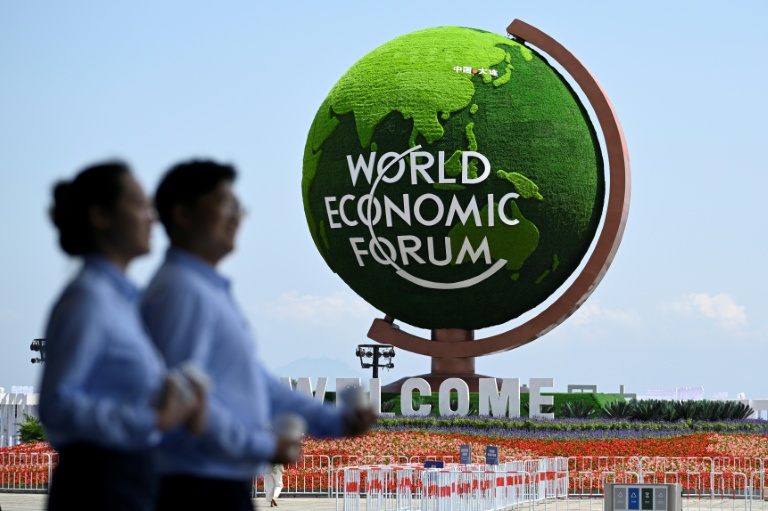
Advances in AI and other technologies have been touted as a driver of economic growth, but there are headwinds, including concerns about job losses and geopolitical tensions, speakers at China’s Summer Davos conference this week told AFP.
Organized by the Switzerland-based World Economic Forum (WEF), the annual conference brings together policymakers and experts in areas important to the global economy.
Mirek Dusek, WEF’s managing director, said on Tuesday that AI is “really transforming industries and economies,” creating new opportunities in education, health care and other sectors.
“We’ve been blessed with a lot of technological advances recently, but the main responsibility for decision-makers around the world is actually how do we make sure this matters in the real economy,” Dusek told AFP.
There is also a “risk of a backlash against some of these technologies,” he warned.
There are growing concerns about AI’s disruption to labor markets and the potential security risks it poses, from breaches of cyber defenses to use in conflict.
Adding to the pressure on the international economic system is the United States and Israel’s war with Iran, which is blocking shipping from the oil-rich Middle East.
~”Lukewarm water environment”~
Against this backdrop, the World Bank has lowered its global growth forecast for this year to its lowest level since the coronavirus pandemic.
Dusek said the global economy currently faces a “lukewarm environment.”
“We all know that there is a threat of lost opportunities in terms of global growth if we get really deeply fragmented.”
Chinese Premier Li Qiang was scheduled to deliver a high-profile speech on Wednesday morning at this year’s WEF New Champions Annual Meeting in the northeastern port city of Dalian.
The occasion will be an opportunity for Beijing’s No. 2 leader to deliver a message about China’s economy to the powerful technology and business leaders in attendance.
China’s economy, second only to the United States, has struggled in recent years to keep up with the breakneck pace of development it has maintained over the past few decades.
Despite a significant boom in exports and AI technology, weak household consumption and an entrenched debt crisis in the real estate sector have weighed on post-pandemic growth.
Complicating matters is the unstable relationship between Beijing and the US government.
Graham Allison, a Harvard Kennedy School professor who frequently speaks privately with Chinese and US foreign policy officials, told AFP in Dalian that he was very concerned about a potential war between the two powers.
Allison is credited with coining the term “Thucydides Trap,” which he defined Tuesday as “the dangerous dynamic that occurs when a great power like China, which has risen rapidly over the past few generations, exerts influence over a major dominant power like the United States.”
~To avoid the hardships of history~
Allison said the ancient Greek historian Thucydides warned that in such situations, “business as usual, business as usual diplomacy (and) business as usual national strategy will breed war.”
However, recent high-level engagement between China and the US president is reason for optimism that war can be avoided, he added.
At a summit in Beijing last month, Xi Jinping asked Donald Trump whether the two countries could “overcome the so-called ‘Thucydides Trap’ and forge a new paradigm of great power relations.”
Allison told AFP that Xi “obviously understands” and that the reference to vague historical concepts was “not a coincidence.”
Meanwhile, Allison said President Trump is “out of line in his own way” and called this year’s war with Iran a “terrible” and “unnecessary mistake”.
However, he said, “China understands that it is different.”
Looking at President Xi’s response last year to the exorbitant tariffs the United States imposed on China, which curtailed America’s access to critical rare earth minerals, Trump realized that “now he’s facing someone who’s almost his equal.”
“These two presidents are clearly trying to redefine or restructure the relationship in a way that overcomes the Thucydides Trap.”
pfc/dhw/kaf