Imagine if ChatGPT was trained on scientific and mathematical reality instead of text and images. This is the vision behind Polymathic AI, an initiative launched in 2023 and supported by the Simons Foundation and the Flatiron Institute.
Generative artificial intelligence, a powerful form of AI that underlies large-scale language models such as ChatGPT, has led to many scientific advances. However, most scientific models are built for specific, idiosyncratic problems and cannot be broadly applied. The Polymathic AI team builds large-scale foundational models that can tackle a wide range of scientific problems, from astrophysics to molecular biology.
The idea for this initiative was born at a physics conference attended by Shirley Ho, who is currently the project lead at Polymathic AI. There was a lot of talk about how generative AI chatbots like ChatGPT and Google Gemini solve major scientific problems. “We thought, ‘How can we make this work?'” said Ho, who is also a senior researcher at the Flatiron Institute. “These models are only trained on large amounts of text, web images, and YouTube videos and are not based on physical reality. What if we instead built large-scale generative AI models for science?”
This name represents the wide range of possibilities of this endeavor. Like multi-subject human polymaths, Polymathic AI’s models cut across individual scientific disciplines.
“If you know seven languages, it’s easy to pick up an eighth,” Ho says. “It’s a similar argument here. The physical realities underlying the models are all connected. That transferability makes these models so powerful.”
The Polymathic AI team is building several large-scale models that span various fields of science.
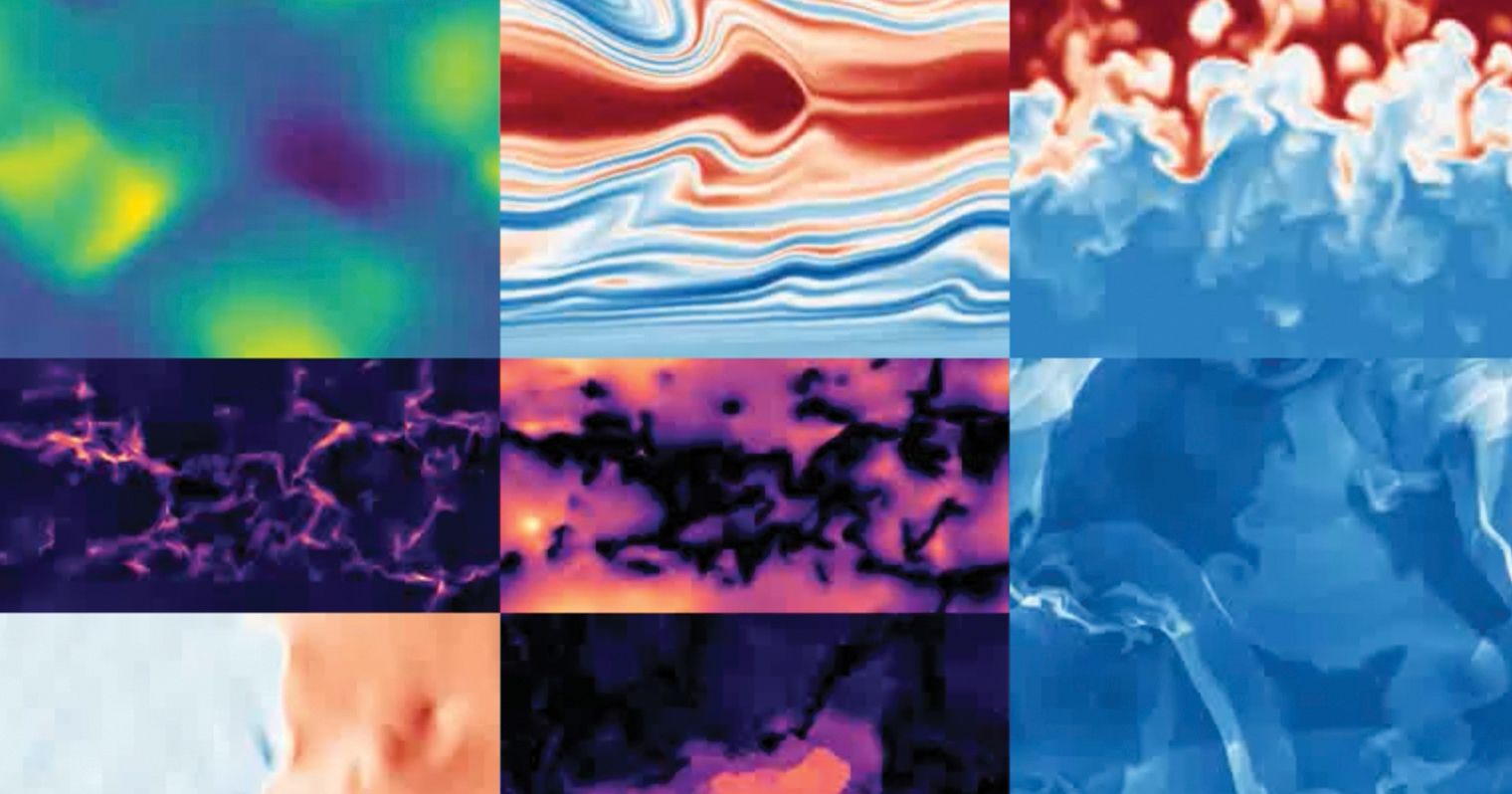
In 2025, the Polymathic team released Walrus, a foundational model for multidisciplinary physical mechanics. Walrus can predict the dynamics of fluids and fluid-like systems, from the merging of stars and sound waves to the movement of bacterial colonies. This was made possible by the team’s previous data release, Well. This data includes 15 terabytes of high-quality simulation data provided by computational scientists such as the Flatiron Institute. The Well includes 19 different physics scenarios spanning 63 different scientific disciplines.
“Compared to what existed before, this was a huge advance for data quality in this space,” said Michael McCabe, lead developer at Walrus and research scientist at Polymathic AI.
Walrus not only benefits from the diversity of data in the training set, but also has a design that overcomes some of the hurdles encountered by previous fluid dynamics models. This means you can make better long-term predictions and be more efficient. This is important in fields that deal with large data sets that require complex calculations to analyze.
Also in 2025, Polymathic AI released the first iteration of AION-1, a large-scale foundational model for astronomy. Astronomical models are trained on measurements such as images taken with powerful telescopes and the spectral fingerprints of stars. In collaboration with many other astronomers, the team first built and released a 100 terabyte dataset called the Multimodal Universe, consisting of hundreds of millions of data points in a format ready for use in AI training.
The AION-1 model has a wide range of applications. We can estimate the physical parameters of galaxies, such as their distance from Earth, their mass, and the rate of new star formation. Galaxies can be classified by their shape, but this process usually has to be done manually. You can also infer conclusions from small amounts of data. This is especially important when data collection requires powerful and expensive machinery such as space telescopes.
Other companies in the space are currently looking to build something similar, said Francois Lanous, co-leader of AION.
“No one has yet been able to do the same type of training at this scale, and it’s a credit to the Simons Foundation that we were able to do this at this scale,” he says. “When we started, this was something that was very promising. We knew that if we brought together good people and thought about it seriously, we would find interesting applications. But this was not possible with traditional funding agencies.”
That’s because Polymathic AI’s models are broadly applicable. Most other generative AI models in science are built to tackle singular problems. The Polymathic team is building models that can be applied across sectors, areas where traditional government funding is scarce.
Another model aims for a closer celestial body: the Sun. Polymathic AI researchers use data from NASA’s Solar Dynamics Observatory to model the dynamics of active regions on the Sun’s surface. Solar flares (spouts of electromagnetic radiation on the Sun) can disrupt communications on Earth and cause power outages. The ability to predict and prepare for such flares could help governments and businesses protect satellites and other equipment from costly damage. Unlike other groups building AI models that predict the evolution of active areas, their accuracy declines rapidly over time, says project leader Rudy Morrell, who says Polymathic AI models can maintain accuracy for an order of magnitude longer. This model could have wide applications across physics for those who want to make predictions on very long timescales.
The Polymathic AI team also tackles complex scientific problems at a much smaller physical scale: biomolecules. Since the Human Genome Project was completed more than 20 years ago, biologists have amassed vast datasets that are broadly classified as “omics.” These datasets may include complete collections of DNA sequences, RNA levels, or protein levels in a particular cell or organism, among other measurements. However, predicting how one type of molecule will affect another type of molecule (for example, what ripple effects a single DNA mutation will have throughout the body) remains impossible for many models. The first iteration of the Polymathic AI model is able to predict the downstream effects of any mutation, allowing us to take a meaningful step toward predicting the structure of RNA molecules, an even trickier problem than the protein structures predicted by DeepMind’s AlphaFold, said project leader Siavash Golkar.
Another group at Polymathic AI wants to understand how AI works. The beauty and frustration of large base models like ChatGPT is that no one understands how the model works. Developers do not have access to the model’s internal reasoning. Although the model is built on a backbone of linear algebra and statistical likelihood, how it reaches its conclusions remains a mystery. The answers to these mysteries likely come in the language of mathematics, Ho says.
“Can we turn these models into insights? Perhaps those insights will be in the form of mathematical equations,” she says. “Mathematics is the basis of all machine learning and ultimately everything we do. We are no longer just teaching machines to speak our language, we are teaching them to speak the language of the universe.”