
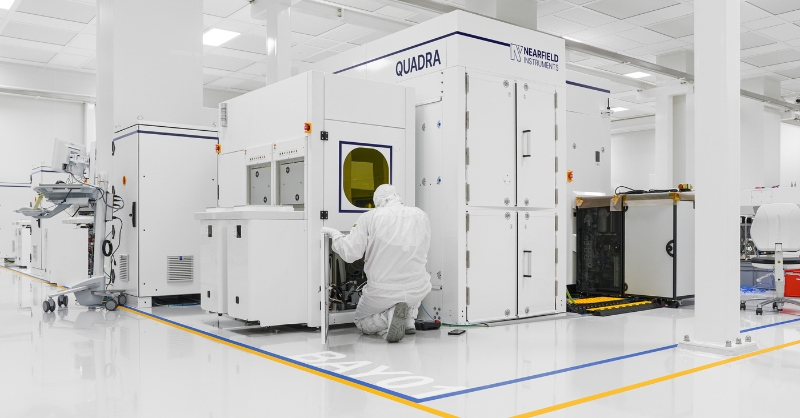
- Rotterdam-based Nearfield Instruments has completed a $380 million Series D at a valuation of $1.6 billion. This is the largest deep tech funding in Dutch history.
- The round is the latest signal that the Netherlands is assembling a complete semiconductor stack, from chip design to manufacturing testing, that no other European country can imitate.
- With backers including Fidelity, Qatar Investment Authority and Temasek, government and institutional money rarely comes together by chance.
There is a version of the AI chip story that everyone knows. NVIDIA designs them. Made by TSMC. Governments are fighting over who controls the supply chain.
A version that fewer people are tracking is occurring in the Netherlands.
Recently, Nearfield Instruments, a Rotterdam-based deep-tech company that makes tools used to inspect chips after production, closed a $380 million Series D at a valuation of $1.6 billion. Fidelity Management & Research Company led the round, with participation from Temasek, Walden Catalyst Ventures, Innovation Industries, M&G Investments, and Invest-NL. Qatar Investment Authority participates as a new investor. The round was oversubscribed and was the largest deep tech financing ever completed in the Netherlands.
Countries building the entire chip stack
There is already ASML in the Netherlands. ASML is based in Eindhoven, and its extreme ultraviolet lithography equipment is so important for advanced chip manufacturing that the U.S. government has spent years trying to block China’s access to it. The advantages of ASML are well documented. What doesn’t get much attention is what’s growing in the shadows.
Axelera AI, an Eindhoven-based startup developing low-power edge AI chips, raised $250 million earlier this year led by Innovation Industries, the same investor behind this nearfield round. Euclyd, founded by a former ASML director, is seeking at least €100 million to build an AI inference chip from an attic in Eindhoven. Invisix, founded by two ASML graduates, has closed a €20 million seed round to discover semiconductor manufacturing errors using soft X-rays. Race Lithography has raised $40 million to replace light with atoms in chip manufacturing.
Each of these companies is attacking different layers of the same stack, including design, manufacturing, inspection, and packaging. Taken together, this is starting to look more like an industrial strategy than a cluster of startups.
Why is sovereign money attracting attention?
The nearfield round was notable not only for its size, but also for who participated. Qatar Investment Authority and Singapore’s state-owned investment fund Temasek are not typical early-stage venture backers. Their presence alongside global asset managers like Fidelity shows that this is no longer a bet on promising startups, but on critical infrastructure.
“This highly successful funding round represents a defining moment in our journey and reflects the growing strategic importance of metrology and inspection in the era of AI-driven semiconductor innovation,” said Dr. Hamed Sadegian, co-founder and CEO of Nearfield Instruments.
This language is strategically important and works in practice. As AI scaling continues to require more complex chip architectures, being able to measure and inspect at the nanometer scale without destroying the chip is a challenge. Nearfield’s QUADRA platform does just that, using high-throughput atomic force microscopy to image structures that cannot be resolved three-dimensionally with optical and electron beam systems.
According to Global Market Insights, the global semiconductor metrology and testing market was valued at $10.3 billion in 2025 and is expected to reach $15 billion by 2031, growing at a CAGR of 7.1%. Nearfield’s competitors, KLA Corporation, Applied Materials, Bruker, and Onto Innovation, are all significantly larger. The capital will be used to expand production capacity, create a new application center of excellence, and deepen research and development with leading chip manufacturers.
“Nearfield is no longer a startup. We are here to stay, scale, and build a leading global technology company,” Dr. Sadegian added.
underlying ecosystem
None of this is a coincidence. The Netherlands has spent decades building the conditions for this moment. TNO is a national research institute that has spun out both Nearfield and several other deep tech companies, and is at the heart of a research-to-commercialization pipeline that most European countries struggle to replicate. According to TFN’s previous analysis of the Dutch ecosystem, the country accounts for just 2.8% of Europe’s population but holds 8% of the continent’s AI talent.
Innovation Industries, the Dutch deep-tech VC that backed both Nearfield and Axelera AI, has been one of the most consistent threads running through the country’s semiconductor ambitions. Invest-NL, a national financial institution, is currently appearing in multiple rounds across the stack. Broad European pressure for semiconductor sovereignty is giving Dutch players a political tailwind and shows no signs of letting up.
It remains an open question whether the Netherlands will be able to maintain this momentum and whether the companies it is incubating will be able to maintain a technological lead over large incumbents in the US and Asia. But it’s no coincidence that the $380 million excess offering round backed by Qatari and Singaporean sovereign wealth funds went to the Rotterdam chip testing company. That’s a signal.

