
Three and a half years after the explosion of generative AI, the market has reached a new juncture. While optimism is still accelerating, skepticism is also accumulating. Merely determining whether a “bubble” is coming is not enough to explain the current complexity. In our “AI Beliefs and Bubbles” series, we look for important variables from a variety of market, technology, industry, and company perspectives.
In the first half of 2026, a range of AI applications that were once highly favored by capital will gradually be withdrawn from the market. It’s not just startup teams struggling with funding. Major companies like OpenAI and Google are also aggressively scaling back previously expanded product lines.
In March 2026, OpenAI announced plans to retire the Sora video generator, which was launched just six months ago. The application featured a “social-like” experience and once occupied the top spot in the Apple App Store, but was eventually discontinued due to continued decline in download numbers and the consumption of enormous amounts of daily computing power.
In the same month, Yupp.ai, an AI model evaluation platform, announced its closure. Led by Chris Dixon of a16z cryptocurrency, it raised $33 million. It gained 1.3 million users in less than a year, but couldn’t find a strong enough product to fit the market. The founders acknowledged that crowdsourced evaluations based on a chat layer are becoming less and less important as the capabilities of models rapidly improve and user work shifts to agent systems that can invoke tools and memories. This site will be maintained until April 15th for users to export their historical data.
Additionally, Google has also begun scaling back its internal AI application line. In June, Pixel Studio’s core image generation functionality was shut down with the v2.3 update, redirecting users to Gemini and Nano Banana. Project Mariner, an experimental browser agent project, ended on May 4th, and its functionality has been integrated into larger production systems such as Gemini Agent and AI Mode.
The AI application layer is moving from early stages of functional testing to more rigorous commercial screening periods.
Much of this market cleansing is happening with application layer products that are “built on single-point model functionality.” Some are internal functional integrations of large companies, some are commercialization failures of startups, and some are experimental projects being integrated into larger platforms. Although they differ in form, they all expose the same problem. That is, does the application layer form a sufficiently thick set of independent values as the underlying model continues to upgrade?
Darren Mowry, global head of startup business at Google Cloud, said in an interview with TechCrunch: If startups rely primarily on a backend model to get work done, this format is almost like a white-label Gemini or GPT-5, and the industry has little patience for this.
So-called “white labeling” means repackaging someone else’s model functionality with your own interface and branding. Users will see new applications, but the core functionality will still be supported by leading large models such as Gemini, GPT, or Claude.
Applications supported solely by model dividends are losing their reason to exist independently.
Now that the storm has passed and the underlying models are always more accessible, where should the application layer moat be?

Images are generated by AI tools.
Application tier pricing will change after larger model features become more available
The downfall of many application layer companies does not mean they were worthless to begin with. The problem is that the model is not good enough, the users are not mature enough, and its value is established at a stage where scenarios need to be repackaged. This part of the value is reevaluated as soon as the model’s functionality reaches the user’s entry point.
Jasper AI was one of the first companies to be influenced by this logic. Once a star in the AI writing applications space, it leverages GPT – 3 to automatically generate creative marketing content and quickly became a unicorn with a valuation of up to $1.5 billion. However, with the proliferation of ChatGPT, “marketing copy generation” has quickly changed from a core selling point of standalone applications to a fundamental feature of large-scale models. Jasper then went through layoffs, review adjustments, leadership changes, and shifted its focus to enterprise marketing workflows.
A similar story happened to Chegg.
Chegg is an online education company that has been severely impacted by AI tools such as ChatGPT and Google AI Overrs. Revenue for the first quarter of 2026 was $63.3 million, down 48% year-over-year. Chegg then laid off employees, saw its revenue decline, and shifted its focus to its AI and job skills business.
Chegg CEO Dan Rosensweig has publicly acknowledged that growing student interest in ChatGPT is influencing the company’s new user growth. User could not find another Chegg. Instead, they migrated their needs directly to ChatGPT. For the application layer, the most dangerous alternative is often that the underlying model, rather than the peer, suddenly becomes the entry point for the user.
Previously, there was a large gap between the intended functionality of the model and the actual needs of end users. Although the model was powerful, it was difficult to use, select, and implement. Users had a need, but they didn’t understand the model, didn’t know how to tune the parameters, and were reluctant to incur the cost of trial and error.
The value of the application layer lies in transforming what a model can do into what it can be used for, and charging for this transformation. The wider this difference, the greater the profit margin.
However, in reality, this space continues to be compressed infinitely.
An entrepreneur in the application layer of large models said, “Now, upstream model manufacturers are also becoming involved in the application layer. This gap is being filled from both ends. In addition, downstream enterprise customers are also maturing rapidly. With the spread of large AI models, a series of market education has been completed, and enterprises are clear about the main core capabilities. More importantly, there are more and more optional suppliers.”
Manufacturers of upstream models have core functionality and can easily integrate them as native functionality. Downstream customers are becoming more savvy and demanding lower prices, better results, and higher ROI. There are countless alternatives, from ChatGPT, Gemini, and Copilot to cloud providers and office software. To make matters worse, new competitors may enter the market at any time.
Therefore, the middle application layer is transforming from a “technological gain amplifier” to a “high-hit area to prove value.”
Application layer products that survive will not only “sell AI”
Behind the series of closures of Sora, Yupp.ai, and Pixel Studio, there is still a booming market. In 2025, the number of downloads of generated AI applications will double from the previous year to 3.8 billion, and in-app purchase revenue will nearly triple to more than $5 billion, according to Sensor Tower data. Sensor Tower also predicts that generated AI application revenue will exceed $10 billion by 2026. So there is both money and users. It’s not the industry that’s collapsing, it’s primarily the product lines that were “on the wrong foot.”
So what exactly did application layer products do right that really survived and even thrived?
The 6th edition list of generative AI consumer applications released by a16z in March 2026 shows that the product form of truly successful AI application layers is changing. There are three main core types:
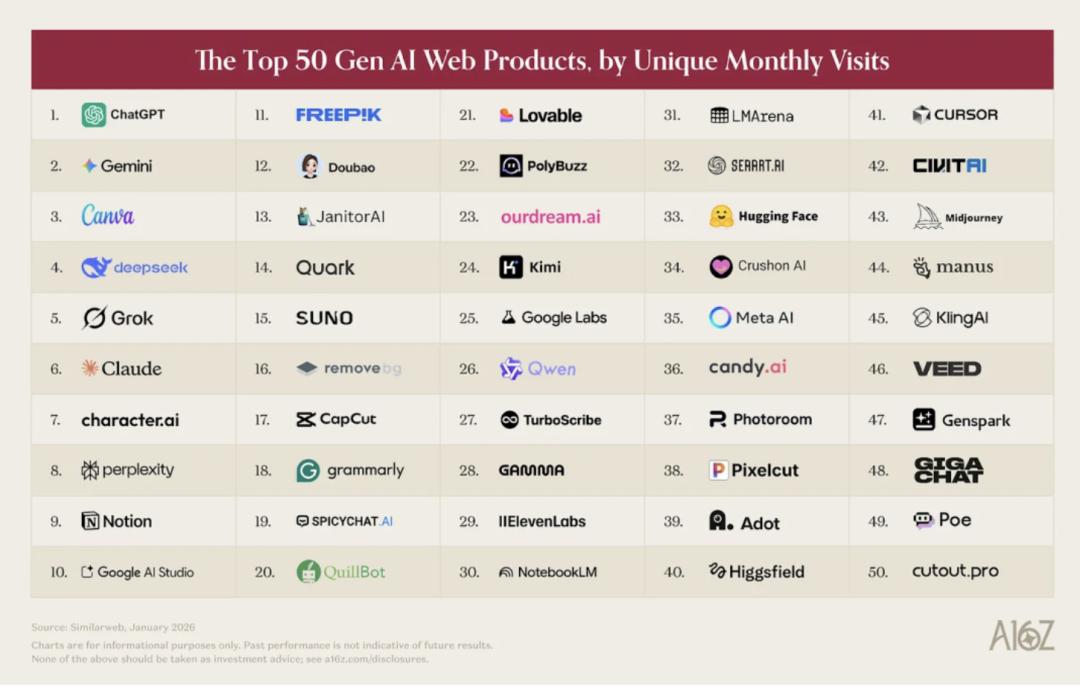
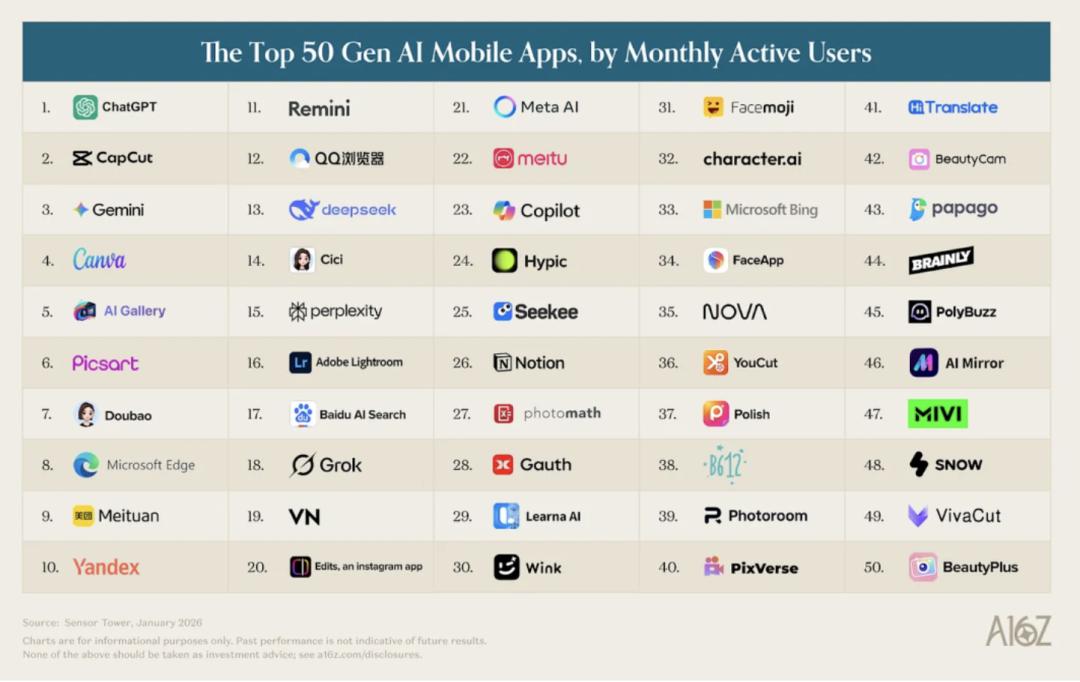
The first type of application is a super application, which is the default entry point.
For example, horizontal AI products such as ChatGPT, Gemini, and Claude are no longer traditional tools. They are all competing for entry points into AI. Users see these tools as new workbenches where they can ask questions, search for information, write code, create spreadsheets, connect calendars, access email, call external applications, and more. a16z specifically mentioned that both ChatGPT and Claude are building an ecosystem of connectors and apps. As users connect email, calendars, CRMs, documents, and work software to AI assistants, switching costs quickly rise.
The second type of applications are those that primarily occupy high-frequency or vertical scenarios.
Let’s take a cap cut as an example. It’s a video editing tool with over 800 million monthly active users, and some of its most popular features like background removal, AI special effects, automatic subtitles, and text-to-video conversion are all AI-driven. However, users do not come looking for “AI”. The focus is on the video editing function itself, and AI reduces operations that would normally take 10 minutes to just one click.
There’s also Notion AI, which integrates AI into a company’s knowledge base, project management, meeting recording, and automation processes. That’s why Notion AI’s paid adoption rate is likely to increase rapidly. Users don’t just buy new tools. They’re paying for a way to work more efficiently with a system they can’t live without.
The third type of product that has survived has evolved from a tool to an agent that does something for you.
a16z specifically highlighted in this list that agents are starting to emerge. For example, Lovable, Cursor, Bolt, Replit, and Claude Code represent agent behaviors in development scenarios. They are starting to help users build products, modify code, analyze projects, and advance tasks. Horizontal agents like Manus and Genspark allow users to assign more flexible tasks such as research, spreadsheet analysis, and slide generation, while AI completes the end-to-end workflow.
Although the forms of these types of products are different, the logic for survival is the same. They don’t just rely on being “AI-powered” to acquire customers. At its core, it’s about integrating AI into essential entry points, scenarios, and tasks for users.
The AI application layer is not shrinking. It’s just that the threshold has become higher.
Therefore, when discussing the closure or reduction of the AI application layer, it cannot simply be interpreted as “the AI application layer is shrinking.”
What is actually emerging on the market is a series of lightweight applications that package single-point functionality into independent products. A growing number of application-layer products are embedded in high-frequency scenarios, occupying user entry points, and entering real-world workflows. They may not appear under the name “AI applications,” but the core point is that AI has long been integrated and part of a variety of product formats, such as video editing software, office suites, browsers, and design tools.
Gone are the days when single point functions could be independently monetized.
The story of the AI application layer continues.
In the future agent era, the application layer will become even more demanding, and single-point functionality will become even more inadequate. Whether a truly valuable product enters the process, connects systems, is accountable, secure and controllable, it can transform the functionality of the model into a closed loop of business that is executable, traceable and measurable.
In the developer scenario, you will see this change come a long way. Tools like OpenAI Codex and Claude Code are pushing AI from “code completion” to “software development agency.” These agents begin understanding your code repository, modify files, troubleshoot errors, generate tests, and even continue to advance your development tasks.
It is difficult to directly replace such functionality with a generic chat box. Real-world software development requires continuous decision-making, modification, validation, and delivery of complex engineering systems. When a product is used long enough, it accumulates project context, team habits, past issues, and operating records, and becomes increasingly tied to users’ daily work.
This screening will continue in the future. Any product that survives today must always answer the same questions. Who will remain in the field after the tide goes out? Only time will tell.
This article is from the WeChat official account “Tencent Technology”. Author: Li Hailun, Editor: Xu Qingyang. Republished by 36Kr with permission.


