
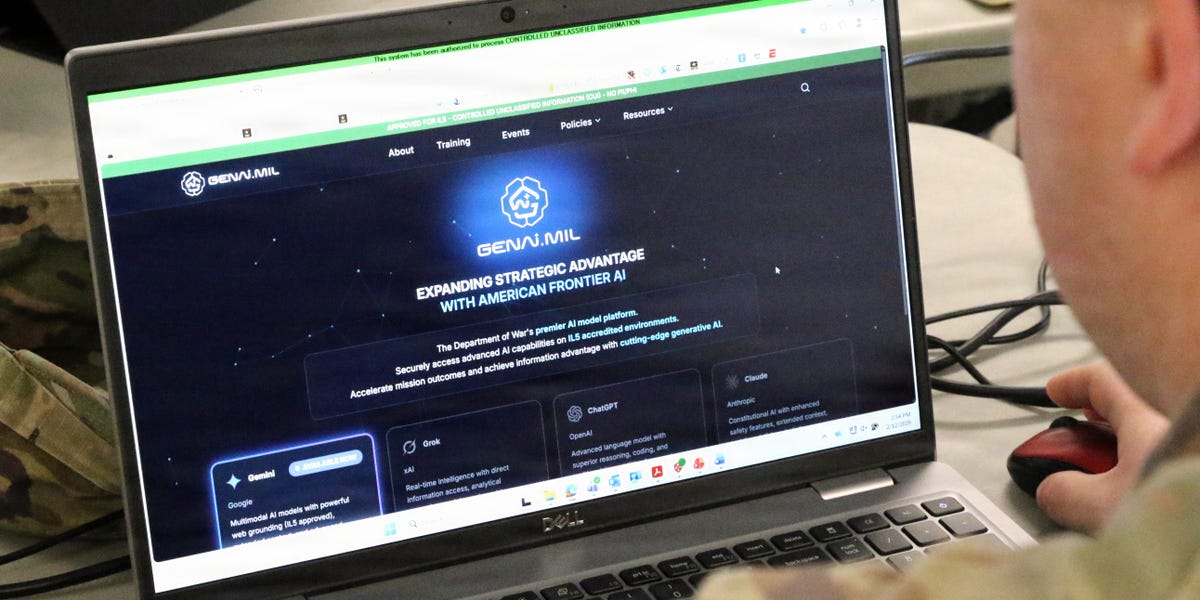
The number of Pentagon employees using the military’s generative artificial intelligence platform has jumped to 1.5 million, according to the Pentagon’s chief technology officer.
The system, GenAI.mil, had fewer than 100,000 users just six months ago. The increased usage suggests that more personnel are leveraging the platform to assist with the monotonous parts of their jobs, as DoD leadership encourages the proliferation of GenAI.mil and other AI platforms across the workforce.
Emil Michael, the Under Secretary of Defense for Research and Engineering and the Pentagon’s chief technology officer, revealed at a Hudson Institute think tank event last week that when GenAI.mil was introduced in December 2025, only 80,000 of the department’s 3.5 million employees were using it.
“The rules weren’t clear about where it could be used or what it could be used for, so we ignored it,” he said.
The Pentagon then launched Google’s Gemini on its unclassified network, and daily user numbers have skyrocketed since then, Michael said.
When GenAI.mil was first launched, the Department of Defense said the program would improve worker efficiency and provide analytical and creative tools to make their jobs easier. More broadly, the Department of Defense is deploying AI across the department for conventional missions and combat, requesting billions of dollars for next-generation AI and computers in the fiscal year 2027 budget.
Michael attributed the large increase in GenAI.mil users over the past six months to directives from the Department of Defense on what AI can and should be used for, as well as DoD personnel’s exposure to AI outside of work.
“So we just put it in front of them and do case studies on what people are using it for,” he says. “Those things are prevalent throughout the department now.”
The types of tasks for which Department of Defense employees are using AI are similar to tasks in other departments. Michael mentioned paperwork and explained that the use of AI gives employees the flexibility to focus on other tasks.
“More and more people are going to think, ‘Oh my god, maybe I can write a job description,’ so from something very simple to something more elaborate,” he said. “‘I have to report to Congress on this every year. Let me load all the documents into it and draft a Congressional report. What would otherwise take 200 hours of staffing, I’ll do in five hours.'”
“In this case, it’s just a matter of trying to catch up on the basics in the commercial world,” he says.
Other officials point to similar potential benefits of AI, believing the technology can reduce the cognitive load on workers, help them complete tasks that typically require more time and human resources, and serve as a resource.
The Department of Defense is also studying how AI can be used in and around combat. Officials are adamant that the technology has guardrails to keep humans in the loop, but acknowledge that the speed of future wars may require AI to process data and make faster decisions.