In the rapidly evolving field of materials science, the integration of artificial intelligence (AI) has transformative potential to accelerate discovery and design. A team of researchers at the Tokyo Institute of Science has unveiled a pioneering method that lifts the veil on the mysterious inner workings of AI models applied to materials prediction and provides a path to deciphering the complex relationships between atomic structure and optical properties. Their novel approach not only increases interpretability but also facilitates deeper mechanical understanding, which is essential for rational materials design.
Traditional AI methods in materials research have often suffered from the “black box” problem. Although models can produce highly accurate predictions, they provide little insight into how atomic configurations translate into material properties. This opacity has hindered the use of AI beyond prediction, particularly in guiding experimental design and interpreting fundamental structure-property relationships. Addressing this challenge head-on, a Japanese research team has developed advanced techniques to extract and interpret features learned by deep learning architectures trained on comprehensive spectroscopic datasets.
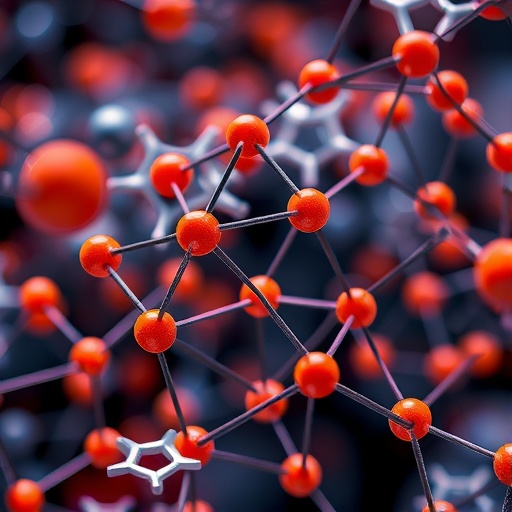
At the heart of this breakthrough lies the use of a graph neural network known as an Atomistic Line Graph Neural Network (ALIGNN). The model is adept at capturing the complex connectivity and properties within crystal structures by representing atoms and their bonds in graph form as nodes and edges. By training ALIGNN on an extensive database of 2,681 inorganic compounds, including metal oxides and chalcogenides, the researchers equipped a network that can predict detailed optical absorption spectra directly from atomic structure input, without explicit knowledge of electronic configuration or oxidation state.
This research is unique in its focus on spectral data, which encapsulates rich multidimensional information about how materials interact with light across a variety of wavelengths. Unlike scalar properties, spectra exhibit high-dimensional output, which traditionally poses interpretability challenges in machine learning frameworks. By probing the inner layers of the trained ALIGNN model, the researchers extracted latent features that encode important aspects related to crystal structure and optical response.
To organize this rich information into consistent and actionable insights, the team implemented hierarchical clustering on the extracted features. This statistical method groups materials based on similarities in both structural attributes and spectral properties. As a result, this method divides the dataset into distinct clusters, each representing a group of materials with common physicochemical properties and common optical behavior. This classification reveals the underlying patterns automatically learned by the AI and provides interpretable rules that neurons rely on for spectral prediction.
The impact on materials science is profound. Optical properties are the basis for numerous technological applications, from pigments and dyes that determine visual aesthetics to optoelectronic devices such as solar cells and photodetectors whose performance depends on the interaction of light and matter. Understanding what structural motifs and elemental compositions influence specific spectral patterns allows scientists to design materials with targeted optical functionality. Through this interpretable AI framework, researchers can now rationalize how microscopic atomic arrangements affect macroscopic spectral features.
Furthermore, the versatility of this approach extends beyond optical analysis. This methodology can be generalized to investigate correlations between atomic structure and other spectroscopic or physical properties under various environmental conditions such as pressure and temperature. This flexibility paves the way for high-throughput screening to identify common features across promising material classes, accelerating discovery and optimization in fields as diverse as thermoelectrics, catalysis, and superconductivity.
One notable finding was that the AI model derived meaningful electronic and chemical insights from atomic positions alone, without inputting chemical information. This suggests that graph neural networks like ALIGNN inherently internalize comprehensive structure-property relationships, paving the way for data-driven modeling strategies with minimal human intervention and assumptions. Such autonomy increases confidence in deep learning as a discovery tool that can uncover hidden correlations within complex datasets.
Assistant Professor Akira Takahashi, who co-led the study, emphasized the importance of this transparency: “Our classification method reveals how the AI model derives its predictions and extracts important elements related to spectral shape. This not only increases the reliability of computational predictions, but also provides actionable insights for materials design, bridging the gap between data science and physical chemistry.”
This study also demonstrates interdisciplinary synergies by combining expertise in machine learning, materials characterization, and computational physics and provides a model for future research efforts. The collaboration between Science Tokyo and Tohoku University brings together advanced AI techniques and deep domain knowledge to foster a robust framework that can spark similar innovations around the world.
This research, published in the journal Advanced Intelligent Discovery, is a major milestone in solving the puzzle of AI in materials science. By improving interpretability, this research enables scientists to leverage AI not just for black-box predictions, but as a transparent lens for deriving new scientific understanding, driving progress toward engineered materials with unprecedented capabilities.
Global challenges such as renewable energy, sustainable manufacturing, and advanced electronics require new materials with precise properties, making computational methods that integrate interpretability and predictive accuracy important. This new approach is an important step in that direction, demonstrating how deep learning can evolve from a predictive tool to a discovery paradigm driven by interpretable insights.
In conclusion, the development of this hierarchical clustering and graph neural network-based interpretation represents a transformative advance in AI-assisted materials research. It provides a blueprint for extracting physically meaningful features from complex high-dimensional datasets, allowing for a principled understanding of structure-property relationships. This innovation sets the stage for a new era of materials discovery, where AI acts as an interpretive partner to unlock the secrets encoded in atomic architecture.
Research theme: Not applicable
Article title: Extraction of promising material groups and common features from high-dimensional data using deep learning: Example of optical spectrum of inorganic crystals
News publication date: June 15, 2026
Web reference:
10.1002/aidi.202600007
References:
Akira Takahashi, Fumi Ohba, Akira Takamatsu, Yuya Kumagai (2026) Extracting promising material groups and common features from high-dimensional data using deep learning: Examples of optical spectra of inorganic crystals Advanced Intelligent Discovery, DOI: 10.1002/aidi.202600007.
image credits: Tokyo University of Science
keyword
Artificial intelligence, machine learning interpretability, materials discovery, graph neural networks, optical absorption spectra, hierarchical clustering, structure-property relationships, inorganic crystals, deep learning, computational materials science, spectral data analysis, atomic structure
Tags: AIAI-Driven Materials Discovery for Optical Property PredictionAtomic Line GraphsNeural Networks ALIGNNDeep Learning in Materials DesignExplainable Machine Learning ModelsGraphs for Materials PredictionNeural NetworksInterpretable AI in Materials ScienceMechanical Understanding of MaterialsOvercoming Black Box AI ModelsRational Materials Design with AISpectroscopy Data Analysis with AIRelationships between Structure and Properties of Materials