
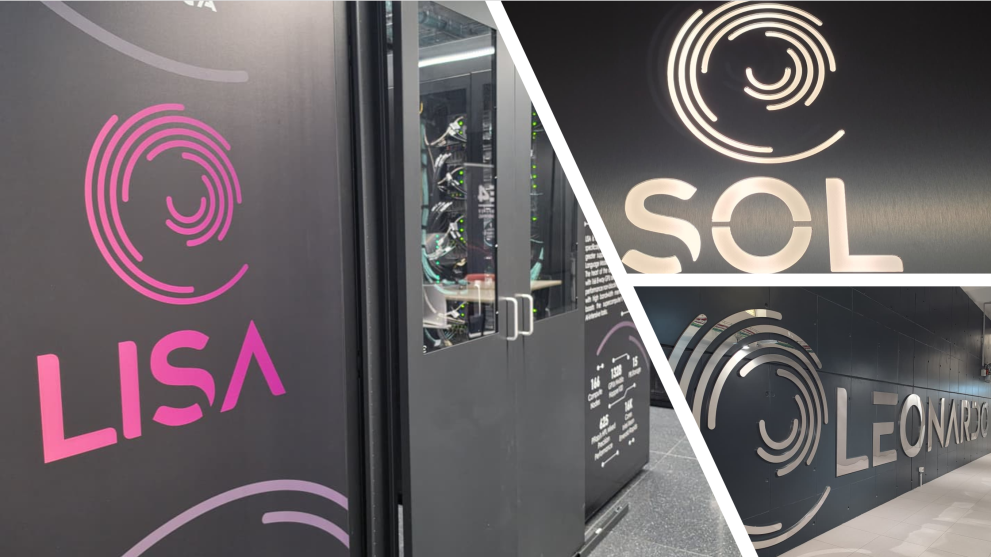
The EuroHPC Joint Venture (EuroHPC JU) has officially launched the SOL quantum computer and the new LISA artificial intelligence computing partition in Bologna, Italy.
The two systems were unveiled at the DAMA Technopole in Emilia-Romagna in a ceremony hosted by CINECA and the Italian Research Center for High Performance Computing, Big Data and Quantum Computing (ICSC).
The launch marks a major investment in Europe’s next-generation computing infrastructure. Both systems are integrated with Leonardo, one of Europe’s leading pre-exascale supercomputers, and are designed to accelerate advances in quantum computing, AI, scientific research, and industrial innovation.
As a result, Europe has gained additional computing capacity aimed at strengthening its technological sovereignty, supporting cutting-edge research and improving access to advanced digital resources for scientists, businesses and public institutions across the continent.
EuroHPC JU Executive Director Anders Jensen believes the two systems will transform Europe’s supercomputing capabilities.
“With SOL, our new EuroHPC quantum computer, and LISA, our AI upgrade to our world-class Leonardo supercomputer, we are further strengthening our sovereign supercomputing ecosystem and giving European users new tools to innovate across AI, HPC and quantum technologies.
“This milestone expands opportunities for research, industry and the public sector, while strengthening Europe’s technological leadership in the strategic supercomputing field.”
A presentation that attracts attention in Bologna
The inauguration ceremony brought together dignitaries from Europe and Italy, including Anna Maria Bernini, Italy’s Minister of University Research, Roberto Viola, Secretary General of the European Commission, and Daniel Opalka, EuroHPC JU representative.
These projects were jointly funded by the European Union and the Italian Ministry of University and Research through ICSC.
Officials described the implementation as another step towards building a globally competitive European computing ecosystem that can support emerging technologies and reduce dependence on non-European infrastructure.
SOL quantum computer adds quantum capabilities to Leonardo
The newly launched SOL quantum computer will be hosted and operated by CINECA and powered by French quantum computing company Pasqal.
Built using neutral atom technology, the system utilizes an array of optically trapped atoms controlled by programmable laser interactions.
The name “SOL” reflects both the system’s laser-based architecture and Italian cultural heritage, drawing inspiration from classical references to the sun and precision.
First generation processors offer at least 140 qubits operating in analog mode. Upgrades planned for 2027 will introduce hybrid analog and digital capabilities, expanding platform flexibility and enabling more advanced computing applications.
SOL is expected to support hybrid quantum-classical workflows by directly integrating quantum resources with the Leonardo supercomputer.
Researchers will be able to explore complex optimization problems, quantum many-body physics simulations, and new machine learning applications that are difficult to solve using traditional computing methods alone.
The system is currently being finalized and is expected to be available to European users during fall 2026.
SOL expands European quantum network
Although quantum computing remains an emerging technology, Europe is rapidly expanding its capabilities through concerted investment.
The SOL quantum computer represents the sixth quantum system procured under the EuroHPC program and further expands the continent’s growing quantum infrastructure network.
Unlike traditional computers, which use binary bits to process information, quantum systems use qubits that can represent multiple states simultaneously.
This approach has the potential to accelerate certain classes of computations related to materials science, pharmaceuticals, logistics, energy systems, and advanced AI research.
SOL will provide European researchers and industry users with access to domestic quantum resources integrated with one of the continent’s most powerful supercomputing environments.
LISA expands Europe’s AI computing capacity
Alongside SOL, EuroHPC also launched LISA, the Leonardo Improved Supercomputing Architecture Partition.
Designed specifically for AI workloads, LISA introduces dedicated AI-focused infrastructure within the Leonardo ecosystem.
The system is designed to meet the intensive compute, memory, and networking demands associated with large-scale language models, generative AI, and multimodal AI applications.
This upgrade includes 166 advanced GPU servers for a total of 1,328 interconnected graphics processors. This significantly increases Leonardo’s ability to train and run complex AI models.
LISA is the first EuroHPC computing partition developed from the ground up specifically for AI applications, reflecting the growing importance of AI in Europe’s digital strategy.
The platform will also support IT4LIA, Italy’s EuroHPC AI Factory initiative aimed at strengthening AI research, innovation and industrial adoption in Europe.
LISA is expected to be operational for users during the summer of 2026.
Europe’s major investment in the future of computing
The SOL quantum computer procurement contract was signed with Pasqal in March 2025 following a competitive bidding process that began in 2024.
The total acquisition cost of the project is EUR 13 million, with funding to be divided equally between EuroHPC JU and the Italian Ministry of University and Research through the ICSC.
On the other hand, deploying LISA will involve a significant investment of around €50 million, covering infrastructure acquisition, installation, operation and support.
EuroHPC currently has six quantum computers deployed across Europe, with systems operating in Poland, Czech Republic, Germany, France, Spain and Italy.
Together, these facilities will form a growing pan-European quantum computing network designed to provide researchers and businesses with access to advanced computational resources.
With the announcement of the SOL quantum computer and LISA, Europe continues to expand its capabilities in two of its most strategically important technology areas: quantum computing and AI.


