
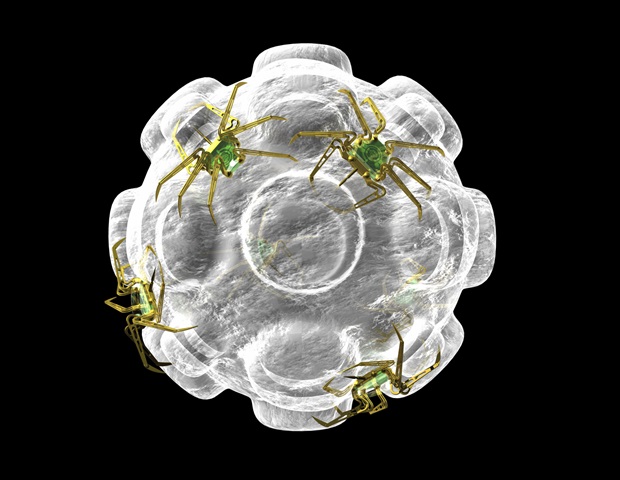
If a tumor successfully colonizes an organism’s brain, it has done something particularly clever from the tumor’s perspective. The virus hides behind the blood-brain barrier, one of the body’s strongest barriers to protect its most vital organs. The blood-brain barrier is a highly selective filter that allows only certain substances to pass through. However, most drugs are not among them. Therefore, finding effective chemotherapy for brain tumors is a major challenge for biomedical research.
In recent years, researchers have discovered a promising ally: nanotechnology. Nanoscale materials can figuratively act as postmen, delivering active ingredients to the right address. Nanoparticles are so unimaginably small—about 500 times smaller than the diameter of an average human hair—that some can pass through the body’s protective barrier without damaging them. Sticking with the brain tumor example, nanoparticles could potentially transport chemotherapy drugs across the blood-brain barrier and fight brain tumors there.
In search of suitable nanomaterials
However, depending on the task they need to perform, nanoparticles must have very specific properties. Depending on their shape, material composition, and size, nanoparticles have highly variable distribution within the body and accumulate in different organs. Therefore, it is important to find out which particles perform their role to the maximum and cause as little damage as possible. Until now, researchers have primarily used mouse models to answer these questions. We administered various types of nanomaterials to mice and investigated how they were distributed in the mice’s bodies and what side effects they caused. However, these animal experiments are not only complex, time-consuming and expensive, but also raise ethical issues. It is not without reason that the Swiss Animal Welfare Act requires that the number of animal experiments carried out be kept to the minimum necessary.
AI mouse with decisive advantage
So Empa researcher Jimeng Wu, a PhD student in Empa’s Nanomaterials in Health and Technology and Society labs, developed a virtual mouse that uses AI to perform these tests in a more time-efficient manner. Wu based this so-called physiologically-based pharmacokinetic model (PBPK model) on data from 18 mouse studies, experiments conducted by different research teams on living mice. She also integrated a statistical method into the model: Bayesian analysis with Markov chain Monte Carlo simulations.
The result is a virtual mouse that can administer nanoparticles. The model then calculates their distribution within the mouse body based on properties such as size, coating, and surface charge. Compared to traditional PBPK models, which are calibrated against a single substance at a time, Wu’s AI mouse has a decisive advantage. “The model can adapt its parameters to the measurable properties of each nanoparticle,” explains Jimeng Wu. This feature of the tool is due to the multivariate linear regression model, which is a machine learning approach.
Contributing to safety and sustainability through design
“This AI-supported screening tool allows researchers to virtually test which types of nanoparticles are best suited for a particular task before manufacturing the particles,” explains Jimeng Wu. This saves not only time but also money by supporting decision-making before starting expensive clinical trials.
“This model therefore contributes to the concept of safe and sustainable design (SSbD),” added Peter Wick, who along with colleague Bernd Novak is supervising Jimen Wu’s doctoral thesis. This is because virtual mice improve the safety of new materials and treatments even before they are developed. However, he points out that the datasets used to train the models are still very limited. So far, only 18 peer-reviewed papers with sufficient data quality have been found. “Many studies do not describe the properties of the nanoparticles used in sufficient detail,” he points out. The task here is to feed the virtual mouse with additional research data to validate it in order to further increase the reliability of the predictions. “Our long-term goal is to shorten the process from the development of nanomedical materials to their use as medicines in patients, ideally avoiding animal testing,” he emphasizes.
Adapting models to human disease
Jimeng Wu’s future research will also focus on so-called “bridge strategies” to transfer the principles of her in silico models to human studies. To achieve this goal, she plans to embed the virtual mouse principle into a human PBPK model. Unlike her simulated mouse, which only calculates the distribution of nanoparticles within the liver, kidneys, lungs, and spleen, the human in silico model can also be used to study sensitive target organs, for example to investigate the extent to which a particular nanoparticle can cross the blood-brain barrier. Even the brain tumor mentioned at the beginning will no longer feel safe on the other side of this barrier. Nanoparticles could act as “postmen” and deliver packages containing targeted doses of chemotherapy.
sauce:
Reference magazines:
Wu, J. Others. (2025). Data-driven prediction of nanoparticle biodistribution from physicochemical descriptors. ACS Nano. DOI: 10.1021/acsnano.5c03040. https://pubs.acs.org/doi/10.1021/acsnano.5c03040


