
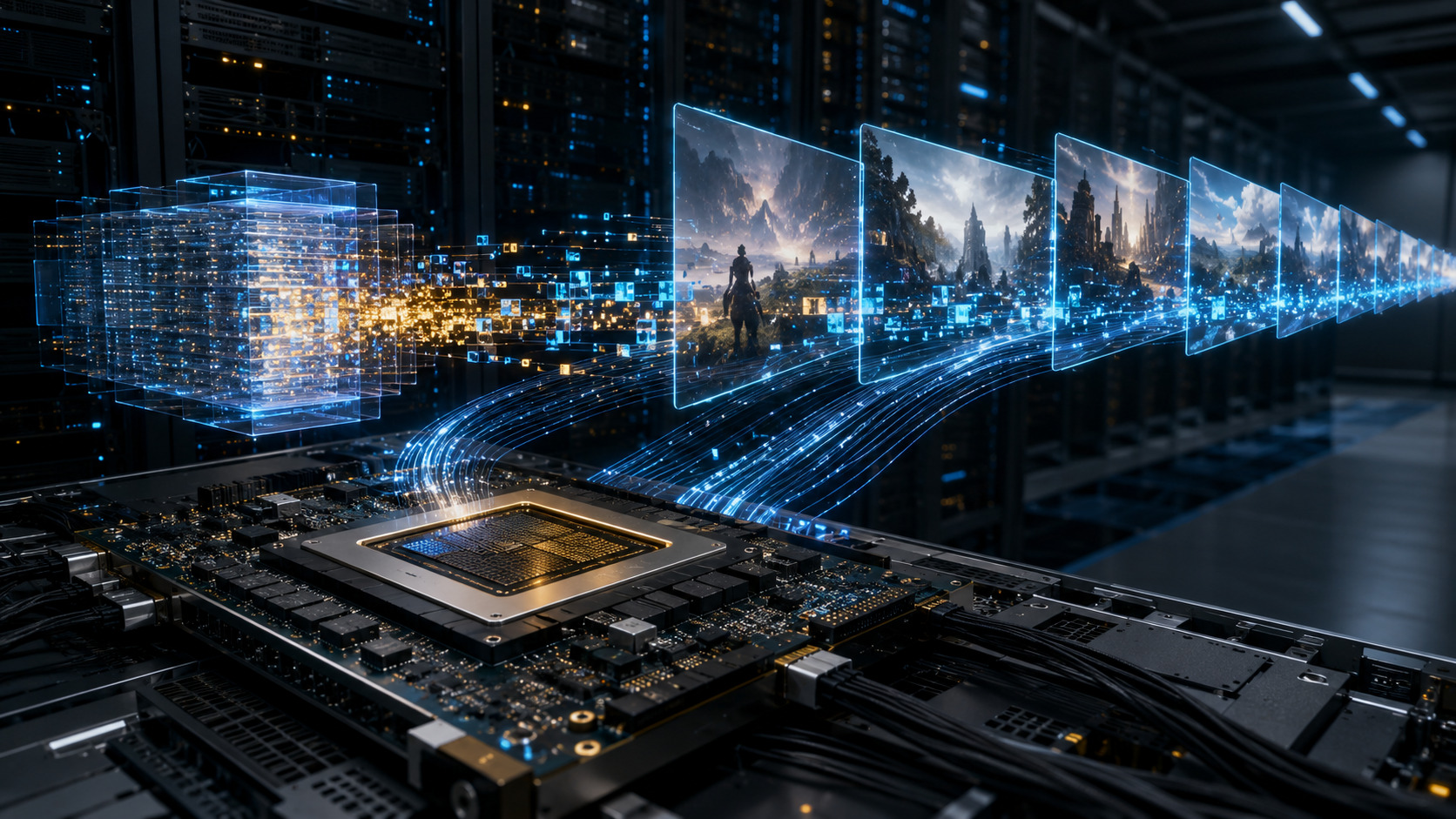
NVLabs has updated LongLive 2.0 to advance infrastructure, a technology-defining topic where AI video generators often pale in comparison to the finished clip. The main goal of this project is not to show you the next attractive demo video, but to help you train and run the generation of long, interactive, multipart videos more efficiently. At the heart of this is NVFP4. NVFP4 is a 4-bit floating point format that plays a central role in this system for training, inference, and KV caching.

Current GitHub status lists NVFP4 inference path optimizations for May 25, 2026. This includes a unified Triton kernel for RoPE and adaLN, reduced KV cache synchronization overhead, in-place updates for quantized cache data, faster FP4 dequantization, optimized VAE forwarding, and a more secure workflow for LoRA before quantization. According to the repository, this aims to increase overall throughput by 18.6%. This is not a new consumer app or a finished cloud service, but rather a classic deep dive job in the machine room. Indeed, performance is barely visible in press images, but it ultimately shows up in your electricity bill. According to the project page, LongLive 2.0 itself is introduced as “NVFP4 Parallel Infrastructure for Long Video Generation.” For training, the system relies on balanced sequence parallelism for autoregressive training, NVFP4, and a pipeline that processes long multipart videos more directly. For inference, we combine W4A4 execution, NVFP4 compressed KV cache, parallel dequantization, and asynchronous VAE decoding. Therefore, this approach treats the model, memory path, cache, and decoding as a connected system rather than treating them separately. This is very important for long videos because not only does the diffusion itself perform the computation, but the context, intermediate storage, and video output also keep increasing. Reported numbers are equally important, but must be carefully categorized. The project page cites 2.1x faster AR training in 64 seconds compared to BF16 with sequence parallelism, 45.7 FPS on GB200 with two-stage generation, and 19.4 GB of peak memory with NVFP4 KV cache. In this paper, LongLive 2.0 is described as an end-to-end NVFP4 system for training and inference. Up to 2.1x training acceleration and 1.8x inference acceleration are reported.
While this sounds strong, it is not a blanket endorsement for all GPUs in enthusiast systems. The authors themselves point out that the most important limitation is that NVFP4’s speed advantage is hardware dependent. Blackwell GPUs such as the GB200 benefit from accelerated NVFP4 inference due to the availability of corresponding Tensor Cores and optimized kernels. Older architectures such as A100 and H100 do not have this native support for the corresponding optimized paths. For non-Blackwell systems, sequence-parallel inference remains an alternative, but the real appeal of NVFP4 clearly lies in the new hardware generation. This is an inconvenience for owners of expensive older accelerators, but technically it’s not surprising. New number formats will only be faster if they are supported on the silicon side. LongLive 2.0 is therefore less interesting as a standalone research project and more as an indicator of market direction. Long AI videos fail not only because of model quality, but also memory requirements, latency, cache growth, and throughput. If you want to generate minutes instead of seconds, you need to preserve context, handle scene changes, and be fast enough so that the results don’t become a test of your patience. NVFP4, KV cache compression, and parallel decoding are not marketing terms for end users, but are building blocks of what is later sold as “smooth video generation” in data centers. Often the trick starts with reducing the number of bits.
conclusion
LongLive 2.0 is not a complete video platform; it is an infrastructure component derived from research. That’s exactly why this report is important. The combination of NVFP4, W4A4 inference, KV cache compression, and Blackwell-oriented optimizations shows that AI hardware and software are moving in tandem. This means less memory, more throughput, and more specialized compute paths. For ordinary users, little has changed today. However, for developers of data centers and long AI videos, this is a pretty clear signal. The next performance step will come not just from larger models, but from more aggressive system optimization.


