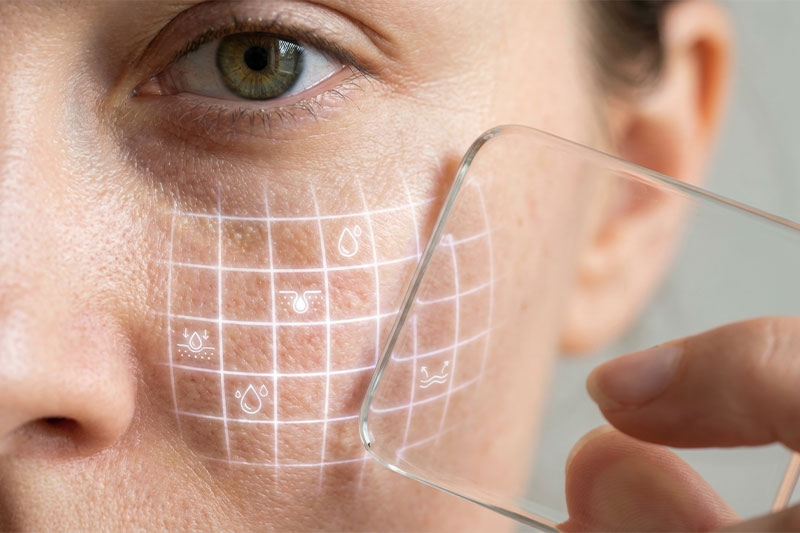
Today’s AI-powered skin analysis tools can scan a selfie, identify concerns invisible to the naked eye, and match a shopper to the right products in seconds. For beauty brands and retailers, that translates directly into fewer returns, higher basket sizes, and customers who come back.
Which are some of the leading AI skin analysis tools shaping skincare in 2026, and how are they being used across the industry?
5 AI Skin Analysis Tools Worth Knowing in 2026
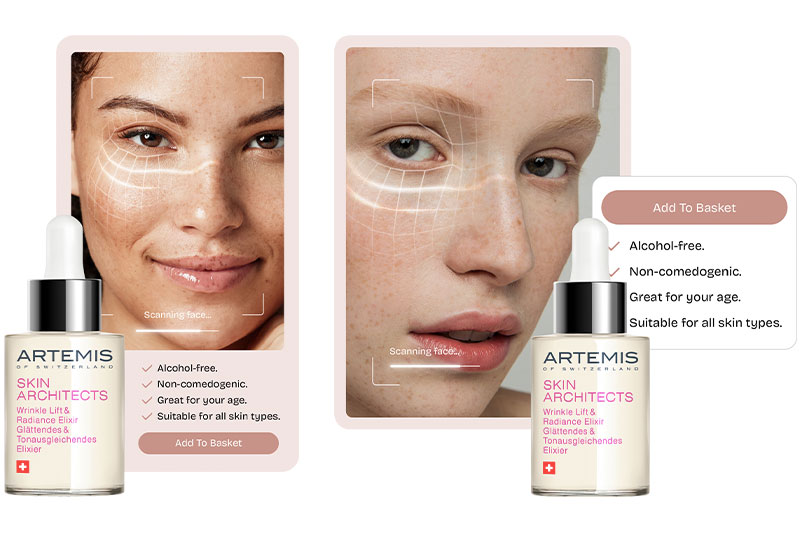
The AI skin analysis market is growing fast, valued at USD 1.61 billion in 2025 and projected to reach USD 7.75 billion by 2035, according to Metatech Insights. Rising skin health awareness, demand for non-invasive solutions, and rapid advances in AI and computer vision are all accelerating adoption. Here are five tools leading the way.
1. Inference Beauty – Skin Match Technology
A B2B AI skin analysis tool that uses face scanning and a customisable quiz to match customers to the right skincare product, based on their skin type, sensitivities, needs, and ingredient preferences.
Key Features:
- Ingredient-deep product matching: Built on a database of 60,000+ decoded ingredients, developed alongside dermatologists and allergists. Every recommendation is matched at the ingredient level, ensuring accuracy across diverse skin concerns and sensitivities.
- Extensive product database coverage: Backed by a database of 150K+ products, allowing quick integration with large retailer inventories and immediate, scalable product matching across extensive catalogues.
- All recommendations explained: Customers don’t just get a product suggestion; they get a reason why. This transparency builds trust, reduces hesitation, and meaningfully improves conversion at the point of recommendation.
- Customisable quiz and design: A tailored quiz uncovers each customer’s unique skin needs and preferences to recommend a complete, personalised skincare routine.
- Plug-and-play integration: A single copy-paste of the provided code is all our skin match technology takes to go live on any website platform. Inference Beauty handles the full inventory matching in the background.
- Real-time analytics dashboard: Brands get direct access to a dashboard showing what skin concerns their customers are trying to solve, their pricing sensitivity, and which products perform best.
|
|
|
|
|
|
|
|
|
|
|
|
|
|
|
|
|
|
|
|
|
Best For: Beauty retailers with extensive inventories and skincare brands that want to simplify product discovery using ingredient-level matching and extend personalisation to product detail pages (PDPs) for more relevant, conversion-focused experiences.
Website: https://inferencebeauty.com/skincare-finder/
Client Case: Kiehl’s Partnered with Inference Beauty for Personalised Matching
Kiehl’s implemented a Skincare Finder quiz powered by Inference Beauty to improve product discovery and personalisation online. They were facing growing expectations for personalised content, with up to 74% of shoppers disengaging from non-tailored experiences, and customers struggling to find products suited to their specific skin needs.
The solution used a 6-question quiz to match users’ skin types and concerns to a curated set of 60 products, generating a simplified 5-step routine. Based on this input, product detail pages (PDPs) were personalised to show more relevant recommendations and clearer product relevance. This approach helped users navigate a complex catalogue with better guidance and resulted in a 30% increase in conversion, with around 750 users completing the quiz daily.
2. Perfect Corp.
Trained on over 70,000 medical-grade images and backed by 10+ years of AI model development, turning facial skin data into personalised recommendations and actionable business insights.
Key Features:
- Detects 15+ skin concerns in a single scan, including wrinkles, acne, pores, redness, texture, oiliness, dark circles, eye bags, moisture levels, and firmness, using 180° full face mapping for comprehensive coverage.
- Offers both HD and SD analysis modes: HD delivers ultra-precise diagnostics trained on twice the resolution of standard imagery; SD provides reliable overall skin assessment via photo and live camera.
- Combines skin analysis results with AI recommendation models to generate tailored skincare routines and product suggestions aligned to each user’s unique skin condition, improving product relevance and conversion rates.
- SkinGPT AI beauty agent delivers real-time, personalised skincare consultations through conversational chat, helping brands drive engagement and conversion through interactive shopping experiences.
- API and SDK designed for fast, scalable deployment across websites, mobile apps, and enterprise platforms, with real-time image processing and customisable outputs.
Best For: Skincare brands, dermatology clinics, and eCommerce platforms that need a scalable, clinically detailed skin diagnostics engine, with the flexibility to integrate across digital touchpoints and the data infrastructure to turn skin analysis into long-term business intelligence.
Website: https://www.perfectcorp.com/
3. Haut.AI
Built for beauty and skincare brands, trained on over 3 million data points and 150+ multidimensional facial biomarkers to deliver clinically accurate, personalised skincare recommendations.
Key Features:
- Analyses 15+ essential skin health metrics, including wrinkles, pores, pigmentation, and hydration, using 94 algorithms trained on over 3 million images for 98% accuracy across all skin tones, ages, and ethnicities.
- Evaluates 150+ multidimensional facial biomarkers through a Smart Camera module that guides users to capture high-quality selfies, then processes facial zones individually for precise, secure analysis.
- Generates personalised skincare routines and product recommendations based on each customer’s unique skin analysis results.
- No-code, plug-and-play integration embeds into any e-commerce site or in-store experience via a small piece of code, with automatic inventory sync for Shopify and WooCommerce, and white-label API access for fully customised deployments.
- Supports in-store and online experiences from a single platform, giving beauty brands a consistent, consultative skin analysis journey across every customer touchpoint.
Best For: Beauty and skincare brands that want a skin analysis tool they can add to their website without any coding, and see a direct impact on sales and order value.
Website: https://haut.ai/
4. Revieve
Trusted by 60M+ users across leading global beauty brands, delivering dermatologist-grade skin diagnostics and personalised skincare recommendations.
Key Features:
- Analyses 200+ facial and skin health metrics instantly, covering ageing, hydration, pigmentation, sensitivity, skin type, and zone-specific evaluation (T-Zone, Cheek-Zone, U-Zone), with the flexibility to create custom, brand-specific metrics.
- Developed by PhD-level AI and dermatology experts, and validated against professional dermatologist tools for clinical-grade accuracy.
- Real-time selfie guidance adjusts automatically for lighting, eyeglasses, and facial positioning, ensuring consistent, high-accuracy results across every user, every time.
- Fully customisable skin metrics allow brands to build diagnostics aligned to their unique skincare philosophy, going beyond fixed, pre-set outputs that competitors offer.
Best For: Beauty brands that want skin diagnostics with the flexibility to create custom, brand-specific skin metrics tailored to their customers’ needs.
Website: https://www.revieve.com/
5. Skinive AI
A CE-marked AI skin analysis app trusted by dermatologists and consumers alike, providing 24/7 skin condition screening.
Key Features:
- Detects and risk-rates 55+ skin conditions, including acne, eczema, psoriasis, dermatitis, HPV, fungal infections, and skin cancer indicators, giving users a clear understanding of whether to seek professional consultation.
- AI-powered real-time camera guidance helps users capture the best possible photo for accurate analysis, ensuring consistent results regardless of user experience or device.
- 3D full body mole-mapping increases documentation accuracy and speed, particularly valuable for tracking changes in moles and skin lesions over time.
- Serves patients, doctors, and developers from a single platform, supporting home self-screening, clinical diagnosis assistance, and API integration into digital healthcare and beauty apps.
- CE-marked medical software with over 1 million satisfied users and a 4.8 average rating, with 6M+ skin checks completed and counting.
Best For: Patients looking for at-home skin screening, doctors seeking AI-assisted diagnosis support, and health providers wanting to integrate clinically trusted dermatology AI into their digital platforms.
Website: https://skinive.com/
How Do AI Skin Analysis Tools Compare Across Key Features
|
|
|
|
|
|
|
|
|
|
|
|
|
|
|
|
|
|
|
|
|
|
|
|
|
|
|
|
|
|
|
|
|
|
|
|
|
|
|
|
|
|
How Does AI Skin Analysis Actually Work
AI skin analysis tools use computer vision and machine learning to assess a person’s skin condition from a photo or live camera feed, identifying concerns, building a personalised skin profile, and recommending the right products, all in a matter of seconds. Here’s how the process works step by step:
- Image Capture: The process starts with a selfie or photo upload. The tool guides users in real time, adjusting for lighting, angle, and positioning, to ensure the image is good enough for accurate analysis. Some tools use live camera mode; others work from a static photo.
- Skin Analysis: Once the image is captured, AI models scan the face across multiple zones, forehead, cheeks, T-zone, under-eye area, detecting concerns like wrinkles, acne, pores, pigmentation, redness, and hydration levels. Results are delivered in seconds.
- Profile Building: Detected skin concerns are combined with additional inputs, such as lifestyle, sensitivities, budget, and product preferences, to build a complete picture of the customer’s unique skin needs. This is where a basic diagnostic becomes a truly personalised experience.
- Product Recommendation: The skin profile is matched against a product database to surface the most relevant recommendations, explained clearly so customers understand exactly why each product suits their skin.
- Learning Over Time: As users interact, rate products, and repurchase, the system learns and refines its recommendations, giving brands increasingly rich data about their customer base.
How Do AI Skin Analysis Tools Differ in Technical Capabilities and Integration
|
|
|
|
|
|
|
|
|
|
|
|
|
|
|
|
|
|
|
|
|
|
|
|
|
|
|
|
|
|
|
|
|
|
|
|
|
|
|
|
|
|
|
|
|
|
|
|
|
|
|
|
|
|
|
|
|
|
|
|
|
|
|
|
|
|
|
|
|
|
|
|
|
|
|
|
|
Trends Shaping AI Skin Analysis in 2026
- Ingredient Transparency Is Driving Purchase Decisions: Shoppers are moving past surface-level recommendations. They want to know exactly which ingredients address their skin concerns and why, and brands that deliver this clarity are converting better and retaining longer.
- AI Skin Analysis Is Going Omnichannel: Leading brands are deploying skin analysis across websites, mobile apps, and in-store kiosks, creating one consistent, personalised experience across every touchpoint a customer interacts with.
- Cross-Category Discovery Is Expanding Basket Size: A single skin scan is increasingly powering recommendations across skincare, haircare, makeup, and wellness in one session, turning a diagnostic tool into a full-catalogue revenue driver.
- Skin Analysis Is Converging with Healthcare: CE-marked tools capable of detecting medical skin conditions are blurring the line between beauty and dermatology, creating new opportunities in telehealth, digital pharmacy, and health-focused beauty.
- Predictive AI Is Replacing Reactive Diagnosis: The shift from identifying current skin concerns to simulating future outcomes is underway. Predictive skin modelling gives customers a reason to commit, and gives brands a more powerful way to communicate product efficacy.
Conclusion
AI skin analysis is no longer optional for beauty brands serious about personalisation. The right tool depends on your use case, whether that’s driving retail conversion, building clinical credibility, or scaling across the enterprise. What’s clear is that customers now expect recommendations tailored to their skin, and the brands delivering that experience are the ones pulling ahead.