NVIDIA launched an AI research lab in Singapore, and Google expanded its partnership with the government to support the city-state’s ambitions to become an AI hub.

At this year’s ATxSummit, the Singapore government announced the expansion of key partnerships with NVIDIA and Google as part of its national AI strategy to deploy AI at scale, drive enterprise innovation, and strengthen the workforce.
NVIDIA will collaborate with university researchers, industry partners, and government agencies to establish an AI research lab in Singapore focused on advancing embodied and efficient AI.
The lab is NVIDIA’s Singapore hub and second research location in the Asia Pacific region.
This lab explores potential applications in manufacturing, including using AI to enable intelligent systems to perceive, reason, and act on the physical world. We will also find ways to optimize models and infrastructure to reduce compute costs, improve energy efficiency, and support scalable AI deployments.
“Ideas developed in the lab do not always work well in a real factory environment,” said Singapore’s Digital Development and Information Minister Josephine Teo in her opening keynote address at ATxSummit 2026.
“To see real-world impact, we need collaborators in the hardware, software, and operational domains. This is why we welcome NVIDIA’s new lab in Singapore, which is focused on embodied and efficient AI.”
“This strengthens NVIDIA’s existing infrastructure in Singapore, deepens the AI talent ecosystem, and unlocks new sources of innovation.”
Google drives R&D and corporate innovation
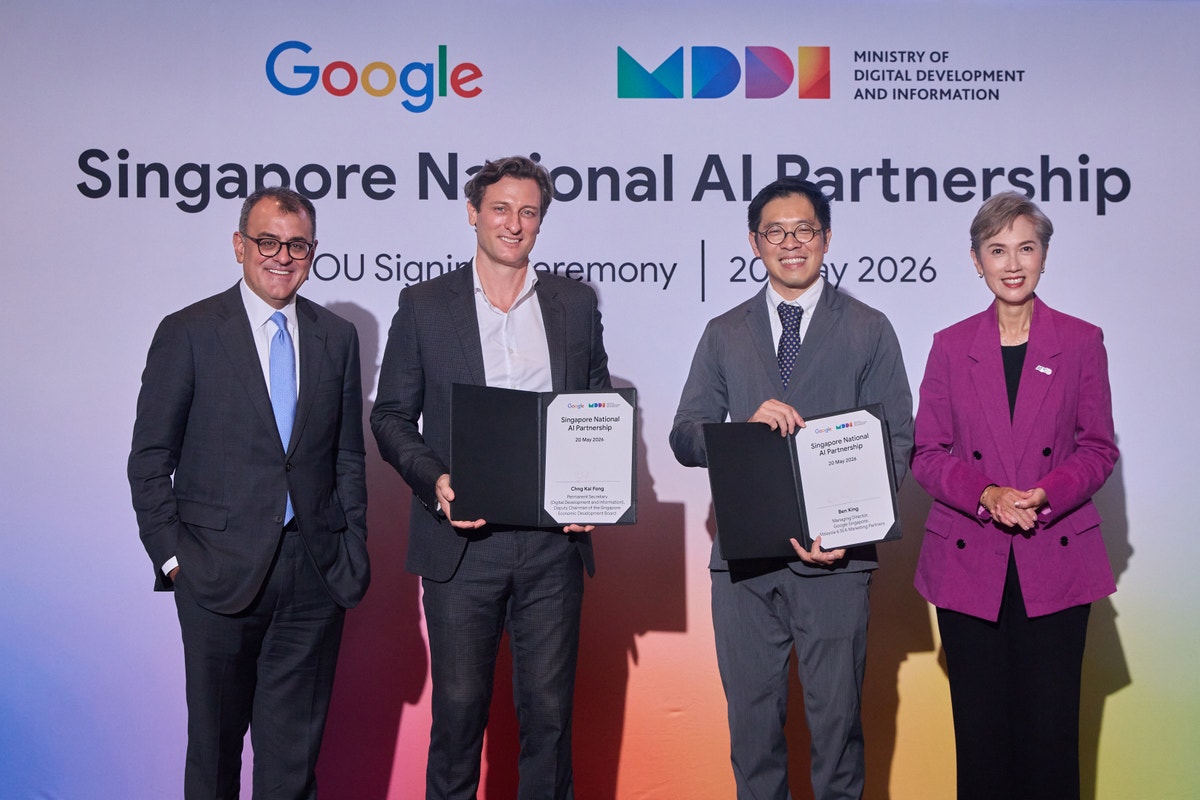
Additionally, the Ministry of Digital Development and Information (MDDI) has expanded its collaboration with Google to accelerate the adoption of frontier AI in Singapore. The new AI partnership builds on a Memorandum of Understanding (MOU) signed with Smart Nation and Digital Government Group in 2022.
Through this collaboration, Google aims to drive innovation for growth across the company and the local startup ecosystem. Following the launch of the Singapore Engineering Center, Google Cloud’s expanded team of engineers will help Singapore-based companies accelerate and scale their agent-powered enterprise transformation. This new partnership also builds on Google Cloud’s ongoing efforts with multiple public authorities.
Additionally, Google will accelerate the use of Google DeepMind across Singapore’s public sector and research institutions to deploy frontier AI models, starting with the health and life sciences sectors.
For example, as part of the Global AI Collaborative Clinical Research Initiative, Google DeepMind will work with public health clusters to explore ways to use AI to deliver higher quality care. Google DeepMind is also partnering with the National Research Foundation (NRF) to train local researchers on agent AI tools for science.
Google is also expanding its collaboration with the Department of Education to strengthen its AI capabilities across teaching and learning, including educator training and upskilling programs.
Google also launched a joint whitepaper to discuss the findings of the AI Agents Sandbox and share best practices for AI governance. The whitepaper shares recommendations on how agents can safely and efficiently perform tasks such as software testing.
This document was produced in collaboration with the Cybersecurity Authority of Singapore (CSA), the Government Technology Agency of Singapore (GovTech Singapore), and the Information and Communications Media Development Authority (IMDA).
As Singapore moves forward with its national AI strategy, focus now shifts to deploying frontier AI to “accelerate real-world impact for the country”, said Ben King, Country Managing Director, Google Singapore.
“Through our expanded partnership with the Singapore government, we are combining the best of technology, R&D expertise and local talent to bring AI to life and accelerate AI for the public good. This also creates a scalable blueprint for responsible AI innovation.”