
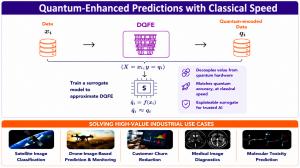
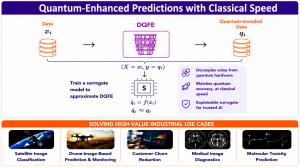
Describing an offline DQFE pipeline, quantum features are extracted once, surrogates are trained, and inferred at classical speeds across high-value industrial use cases.
Kipu Quantum’s quantum feature surrogate framework delivers peer-reviewed ML accuracy improvements on IBM hardware and can be deployed at traditional speed, cost, and scale.
BERLIN, Berlin, Germany, May 20, 2026 /EINPresswire.com/ — Kipu Quantum today released a new hybrid quantum-classical framework. This allows quantum-enhanced machine learning models to be trained on quantum processors and fully deployed on classical hardware, giving companies the speed, cost, and operational profile they need for their production pipelines.
Quantum feature extraction has achieved significantly richer data representations than classical feature engineering across multiple peer-reviewed studies and has been validated by Kipu Quantum and others on IBM quantum processors, including the 156-qubit IBM Quantum Heron r2 processor.
Current workflows can be slowed down by queue time. A new framework developed by Kipu Quantum changes the ability to extract useful features. The quantum processor is only used in a targeted training phase to learn the correlations that quantum feature extraction is uniquely good at. These quantum-derived representations are transferred to lightweight classical surrogate models. From that point on, the deployment becomes completely classic. With microsecond inference latencies, it can be retrained with regular MLOps cadence and is managed under the same procurement conditions as classical models. In reality, quantum processors run on just 20% of classical training data (a representative subsample) and achieve the same accuracy at one-fifth the quantum hardware cost. This ratio improves further as the amount of data increases. This is possible because quantum feature mappings are stable and reproducible across hardware backends. This is because classical models learn mappings from a manageable set of training samples and are consistent enough to generalize reliably at scale.
In the process, the role of quantum computers will also change. It is no longer an expensive real-time inference engine, it is used once, adds unique value, and then removed from production systems.
The predictive lift provided by quantum feature extraction is maintained. The cost, delay, and operational profile of the deployed model collapses into a classic one.
The framework has been demonstrated across commercially important workloads, delivering approximately 10% accuracy improvement in molecular toxicity classification, 0.932 AUC versus 0.866 ResNet-50 baseline in medical imaging, and 3% improvement in satellite imagery, all strong classical baselines, with further validation across industrial monitoring, predictive analytics, and customer churn reduction. In the satellite benchmark, the surrogate model accurately matched the full quantum results, achieving 87% accuracy compared to 84% for the traditional baseline. This work is part of Kipu Quantum’s Rimay product suite within the company’s quantum machine learning platform.
We are grateful for the trust and cooperation of our partners and customers who have worked closely with us to implement our findings into real-world industry environments, and what they are building with them.
Scott Crowder, Vice President of IBM Quantum Implementation — IBM Quantum:
“…a cost-effective way to run hybrid QML workflows…IBM quantum hardware efficiently delivers accurate results across a wide range of applications. We expect this to increase interest from industry in the types of problems that quantum computing can solve.”
Andre Koenig, CEO of Global Quantum Intelligence:
“Kipu’s offline surrogate framework delivers economical quantum benefits by capturing the 2-3% absolute accuracy improvement of quantum processors while running inference entirely on classical hardware. By processing only small subsamples that are representative of real quantum hardware, the framework reduces expensive quantum execution by more than a fifth.”
Rika Nakazawa, Chief of Commercial Innovation — NTT Data:
“…quantum derived representation using the classical infrastructure that enterprises already own and trust…measurable accuracy improvements, zero quantum dependencies during inference, and seamless integration into existing operational pipelines. We are ready.”
Estela Vilches, Head of Digital Innovation — MOEVE:
“Through the Kipu Quantum Hub platform, we are achieving a promising milestone that allows us to optimize classical models in image classification for predictive maintenance… employing hybrid classical and quantum techniques for early detection of problems in energy parks.”
Aaron Kemp, Senior Director of Quantum Research and Corporate Innovation — KPMG US:
“The scope of this technology is intentionally broad and industry agnostic…From satellite image classification and advanced customer analytics to rapid screening of drug candidates, Kipu’s approach enables companies to leverage the unique computational advantages of quantum systems across a portfolio of today’s data-intensive challenges.”
Enrique Solano
Kip Quantum
please email here
Visit us on social media:
linkedin
Legal disclaimer:
EIN Presswire provides this news content “as is” without warranty of any kind. Our company does not assume any responsibility or liability
The accuracy, content, images, videos, licenses, completeness, legality, or reliability of the information contained herein;
article. If you have any complaints or copyright issues related to this article, kindly contact the author above.


