
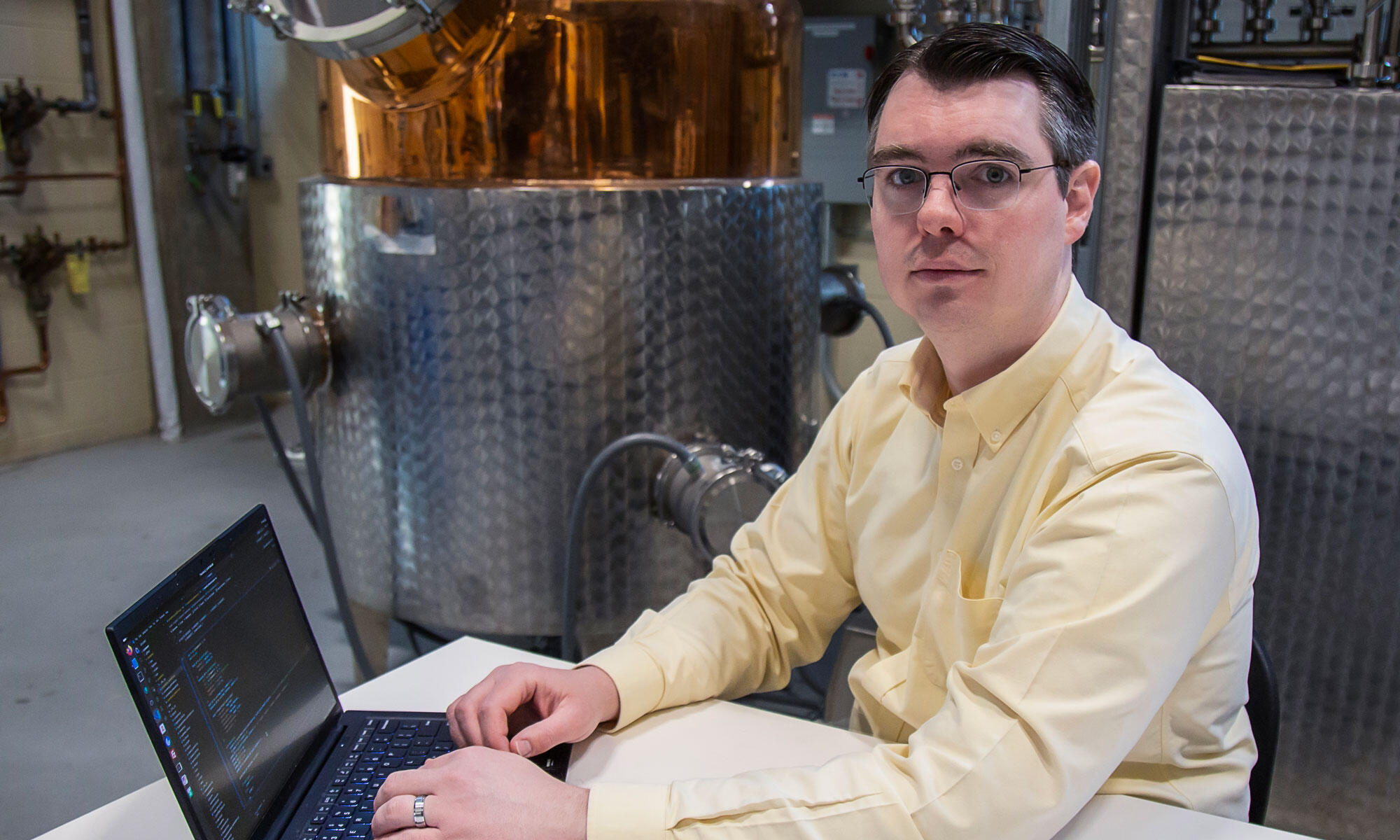
Dr. Charles McGillis not just improving drug manufacturing. He and other Virginia Commonwealth University engineering faculty members are upending decades of tradition to find a better way.
Historically, developing new or modified manufacturing processes for small molecule drugs has been so expensive and time-consuming that many companies fear making major changes and stick to known methods to avoid unexpected failures.
To break this cycle, McGill, an assistant professor in the School of Chemical and Life Sciences Engineering, uses machine learning, a field of artificial intelligence that allows computers to learn from data, identify patterns, and make decisions and predictions with minimal human intervention.
McGill’s AI models serve as a “first look,” allowing researchers to explore a vast array of chemistry options, from new solvents to optimized temperature settings, before a single drop of liquid touches the lab.
“We see machine learning as a way to evaluate a wider range of options,” McGill said. He originally started out manufacturing optical fibers, then shifted his focus to computational chemistry in graduate school and then machine learning chemistry. “This frees up the development process to create faster, cheaper, and more optimal pipelines.”
For pharmaceutical companies, a more streamlined development process means organizations can easily pivot, lowering the barrier to entry into new processes and giving teams greater flexibility in planning and execution.
McGill’s research focuses on two key pillars of small molecule medicine.
- Characteristic prediction: Tools like ChemProp, an open-source software of which McGill was the lead developer when working with MIT’s William Green group, allow his team to predict how molecules will behave. It is already being used around the world to explore the solubility of new classes of antibiotics and drug-like molecules.
- Process optimization: McGill currently focuses on separation and purification, particularly distillation. His group builds models of vapor-liquid equilibrium to help determine the most efficient way to purify pharmaceuticals. This step is often the most resource-intensive part of manufacturing.
McGill’s research has been made possible thanks to important collaborations including: Dr. Thomas D. RoperQingguo Xu, Director of Pharmaceutical Engineering and Professor in the College of Chemistry and Life Sciences Engineering at the Engineering Foundation, and Qingguo Xu, Brick Scholar and Professor of Pharmacy in the VCU School of Pharmacy. All three faculty members are members of VCU’s Center for Pharmaceutical Engineering and Science. The center is a collaboration between the School of Engineering and the School of Pharmacy to address emerging drug development and manufacturing needs.
Several undergraduate students contributed to this research, as well as Zaher Alam, a PhD student pursuing his Ph.D. in Chemical and Life Sciences Engineering from VCU, with a focus on implementing computation and machine learning in the pharmaceutical industry. Starting in January 2026, Alam will join Johnson & Johnson for an internship in the Process Science Modeling and Data team, working on distillation modeling and complex thermodynamics.
McGill utilizes the VCU High Performance Research Computing Core Facility for his work. This is a centralized university resource managed by the Faculty of Engineering that provides the large-scale computing power needed to run complex simulations. It is impossible for a single laboratory to sustain this scale of computing on its own.
This type of facility not only benefits faculty; It will serve as a training ground for students to learn how to meet the challenges of “big data,” which is now the norm at industry giants such as AstraZeneca, Eli Lilly, and Merck. As pharmaceutical companies pour billions of dollars into Virginia’s manufacturing industry, the need for a knowledgeable workforce has never been greater. McGill is at the forefront of this mission, working to ensure that VCU students become more than just engineers, they become leaders in the digital transformation of their industries.
“Chemical engineering students go into a variety of fields, including energy and petrochemistry,” McGill said. “Pharmaceuticals aren’t always on the radar of undergraduate students, but VCU’s location in the heart of Virginia’s growing pharmaceutical hub gives our students a distinct advantage. Thanks to our deep ties to industry, our students are more aware of and better prepared for these opportunities. It’s an exciting time for chemical engineers to be involved in this industry.”
this story first published Found on the Faculty of Engineering website.
Subscribe to VCU News
Subscribe to VCU News at newsletter.vcu.edu and get hand-picked articles, videos, photos, news clips and event listings delivered to your inbox.


