
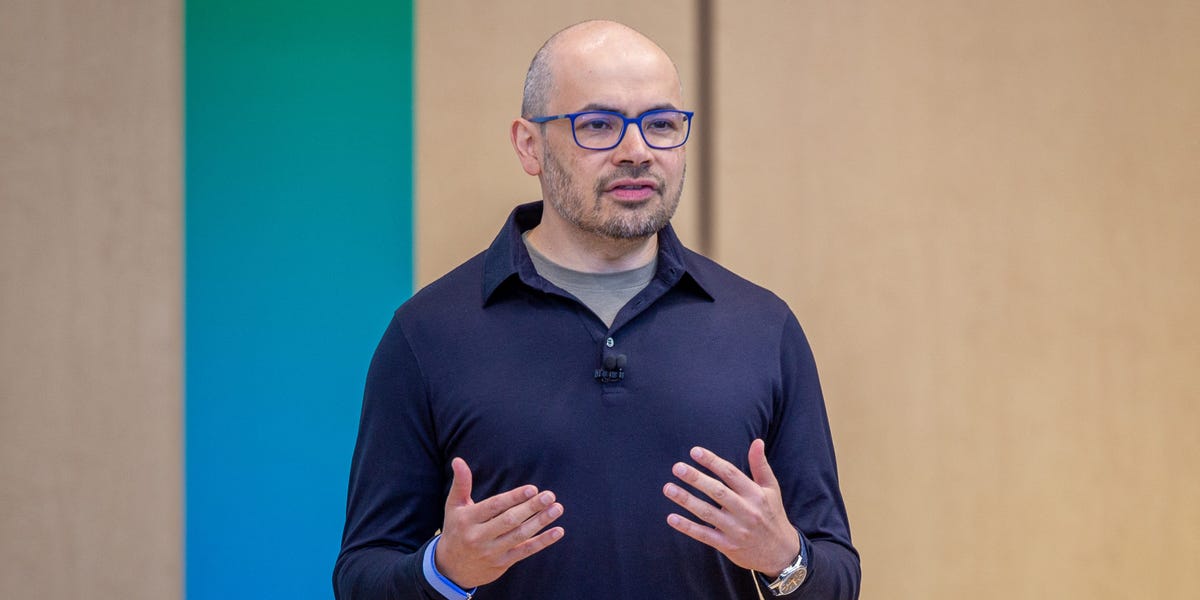
Google’s massive spending on AI is paying off, and it was evident at I/O 2026.
On Tuesday, the tech giant unveiled cutting-edge products like the AI agent Spark, which brings it closer to its goal of providing a super-intelligent assistant to billions of users.
It also highlighted the sudden rise in popularity of the company’s AI products and significant advances in technology such as AI video generation.
All that progress comes with risks. Google’s head of AI, Demis Hassabis, said humanity is moving closer and closer to the “singularity,” the moment when AI begins to improve itself and surpass human intelligence.
Google also isn’t as dominant in the AI space as it would like. The company’s biggest new model, the Gemini 3.5 Pro, has not been released as quickly as many expected, and it is not yet at the cutting edge of areas of focus such as AI coding.
Now that the first day of the conference is over, here are five key takeaways.
Singularity is coming
Perhaps the most memorable quote from the conference was from Mr. Hassabis.
“If you look back at this time, you’ll realize that we were standing at the foot of a singularity,” he said in his keynote address at I/O.
Hassabis said this is a good thing, contradicting those in Silicon Valley who argue that AI will eventually harm or even wipe out humanity.
“This technology will double human ingenuity and usher in a new golden age of scientific discovery and progress that will improve the lives of everyone everywhere,” he said.
Some in the audience gasped at the sweeping statement. One AI startup founder I spoke to afterwards said he took a photo of Hassabis the moment he made his statement for posterity.
As evidence of AI’s potential, Hassabis touted Google’s new Gemini for Science, a suite of AI tools aimed at enhancing scientific research. Hassabis is a strong supporter of the use of AI in science, for which he won the Nobel Prize in 2024.
Google overhauls search
It wouldn’t be an I/O conference without a series of new AI product announcements. Google isn’t slowing down on this front, announcing Spark, a new AI agent that can connect to your email and perform tasks without leaving your laptop open.
Google announced Gemini Flash 3.5, a new AI model that is optimized and especially cost-effective for AI agents.
The tech giant also announced the biggest overhaul ever of its major cash cow, Google Search. The latest AI mode features are added directly to the search box, allowing new agents to search for users in the background.
Gemini 3.5 Pro is not ready yet
One bummer that got groans from the audience is that the Gemini 3.5 Pro isn’t available yet. Many expected Google to announce its latest Frontier model at I/O.
CEO Sundar Pichai, somewhat apologetically, called on Google to provide the service until next month.
“I know you can’t wait to get your hands on it,” Pichai said on stage.
The industry has been watching Google’s big AI models closely, especially since Gemini 3 outperformed expectations and solidified its position as an AI leader.
Google burns out quadrillions of AI tokens
Google touted surprising numbers demonstrating the rapid adoption of its AI tools.
Most notably, Pichai said that people around the world currently spend 32,000 trillion AI tokens a month by using Google’s products. This is seven times more than last year. Many people’s jaws literally dropped when they heard this announcement.
Pichai also boasted about other surging numbers.
Google’s Gemini app recently surpassed 900 million monthly active users, more than doubling from 400 million about a year ago.
Overview of AI in Google Search The CEO also said that the number of monthly active users exceeds 2.5 billion.
Google is behind in AI coding – don’t count it
Three developers Business Insider spoke to at the conference agreed that Gemini’s coding capabilities lag behind rivals like Anthropic’s Claude Code and OpenAI’s Codex. (Of course, none of the developers worked at Google.)
Google is working hard to catch up, and may soon catch up. At I/O, Google made a big splash about its AI agent development product, Antigravity.
DeepMind engineer Varun Mohan, co-founder of AI coding startup Windsurf, told Business Insider at a conference before Google staff dragged him away.
“I think we’re on a great trajectory,” he added.