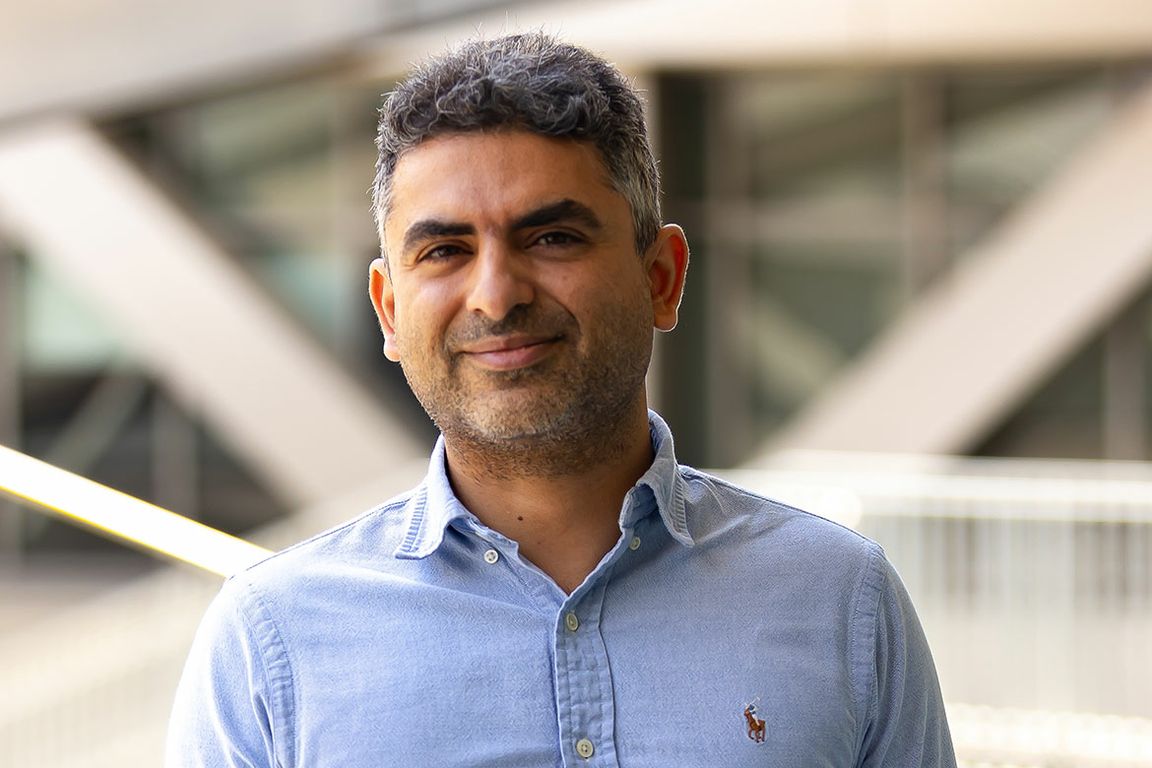
Hossein Mohimani describes two of his signature research projects as coming from “two different universes” in the biological sciences. One will explore new weapons against treatment-resistant infections, and the other will explore the role of specific enzyme families in drug processing.
The common element that ties these studies together is actually the tools used to conduct them. Mohimani, an associate professor of computational medicine at the David Geffen School of Medicine at the University of California, Los Angeles, combines machine learning (a type of artificial intelligence in which algorithms identify patterns after being “trained” with rich data) and mass spectrometry, an analytical technique that reveals the size and identity of molecules in a sample. This combination has the potential to become a kind of Swiss Army knife for tackling biology’s many mysteries.
In an interview, Mohimani, a member of UCLA’s California NanoSystems Institute who came to Westwood from Carnegie Mellon University in 2025, talked about the two universes in his research and how he sees it moving forward.
How can mass spectrometry and machine learning enable your own research in drug discovery?
There are many different types of bacteria, fungi, and plants that have evolved to produce molecules that can kill the most dangerous pathogens. But molecules are complex mixtures, and no one knows what they are. They are difficult to detect.
We screen these natural product extracts using mass spectrometry. The second signal is genomic data about the organisms that produced them. Using these inputs, machine learning is used to determine the structure of the molecule, whether it has been previously identified, whether it has antibiotic activity, or whether there are any newly mapped substructures that have not previously been tested for activity against pathogens. This paves the way for those molecules to be isolated and tested.
At Carnegie Mellon University, we screened thousands of bacterial strains, identified hundreds of previously unknown natural products, and tested them against the most deadly human pathogens. This led to the discovery of a molecule with a previously undescribed mechanism of action that kills Candida auris, a drug-resistant and rapidly spreading fungal pathogen detected in hospitals across the United States.
Together with the project scientist who was leading this research, I founded Chemia Biosciences Inc., which is developing medicines based on the molecule. Kemia has also established a collaboration to test the method we developed against a much wider range of molecules to see if those compounds can kill fungal diseases in crops.
What made you start researching drug metabolism?
For about 17 years, antibiotic discovery was my sole focus. Recently, I have been working on answering other interesting questions in the life sciences. When I first came to UCLA, I talked to Thomas Valim. [associate professor of biological chemistry and CNSI member] About the great things he’s doing in the lab.
He works to understand how the body metabolizes fats and other lipids using a group of enzymes called cytochrome P450s. How P450s change lipids in the body has important implications for our health, and mutations in one of these enzymes can cause disease.
A related question is how the drugs we take are modified by P450 enzymes. Variations in P450 genes across populations result in differences in how drugs are metabolized, making them ineffective in some people and producing toxic byproducts in others.
In drug development, the Food and Drug Administration asks about P450 metabolites with a yield of 20% or higher. However, our research has found that there are many other products that we don’t know about that typically have low yields but can be very toxic or very potent.
Previously, it was not possible to analyze these products due to limitations in laboratory technology. But over the past nine months, we have used high-throughput mass spectrometry and machine learning to screen 2,000 drugs for all biological activities of a single P450 enzyme. In the coming months, we hope to investigate all the P450 enzymes present in the human body.
Usually a single molecule is tested at a time. Instead of studying P450 metabolism, we are analyzing thousands of compounds in small amounts. There are ways to remove complexities such as interactions, which can make screening hundreds of times cheaper.
How do you think this research will progress?
We want to understand how long it takes for a drug to be cleared from a patient’s body, what other molecules it turns into, and how easily it crosses cell membranes. All these questions can be answered using mass spectrometry.
I’m also interested in training machine learning models that can look at the sequence of an enzyme and the structure of the molecules it modifies and predict its likely products. By understanding more about how enzymes change molecules, machine learning models can be trained to plan how enzymes can be used to obtain desired chemical products, such as in drug development.
Why is UCLA a good place to do this job?
The quality of our collaborators at the Geffen School of Medicine is first-rate, and we have access to excellent mass spectrometry equipment. Robert Damoiseau [professor of molecular and medical pharmacology and of bioengineering]He runs the Molecular Screening Shared Resource at CNSI and is a key collaborator. Automation greatly speeds up your work.
I would like to establish more collaborations. I think there are many great projects where you can apply your knowledge of mass spectrometry and machine learning.