
Abstract:
This study examines the influence of artificial intelligence literacy (AIL) on Generation Z’s purchasing behavior on AI-driven e-commerce platforms in Vietnam. Drawing on the Stimulus – Organism – Behavior – Consequence (SOBC) framework and extending the Technology Acceptance Model (TAM), AIL is conceptualized as a multidimensional construct encompassing AI knowledge and understanding, practical use and application, and evaluative-critical competence. Data from an online survey of 810 consumers in Northern Vietnam were analyzed using Partial Least Squares Structural Equation Modeling (PLS-SEM). The results indicate that AI knowledge and application positively affect perceived ease of use and perceived usefulness, while evaluative – critical competence significantly influences perceived ease of use but not perceived usefulness. Both perceived ease of use and perceived usefulness enhance trust, which, together with these perceptions, significantly drives purchase intention and subsequent purchasing behavior. Notably, trust and perceived ease of use emerge as the strongest mediating factors linking AI literacy to behavioral outcomes. Overall, the findings provide robust empirical evidence on the mechanisms through which AI literacy shapes consumer behavior in AI-enabled e-commerce environments.
Keywords: artificial intelligence literacy, AI-driven e-commerce, Generation Z, perceived ease of use, perceived usefulness, trust, purchase intention, purchase behavior, SOBC, TAM.
1. Introduction
The growth of AI technology has risen fast in recent years, especially in e-commerce. AI-personalized marketing is widely accepted by major organizations since they can be adapted to individual interests and requests (An & Ngo, 2025). AI chatbots are also extensively utilized to react to inquiries and aid consumers with product recommendations. In the apparel business, they even operate as virtual fashion stylists for firms such as Tommy Hilfiger and H&M through social messaging platforms like Facebook Messenger and Twitter (Myin & Watchravesringkan, 2024). Through these AI applications, firms can boost client connections and strengthen their brand image.
Alongside this progress, the concept of AI literacy has evolved (Wang et al., 2022). AI literacy refers to the capacity to appropriately identify, use, and evaluate AI-related products within ethical norms. Rather than demanding competence in AI theory, it stresses the ability to apply AI technologies proficiently and responsibly. Wang et al. (2022) established four fundamental components of AI literacy: awareness, usage, evaluation, and ethics which provide a platform for studying its impact on different outcomes. Subsequent research has studied how AI literacy affects AI receptiveness and the adoption of AI technology (Ng et al., 2021; Carolus et al., 2023; Tully et al., 2024; Pinski & Belian, 2024).
However, AI literacy remains underexplored in e-commerce. For example, Liu et al. (2025) explored how AI literacy promotes consumers’ acceptance of AI-Generated Sponsored Vlogs (AISV), revealing that its effects operate through emotional value, information usefulness, and source legitimacy. More broadly, existing research often stresses design features such as humanness, interaction, and ease of use, as well as hedonic value, to explain trust and use intention (Ding & Najaf, 2024; Nguyen et al., 2023). In comparison, users’ knowledge, operational aptitude, and evaluative skills about AI products have gotten less attention. This difference is crucial since perceived usefulness has been recognized as a critical indicator of happiness and online purchase intention in AI-integrated customer service (Chau et al., 2025).
Another issue is that many past researches focus on buy intention without assessing whether it leads to actual purchasing behavior (e.g. McKnight, Choudhury, & Kacmar, 2002; Gefen, Karahanna, & Straub, 2003). This parallels the intention-behavior difference identified by Sheeran (2002). To address this issue, the Stimulus – Organism – Behavior – Consequences (SOBC) model (Davis & Luthans, 1980) offers a useful perspective, yet studies on AI-enabled commerce have mainly relied on the Technology Acceptance Model (TAM) or its extensions (Nguyen et al., 2023; Sun et al., 2023; Zhang, 2024). The integration of SOBC and TAM thus remains limited.
This constraint is notably visible in emerging countries such as Vietnam, where recent research largely investigates customer happiness, continuous usage intention, and purchase intention rather than how AI literacy affects actual purchasing behavior (Chau et al., 2025). This issue is particularly critical for Generation Z, whose internet shopping habits may differ from that of Millennials. Therefore, this research extends TAM by integrating AI literacy as antecedents and combines TAM with SOBC to explain AI-driven e-commerce adoption and purchasing behavior. It also underlines the significance of trust and perceived ease of use in resolving the intention-behavior gap, presenting implications for e-commerce platforms, businesses, consumers, educators, and legislators.
2. Theoretical framework & Hypothesis development
2.1. Theoretical framework
The Stimulus-Organism-Behavior-Consequence (SOBC) model serves as the foundational framework. Unlike previous paradigms, SOBC views the Organism as a cognitive rather than an emotional state. The model defines Stimulus broadly as external factors and Behavior as specific observable actions. Crucially, SOBC adds “Consequence” to separate actions from their outcomes. This distinction enables the evaluation of long-term impacts and links individual behaviors to systemic results. Therefore, the SOBC model is particularly valuable for analyzing complex sectors like digital transformation and sustainability, where an action’s aftermath is as critical as essential as the conduct itself (Davis & Luthans, 1980).
Based on the aforementioned SOBC framework, the proposed research model and the relationships between its constituent variables are structured as follows:
Figure 1. Theoretical model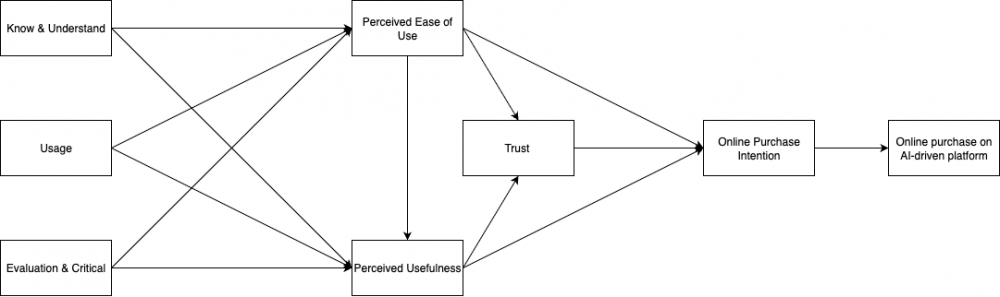
Source : Аuthor’s compilаtion
2.2. Stimulus
Artificial Intelligence Literacy (AIL) is a multidimensional competence encompassing conceptual knowledge and the ability to navigate AI-driven environments (Long & Magerko, 2020; Ng et al., 2021). Beyond its role in mitigating general digital risks (Cetindamar et al., 2022), AIL is uniquely critical in e-commerce for addressing the “black-box” algorithms that shape consumer decisions and exploit personal data. However, current research remains largely confined to educational or professional settings (Laupichler et al., 2022), leaving a significant theoretical gap regarding consumer-specific competencies like detecting commercial ranking or price manipulation. This deficiency necessitates a tailored AIL framework to empower consumers against algorithmic information asymmetry and protect their financial well-being in digital marketplaces.
2.2.1. Know & Understand AI
Know and Understand AI refers to users’ conceptual understanding of AI principles together with their awareness of real-world applications (Ng et al., 2021). Such foundational knowledge can provide users with a clearer mental model of how AI-enabled e-commerce applications operate, thereby reducing uncertainty and facilitating more efficient system interaction (Gefen et al., 2003).
Based on the above reasoning, the following hypotheses are proposed:
H1a: Know and Understand AI positively influences users’ perceived ease of use in e-commerce platforms.
H1b: Know and Understand AI positively influences users’ perceived usefulness in e-commerce platforms.
2.2.2. Use and Apply AI
Carolus et al. (2023) conceptualize Use and Apply AI as the practical ability to employ AI tools in everyday contexts rather than possessing advanced programming expertise. Consistent with this view, the present study operationalizes AI usage ability at a basic, consumer-oriented level, focusing on general familiarity required of typical e-commerce users rather than specialized technical or algorithmic knowledge.
Prior technology adoption research suggests that practical usability skills can reduce interaction effort and facilitate more efficient system use (Venkatesh et al., 2003).
Based on the above reasoning, the following hypotheses are proposed:
H2a: Use and Apply AI positively influences users’ perceived ease of use in e-commerce platforms.
H2b: Use and Apply AI positively influences users’ perceived usefulness in e-commerce platforms.
2.2.3. Evaluate & Critical AI
Across prior research, evaluative competence and AI creation skills are frequently identified as core dimensions of AI literacy (Long & Magerko, 2020; Ng et al., 2021; Carolus et al., 2023). However, in retail e-commerce contexts, consumers rarely develop AI systems; instead, they primarily depend on algorithmically curated outputs to support purchase decisions. Accordingly, evaluative competence – the ability to critically assess the reliability, fairness, and potential commercial bias of AI-generated information – becomes particularly salient. As Eslami et al. (2015) demonstrate, those who can effectively interpret these automated outputs through such mental models experience lower uncertainty and can interact with the system more efficiently.
When users exhibit stronger evaluative competence, they are better equipped to navigate personalized features, ensuring that the outcomes obtained are both highly precise and convenient.
Based on this reasoning, the following hypotheses are proposed:
H3a: Evaluation & Critical positively influences perceived ease of use in e-commerce platforms.
H3b: Evaluation & Critical positively influences perceived usefulness in e-commerce platforms.
2.3. Organism
2.3.1. Perceived ease of use
In the Technology Acceptance Model, Davis (1989) defined perceived ease of use (PEOU) as the degree to which an individual believes that using a system requires minimal effort. Prior research consistently demonstrates that systems perceived as easier to use tend to enhance user performance and technology adoption outcomes, particularly enhance trust and encourage continued usage (Venkatesh et al., 2003; Gefen et al., 2003). Extending this logic to AI-enabled environments, the present study argues that AI-integrated features on e-commerce platforms can simplify user interaction and improve the effectiveness of obtained results. In the context of AI-enabled e-commerce platforms, AI features reducing effort and simplifying the shopping process are expected to enhance users’ purchase intention.
Based on the above reasoning, the following hypotheses are proposed:
H4a: Perceived ease of use of AI-integrated features positively influences users’ perceived usefulness in e-commerce platforms.
H4b: Perceived ease of use of AI-integrated features positively influences users’ trust in e-commerce platforms.
H6: Perceived ease of use of AI-integrated features positively influences purchase intention in e-commerce platforms.
2.3.2. Perceived usefulness
Perceived usefulness (PU) is defined as the degree to which an individual believes that using a particular system enhances his or her performance (Davis, 1989). In AI-enabled e-commerce contexts, intelligent features can improve product search efficiency and recommendation relevance, thereby increasing perceived performance benefits. Prior research suggests that such benefits can strengthen both user trust and behavioral intentions toward technology use (Gefen et al., 2003; Venkatesh et al., 2003).
Based on this reasoning, the following hypotheses are proposed:
H5: Perceived usefulness of AI-integrated features positively influences users’ trust in e-commerce platforms.
H7: Perceived usefulness of AI-integrated features positively influences purchase intention in e-commerce platforms.
2.3.3. Trust
Prior research suggests that once trust in online systems or intelligent features is established, users are more willing to rely on these technologies and engage more frequently with them (Gefen et al., 2003). Stronger trust in AI-integrated functionalities can encourage consumers to depend on AI-generated recommendations to optimize their shopping experience, thereby increasing their likelihood of purchasing recommended products.
Based on this reasoning, the following hypothesis is proposed:
H8: Trust in AI-integrated features positively influences purchase intention in e-commerce platforms.
2.3.4. Purchase intention
Purchase intention is widely used to evaluate the potential effectiveness of new channels and technologies in influencing consumer decisions (Morwitz et al., 2007). The Theory of Planned Behavior (Ajzen, 1991) states that behavioral intention remains the most proximal and accurate determinant of actual conduct. According to this framework, intentions encapsulate the complex motivational factors that drive individuals to perform a specific action, reflecting the degree of conscious effort they are prepared to invest to achieve their consumption goals. Theoretically, as the intensity and stability of a consumer’s purchase intention increases, the probability of translating that cognitive readiness into a finalized transaction becomes significantly higher.
Based on this reasoning, the following hypothesis is proposed:
H9: Purchase intention positively influences actual purchase behavior in AI-enabled e-commerce platforms.
3. Methodology
3.1. Data collection
The data were collected during two months, from August 2025 to October 2025, using a five-point Likert scale, online survey method. The measurement scales adapted from the existing literature on AI literacy and consumer behaviour (Wang, 2023; Carolus et al., 2023; Liu et al., 2025) and redesigned based on the e-commerce context from Wang’s research and the development process established by Gefen. Out of 909 surveys distributed, a total of 810 valid responses were received.
3.2. Common method bias test
Because the data were collected using self-administered questionnaires from the same respondents, Common Method Bias (CMB) might be a potential concern. To address this issue, this study employed the full collinearity assessment approach, which is highly recommended for variance-based PLS-SEM (Kock, 2015).
3.3. Respondent’s profile
The SPSS 26 is used to generate the results of the participants’ profiles. Table 1 indicates respondents’ characteristics.
Table 1. Respondents’ profiles
|
Construct
|
Characteristic
|
Frequency
|
Percent
|
Valid Percent
|
Percent of Cases
|
|
Gender
|
Male
|
324
|
40.0
|
40.0
|
|
|
Female
|
486
|
60.0
|
60.0
|
|
|
|
Occupation
|
Student
|
772
|
95.3
|
|
95.3
|
|
Part Time / Intern
|
7
|
0.9
|
|
0.9
|
|
|
Full-time Worker
|
26
|
3.2
|
|
3.2
|
|
|
Freelancer
|
5
|
0.6
|
|
0.6
|
|
|
Most frequently used e-commerce platform (recent months)
|
Shopee
|
509
|
39.6
|
|
63.9
|
|
Tik Tok Shop
|
429
|
33.4
|
|
53.9
|
|
|
Facebook / Instagram
|
319
|
24.8
|
|
40.1
|
|
|
Lazada
|
29
|
2.3
|
|
3.6
|
|
|
Average monthly spending on e-commerce (VND)
|
Rarely / below 200.000VND/month
|
389
|
48.0
|
48.0
|
|
|
200.000 VND – Below 500.000 VND/month
|
260
|
32.1
|
32.1
|
|
|
|
500.000 VND – Below 1.000.000 VND/month
|
73
|
9.0
|
9.0
|
|
|
|
1.000.000 VND – Below 2.000.000VND/month
|
55
|
6.8
|
6.8
|
|
|
|
2.000.000 VND – Below 3.000.000VND/month
|
15
|
1.9
|
1.9
|
|
|
|
3.000.000 VND/month or more
|
18
|
2.2
|
2.2
|
|
|
|
Perceived interaction with AI features
|
Yes
|
627
|
77.4
|
77.4
|
|
|
No
|
183
|
22.6
|
22.6
|
|
Source : Аuthor’s compilаtion
4. Results
This study employed partial least squares structural equation modeling (PLS-SEM) using SmartPLS 3.2.9 to examine the proposed relationships.
4.1. Preliminary analysis and common method bias (CMB)
Common method bias (CMB) was evaluated in accordance with Podsakoff et al. (2003) because the data was self-reported and cross-sectional. According to Harman’s single-component test, the initial unrotated factor explained less than half of the variation, indicating that CMB is not likely to affect the validity of the results. Furthermore, every inner VIF values were below the conservative cutoff point of 3.3 (Kock, 2015) so multicollinearity is not an issue in the structural model.
Table 2. Inner VIF
|
|
EC
|
KU
|
PB
|
PE
|
PI
|
PU
|
TR
|
US
|
|
EC
|
|
|
|
2.118
|
|
2.269
|
|
|
|
KU
|
|
|
|
2.300
|
|
2.432
|
|
|
|
PB
|
|
|
|
|
|
|
|
|
|
PE
|
|
|
|
|
2.435
|
2.004
|
2.210
|
|
|
PI
|
|
|
1.000
|
|
|
|
|
|
|
PU
|
|
|
|
|
2.521
|
|
2.210
|
|
|
TR
|
|
|
|
|
1.928
|
|
|
|
|
US
|
|
|
|
2.582
|
|
2.722
|
|
|
Source : Аuthor’s compilаtion
4.2. Measurement model
In the present study, outer loadings ranged from 0.778 to 1.000, with the majority exceeding the 0.70 benchmark (Hair et al. (2022). All retained items surpassed the minimum acceptable threshold of 0.60 suggested by Bagozzi and Yi (1988), indicating adequate item reliability.
We conducted an internal consistency analysis that adopted multiple reliability estimates to guarantee that the latent constructs were measured with sufficient precision.
Cronbach’s alpha values for the constructs ranged from 0.737 to 1.000, consistently exceeding the conventional benchmark of 0.70 suggested for established scales (Nunnally, 1978). Composite reliability coefficients fell between 0.851 and 1.000, indicating that the indicators collectively share a substantial proportion of variance in capturing their respective constructs. Similarly, rho_A values, which are considered a consistent reliability estimator in PLS-SEM, ranged from 0.737 to 1.000, further supporting the internal coherence of the measures. Convergent validity was also supported, with all Average Variance Extracted (AVE) values above 0.50 (Fornell & Larcker, 1981; Hair et al., 2013).
Table 3. Convergent validity and composite reliability
|
Latent variables
|
Items
|
Factor loadings
|
Composite reliability
|
AVE
|
rho_A
|
Cronbach Alpha
(α)
|
|
KU
|
KU1
|
0.826
|
0.875
|
0.700
|
0.787
|
0.786
|
|
KU2
|
0.857
|
|||||
|
KU3
|
0.826
|
|||||
|
US
|
US1
|
0.847
|
0.915
|
0.728
|
0.876
|
0.875
|
|
US2
|
0.87
|
|||||
|
US3
|
0.862
|
|||||
|
US4
|
0.833
|
|||||
|
EC
|
EC1
|
0.778
|
0.851
|
0.656
|
0.737
|
0.737
|
|
EC2
|
0.827
|
|||||
|
EC3
|
0.824
|
|||||
|
TR
|
TR1
|
0.827
|
0.898
|
0.688
|
0.85
|
0.849
|
|
TR2
|
0.809
|
|||||
|
TR3
|
0.848
|
|||||
|
TR4
|
0.833
|
|||||
|
PE
|
PE1
|
0.872
|
0.918
|
0.738
|
0.882
|
0.881
|
|
PE2
|
0.871
|
|||||
|
PE3
|
0.85
|
|||||
|
PE4
|
0.843
|
|||||
|
PU
|
PU1
|
0.852
|
0.910
|
0.716
|
0.867
|
0.867
|
|
PU2
|
0.869
|
|||||
|
PU3
|
0.859
|
|||||
|
PU4
|
0.801
|
|||||
|
PI
|
PI1
|
0.880
|
0.917
|
0.786
|
0.865
|
0.864
|
|
PI2
|
0.884
|
|||||
|
PI3
|
0.896
|
|||||
|
PB
|
PB1
|
1.000
|
1.000
|
1.000
|
1.000
|
1.000
|
Source : Аuthor’s compilаtion
The Fornell-Larcker criterion was satisfied, as Table 4 indicates: each construct shares more variance with its own indicators than with other latent variables, as indicated by the square root of its AVE exceeding its correlations with other constructs (Fornell & Larcker, 1981).
All HTMT estimates were also below the 0.90 criterion, which is widely accepted as a reasonable cutoff point for proving discriminant validity in variance-based SEM (Henseler et al., 2015; Hair et al., 2022).
Table 4. FORNELL-LARCKER
|
|
EC
|
KU
|
PB
|
PE
|
PI
|
PU
|
TR
|
US
|
|
EC
|
0.810
|
|
|
|
|
|
|
|
|
KU
|
0.603
|
0.836
|
|
|
|
|
|
|
|
PB
|
0.341
|
0.363
|
1.000
|
|
|
|
|
|
|
PE
|
0.624
|
0.621
|
0.465
|
0.859
|
|
|
|
|
|
PI
|
0.442
|
0.431
|
0.662
|
0.594
|
0.886
|
|
|
|
|
PU
|
0.553
|
0.571
|
0.501
|
0.740
|
0.613
|
0.846
|
|
|
|
TR
|
0.507
|
0.438
|
0.599
|
0.639
|
0.742
|
0.655
|
0.830
|
|
|
US
|
0.696
|
0.688
|
0.391
|
0.641
|
0.469
|
0.588
|
0.560
|
0.853
|
Source : Аuthor’s compilаtion
Table 5. HTMT
|
|
EC
|
KU
|
PB
|
PE
|
PI
|
PU
|
TR
|
US
|
|
EC
|
|
|
|
|
|
|
|
|
|
KU
|
0.788
|
|
|
|
|
|
|
|
|
PB
|
0.398
|
0.411
|
|
|
|
|
|
|
|
PE
|
0.774
|
0.745
|
0.495
|
|
|
|
|
|
|
PI
|
0.553
|
0.523
|
0.711
|
0.681
|
|
|
|
|
|
PU
|
0.692
|
0.691
|
0.537
|
0.846
|
0.706
|
|
|
|
|
TR
|
0.638
|
0.533
|
0.650
|
0.736
|
0.866
|
0.758
|
|
|
|
US
|
0.865
|
0.826
|
0.419
|
0.729
|
0.540
|
0.676
|
0.648
|
|
Source : Аuthor’s compilаtion
4.3. Structural model and hypotheses testing
4.3.1 Goodness of fit measurement.
The measurement model’s full fit to the goodness of fit index and statistical significance were validated by the PLS-SEM results. The standardized root mean square residual (SRMR) of the estimated model in this study was 0.051, which is consistent with the literature as SRMR<0.10 or 0.08. Moreover, the normed fit index (NFI = 0.849) suggests that the measurement model in this study is well-suited for the PLS method to conduct SEM.
Table 6. Goodness of fit index
|
|
Saturated Model
|
Estimate Model
|
|
SRMR
|
0.051
|
0.058
|
|
d_ULS
|
0.929
|
1.195
|
|
d_G
|
0.423
|
0.443
|
|
Chi-Squared
|
2061.240
|
2127.077
|
|
NFI
|
0.849
|
0.844
|
Source : Аuthor’s compilаtion
4.3.2. Hypothesis Testing
This research uses bootstrapping calculation with the Bias-Corrected and Accelerated (BCa) Bootstrap confidence interval method, two-tailed test type and 5% significance level with 5000 subsamples.
Table 7 displays the relationship and hypotheses testing results, with effect sizes ranging from (0.02< f2 < 0.15) to medium (0.15< f2 < 0.35) for significant relationships.
Overall, the results provide strong support for the proposed SOBC-based mechanism integrating TAM and Trust, with 11 out of 12 hypotheses supported.
At the stimulus-to-organism stage, KU has a positive impact on Perceived Ease of Use (PE) and Perceived Usefulness (PU), confirming H1a and H1b. Similarly, US predicts PE and PU, supporting H2a and H2b. AI Evaluation and Critical capability (EC) positively affects PE, supporting H3a. However, its impact on PU is insignificant, leading to the rejection of H3b.
At the organism formation stage, PE strongly influences both on Trust (TR), while PU significantly predicts TR, supporting H4a, H4b, and H5. Among these relationships, PE → PU demonstrates a substantial practical contribution (f² = 0.370), underscoring ease of use as a key antecedent strengthening usefulness perceptions.
Further, the organism-to-behavior relationships indicate that PE, PU, and TR have significant positive effects on Purchase Intention (PI), supporting H6, H7, and H8, respectively. Trust exhibits the strongest influence on PI (f² = 0.397), highlighting it is essential in translating TAM beliefs into intention. Finally, Purchase Intention has a statistically significant positive impact on Purchase Behavior (PB) (H9 supported).
Table 7. Significance testing of direct and indirect effects with bootstrap
|
H
|
Relationship
|
Direct β
|
Direct p
|
Standard Deviation (Stdv)
|
T Statistics
|
Indirect β
|
Indirect p
|
f²
|
Decision
|
|
H1a
|
KU → PE
|
0.276
|
0.000
|
0.045
|
6.165
|
–
|
–
|
0.077
|
Supported
|
|
H1b
|
KU → PU
|
0.109
|
0.025
|
0.049
|
2.243
|
–
|
–
|
0.013
|
Supported
|
|
H2a
|
US → PE
|
0.257
|
0.000
|
0.049
|
5.216
|
–
|
–
|
0.054
|
Supported
|
|
H2b
|
US → PU
|
0.112
|
0.032
|
0.052
|
2.142
|
–
|
–
|
0.011
|
Supported
|
|
H3a
|
EC → PE
|
0.280
|
0.000
|
0.052
|
5.414
|
–
|
–
|
0.078
|
Supported
|
|
H3b
|
EC → PU
|
0.057
|
0.233
|
0.047
|
1.193
|
–
|
–
|
0.003
|
Rejected
|
|
H4a
|
PE → TR
|
0.342
|
0.000
|
0.045
|
7.568
|
–
|
–
|
0.102
|
Supported
|
|
H4b
|
PE → PU
|
0.565
|
0.000
|
0.044
|
12.920
|
–
|
–
|
0.370
|
Supported
|
|
H5
|
PU → TR
|
0.402
|
0.000
|
0.048
|
8.377
|
–
|
–
|
0.141
|
Supported
|
|
H6
|
PE →PI
|
0.117
|
0.025
|
0.048
|
2.437
|
–
|
–
|
0.014
|
Supported
|
|
H7
|
PU →PI
|
0.158
|
0.001
|
0.049
|
3.193
|
–
|
–
|
0.024
|
Supported
|
|
H8
|
TR→PI
|
0.564
|
0.000
|
0.041
|
13.708
|
–
|
–
|
0.397
|
Supported
|
|
H9
|
PI → PB
|
0.662
|
0.000
|
0.025
|
26.076
|
–
|
–
|
0.782
|
Supported
|
|
|
KU →PE→PI
|
–
|
–
|
–
|
–
|
0.032
|
0.031
|
–
|
Supported
|
|
|
KU→PE→PU
|
–
|
–
|
–
|
–
|
0.031
|
0.000
|
–
|
Supported
|
|
|
KU→PE→TR
|
–
|
–
|
–
|
–
|
0.094
|
0.000
|
–
|
Supported
|
|
|
KU→PU→PI
|
–
|
–
|
–
|
–
|
0.017
|
0.080
|
–
|
Rejected
|
|
|
KU→PU→TR
|
–
|
–
|
–
|
–
|
0.044
|
0.021
|
–
|
Supported
|
|
|
US →PE→PI
|
–
|
–
|
–
|
–
|
0.030
|
0.025
|
–
|
Supported
|
|
|
US→PE→PU
|
–
|
–
|
–
|
–
|
0.145
|
0.000
|
–
|
Supported
|
|
|
US→PE→TR
|
–
|
–
|
–
|
–
|
0.088
|
0.000
|
–
|
Supported
|
|
|
US→PU→PI
|
–
|
–
|
–
|
–
|
0.018
|
0.092
|
–
|
Rejected
|
|
|
US→PU→TR
|
–
|
–
|
–
|
–
|
0.045
|
0.053
|
–
|
Rejected
|
|
|
EC →PE→PI
|
–
|
–
|
–
|
–
|
0.033
|
0.027
|
–
|
Supported
|
|
|
EC→PE→PU
|
–
|
–
|
–
|
–
|
0.158
|
0.000
|
–
|
Supported
|
|
|
EC→PE→TR
|
–
|
–
|
–
|
–
|
0.095
|
0.000
|
–
|
Supported
|
|
|
EC→PU→PI
|
–
|
–
|
–
|
–
|
0.009
|
0.273
|
–
|
Rejected
|
|
|
EC→PU→TR
|
–
|
–
|
–
|
–
|
0.023
|
0.234
|
–
|
Rejected
|
|
|
PE→PI→PB
|
–
|
–
|
–
|
–
|
0.078
|
0.016
|
–
|
Supported
|
|
|
PE→PU→TR
|
–
|
–
|
–
|
–
|
0.227
|
0.000
|
–
|
Supported
|
|
|
PE→TR→PI
|
–
|
–
|
–
|
–
|
0.193
|
0.000
|
–
|
Supported
|
|
|
PE→PU→PI
|
–
|
–
|
–
|
–
|
0.089
|
0.002
|
–
|
Supported
|
|
|
PU→PI→PB
|
–
|
–
|
–
|
–
|
0.104
|
0.002
|
–
|
Supported
|
|
|
PU→TR→PI
|
–
|
–
|
–
|
–
|
0.227
|
0.000
|
–
|
Supported
|
|
|
TR→PI→PB
|
–
|
–
|
–
|
–
|
0.374
|
0.000
|
–
|
Supported
|
Source : Аuthor’s compilаtion
The explanatory power of the structural model was assessed using the coefficient of determination (R²). As shown in Table 8, the model explains 58.5% of the variance in PI and 43.9% of the variance in PB, indicating moderate and satisfactory explanatory power for the key outcome variables. At the organism level, the model accounts for 51.0% of the variance in PE, 57.8% in PU, and 48.1% in TR.
Table 8. R SQUARED
|
|
R Squared
|
R Squared Adjusted
|
|
PB
|
0.439
|
0.438
|
|
PE
|
0.510
|
0.509
|
|
PI
|
0.585
|
0.583
|
|
PU
|
0.578
|
0.576
|
|
TR
|
0.481
|
0.480
|
Source : Аuthor’s compilаtion
5. Discussions and limitation
5.1. Discussions
KU and US exhibit strong favorable impacts on both PE and PU, corresponding with theoretical assumptions in AI-enabled e-commerce. Knowledge (KU) helps Gen Z develop a clearer mental model of recommender systems and chatbots, reducing “black-box” uncertainty, while usage skills (US) improve procedural fluency when interacting with AI features such as prompting and verification, lowering effort and strengthening decision benefits. This fits with data indicating that AI familiarity and usage boost both ease-of-use and utility perceptions in online commerce situations (Bunea et al., 2024; Schiavo et al., 2024). In contrast, EC promotes PE but not PU, establishing a boundary constraint in the AI literacy–TAM paradigm. A more critical attitude may promote easier engagement while simultaneously enhancing awareness of privacy hazards and persuasive targeting, so better ease of use does not necessarily translate into higher perceived utility (Huang & Liu, 2025; Aydin, 2026).
Mediation results reveal that PU plays a limited role in conveying AI literacy effects to downstream outcomes, save for KU → PU → TR. Conversely, PE emerges as the primary mediator associating AI literacy with Trust (TR), Purchase Intention (PI), and Purchase Behavior (PB). By eliminating initial adoption obstacles, PE enables AI literacy to convert more effectively into trust and purchasing intents. This pattern resonates with prior studies showing usability as a vital bridge between technology readiness and adoption (Damerji & Salimi, 2021; Ibrahim et al., 2025).
Unlike PE and PU, trust represents consumers’ willingness to rely on AI and introduces a relational dimension of safety and dependability. Within extended TAM, trust typically works as a mediator since perceived risk and uncertainty may limit adoption regardless of a system’s perceived benefit or usability (Singh et al., 2024). This technique is particularly crucial for Generation Z in AI-driven e-commerce, where privacy concerns and apparent algorithmic manipulation may generate hesitancy. Empirical evidence demonstrates that chatbot involvement and perceived humanness boost trust and adoption intentions (Ding & Najaf, 2024), whereas AI exposure and algorithmic accuracy enhance brand trust and purchasing decisions among Gen Z (Guerra-Tamez et al., 2024).
5.2. Theoretical Implications
By introducing dimension-specific antecedents from AI literacy (AIL) into the Technology Acceptance Model (TAM), this work enhances consumer adoption research where literacy is frequently considered broadly or largely examined in educational environments (Laupichler et al., 2022). Dividing AIL into knowledge-understanding (KU), usage (US), and evaluative-critical capability (EC) demonstrates that literacy influences perceived usefulness (PU) and perceived ease of use (PE) through various methods. The findings also reveal a boundary condition: critical literacy may limit perceived utility by increasing knowledge of privacy hazards and algorithmic opacity (Huang & Liu, 2025; Aydin, 2026).
Second, the mediation pattern clarifies TAM dynamics in AI situations. PE operates as the key bridge linking AIL with trust, intention, and behavior, while PU plays a weaker role. This shows that minimizing interaction friction and boosting perceived control may be more significant than performance beliefs in AI-enabled purchasing settings (Damerji & Salimi, 2021; Ibrahim et al., 2025). Trust also acts as a relational mechanism capturing users’ propensity to depend on AI under ambiguity (Singh et al., 2024).
Finally, merging SOBC with TAM gives a consistent explanation of AI-driven e-commerce adoption, where literacy-related stimuli change perceptions (PE, PU, trust) that influence behavior and results (Talwar et al., 2021; Shamim & Misra, 2025). The findings also suggest that trust and ease of use are essential factors bridging the intention–behavior gap among Gen Z customers in emerging economies (Polyportis, 2026; Guerra-Tamez et al., 2024; Ibrahim et al., 2025).
5.3. Practical implications
The findings have clear implications for AI feature designers and Vietnamese e-commerce platforms. Businesses should prioritize AI literacy education as a core design objective, rather than treating it merely as a user trait. Enhancing the shopping experience with features such as “first-use” prompts, guided walkthroughs, and feedback-based training can help users better understand AI tools and how to manage them (for example: adjusting chatbot responses or refining recommendations). Research on Gen Z suggests that boosting usability and perceived value increases users’ familiarity with AI in online shopping, which in turn encourages broader adoption (Bunea et al., 2024).
Second, ethical AI initiatives should be positioned primarily as trust protections rather than direct “value-adds” because evaluative-critical capability does not automatically transition into higher usefulness perceptions in my model. In practice, privacy and fairness measures should be made visible and actionable. This coincides with recent e-commerce findings suggesting that algorithmic transparency and understandability are significant drivers of credibility assessments for AI-generated shopping content, which then supports perceived usefulness and adoption intentions (Jia et al., 2026).
Third, systems should prioritize trust-building signals at the point of reliance, because trust is what makes users comfortable acting on AI output in high-stakes steps (checkout, payment, data sharing). Enhancing perceived interaction and human-like reactivity in AI chatbot designs can boost trust, which in turn encourages adoption intentions (Ding & Najaf, 2024).
Finally, corporations should directly relate literacy to tangible benefits: instead of abstract statements about AI “smartness,” show customers why an item is recommended, how to modify preference signals, and how the system improves after input. This strategy corresponds with the concept that AI literacy is varied and becomes behaviorally meaningful when supported by contextual affordances and system design (Laupichler et al., 2022; Huang & Liu, 2025).
5.4. Limitations and future researches
Although there are a number of limitations, this study provides insightful information about how AI literacy affects Generation Z customers’ buying intentions and behavior in Vietnam. The sequential sequence of interactions, such as from AI literacy via technology beliefs and trust to purchasing behavior, cannot be fully confirmed by the cross-sectional approach, which gathers data all at once. The sample’s high percentage of university students and restriction to Generation Z limited its applicability to other age groups, socioeconomic classes, and cultural backgrounds. Because all of the variables were based on self-reported questionnaires, recall and social desirability bias may have been introduced, particularly with regard to purchasing behavior. Furthermore, other industries like fintech or education might not benefit from the emphasis on AI-integrated e-commerce.
To confirm the sequential mechanism and offer causal evidence, future studies should employ experimental or longitudinal approaches, such as evaluating literacy programs or AI transparency. It would be possible to ascertain whether the bridging function of trust and the prominent role of ease of use are unique to Vietnamese Gen Z by expanding samples to include various generations, socioeconomic levels, and cross-country comparisons.
6. Conclusion
This study explores the role of AI literacy in shaping Generation Z’s purchasing behavior on AI-driven e-commerce platforms in Vietnam, utilizing the S-O-B-C approach. It identifies a research gap in integrating AI literacy within the Technology Acceptance Model (TAM) and trust frameworks. The study develops a comprehensive model assessing AI literacy across three dimensions: knowledge, usage skills, and evaluative abilities, which influence perceived utility and ease of use, consequently impacting trust and purchase behaviors. Findings indicate that AI literacy indirectly enhances purchasing behavior through trust and perceptions of technology. Recommendations for e-commerce stakeholders include improving AI literacy, designing user-friendly AI systems, and strengthening trust mechanisms. The study offers valuable insights for Vietnamese companies targeting Gen Z but highlights limitations in sample scope and suggests areas for further research on consumer behavior in AI-related e-commerce contexts.
References
Ajzen, I. (1991). The theory of planned behavior. Organizational Behavior and Human Decision Processes, 50(2), 179-211. https://doi.org/10.1016/0749-5978(91)90020-T
Attar, R. W. (2025). Predicting Trends and Maximizing Sales: AI’s Role in Saudi E-Commerce Decision-Making. Journal of Theoretical and Applied Electronic Commerce Research, 20(4), 311. https://doi.org/10.3390/jtaer20040311
Aydin, S. (2026). Brand Trust in AI-Driven E-Commerce Personalization: The Well-Being-Privacy Trade-Off. Sustainability, 18(2), 1073. https://doi.org/10.3390/su18021073
Bagozzi, R. P., & Yi, Y. (1988). On the evaluation of structural equation models. Journal of the Academy of Marketing Science, 16(1), 74-94. https://doi.org/10.1007/BF02723327
Bunea, O.-I., Corboș, R.-A., Mișu, S. I., Triculescu, M., & Trifu, A. (2024). The Next-Generation Shopper: A Study of Generation-Z Perceptions of AI in Online Shopping. Journal of Theoretical and Applied Electronic Commerce Research, 19(4). https://doi.org/10.3390/jtaer19040125
Damerji, H., & Salimi, A. (2021). Mediating Effect of Use Perceptions on Technology Readiness and Adoption of Artificial Intelligence in Accounting. Accounting Education, 30, 107-130. https://doi.org/10.1080/09639284.2021.1872035
Davis, F. D. (1989). Perceived usefulness, perceived ease of use, and user acceptance of information technology. MIS Quarterly, 13(3), 319-340. https://doi.org/10.2307/249008
Fornell, C., & Larcker, D. F. (1981). Evaluating structural equation models with unobservable variables and measurement error. Journal of Marketing Research, 18(1), 39-50. https://doi.org/10.2307/3151312
Gefen, D., Karahanna, E., & Straub, D. W. (2003). Trust and TAM in online shopping: An integrated model. MIS Quarterly, 27(1), 51-90. https://doi.org/10.2307/30036519
Goundar, S., Lal, K., Chand, A., & Vyas, P. (2021). Consumer perception of electronic commerce – Incorporating trust and risk with the Technology Acceptance Model. In S. Goundar (Ed.), E-Services (pp. 1-24). IntechOpen. https://doi.org/10.5772/intechopen.98419
Guerra-Tamez, C. R., Flores, M. R. E., & Mendez, L. O. (2024). Decoding Gen Z: AI’s influence on brand trust and purchasing behavior. Frontiers in Artificial Intelligence, 7, Article 1323512. https://doi.org/10.3389/frai.2024.1323512
Hair, J. F., Hult, G. T. M., Ringle, C. M., & Sarstedt, M. (2022). A primer on partial least squares structural equation modeling (PLS-SEM) (3rd ed.). Sage.
Hair, J. F., Ringle, C. M., & Sarstedt, M. (2011). PLS-SEM: Indeed a silver bullet. Journal of Marketing Theory and Practice, 19(2), 139-152. https://doi.org/10.2753/MTP1069-6679190202
Hair, J. F., Ringle, C. M., & Sarstedt, M. (2013). Partial least squares structural equation modeling: Rigorous applications, better results and higher acceptance. Long Range Planning, 46(1-2), 1-12. https://doi.org/10.1016/j.lrp.2012.08.011
Henseler, J., Ringle, C. M., & Sarstedt, M. (2015). A new criterion for assessing discriminant validity in variance-based structural equation modeling. Journal of the Academy of Marketing Science, 43(1), 115-135. https://doi.org/10.1007/s11747-014-0403-8
Huang, Y., & Liu, L. (2025). The impact of algorithm awareness on the acceptance of personalized social media content recommendation based on the technology acceptance model. Acta Psychologica, 259, 105383. https://doi.org/10.1016/j.actpsy.2025.105383
Ibrahim, F., Münscher, J.-C., Daseking, M., & Telle, N.-T. (2025). The technology acceptance model and adopter type analysis in the context of artificial intelligence. Frontiers in Artificial Intelligence, 7, 1496518. https://doi.org/10.3389/frai.2024.1496518
Kim, D. J., Ferrin, D. L., & Rao, H. R. (2008). A trust-based consumer decision-making model in electronic commerce: The role of trust, perceived risk, and their antecedents. Decision Support Systems, 44(2), 544-564. https://doi.org/10.1016/j.dss.2007.07.001
Kock, N. (2015). Common method bias in PLS-SEM: A full collinearity assessment approach. International Journal of e-Collaboration, 11(4), 1-10. https://doi.org/10.4018/ijec.2015100101
Kozak, J., & Fel, S. (2024). How sociodemographic factors relate to trust in artificial intelligence among students in Poland and the United Kingdom. Scientific Reports, 14, Article 28776. https://doi.org/10.1038/s41598-024-80305-5
Laupichler, M. C., Aster, A., Schirch, J., & Raupach, T. (2022). Artificial intelligence literacy in higher and adult education: A scoping literature review. Computers and Education: Artificial Intelligence, 3, 100101. https://doi.org/10.1016/j.caeai.2022.100101
Ma, S., et al. (2024). The Development and Validation of the Artificial Intelligence Literacy Scale for Chinese College Students (AILS-CCS). ResearchGate Preprint.
Ng, D. T. K., Wu, W., Leung, J. K. L., Chiu, T. K. F., & Chu, S. K. W. (2024). Design and validation of the AI literacy questionnaire: The affective, behavioural, cognitive and ethical approach. British Journal of Educational Technology, 55(3), 1082-1104. https://doi.org/10.1111/bjet.13411
Nunnally, J. C. (1978). Psychometric theory (2nd ed.). McGraw-Hill.
Podsakoff, P. M., MacKenzie, S. B., Lee, J. Y., & Podsakoff, N. P. (2003). Common method biases in behavioral research: A critical review of the literature and recommended remedies. Journal of Applied Psychology, 88(5), 879-903. https://doi.org/10.1037/0021-9010.88.5.879
Polyportis, A. (2026). Exploring the intention-behaviour gap in artificial intelligence adoption: The case study of students’ ChatGPT usage in Dutch higher education. Computers in Human Behavior: Artificial Humans, 3(1), Article 100266. https://doi.org/10.1016/j.chbah.2026.100266
Rohden, S. F., & Espartel, L. B. (2024). Consumer reactions to technology in retail: Choice uncertainty and reduced perceived control in decisions assisted by recommendation agents. Electronic Commerce Research, 24, 901-923. https://doi.org/10.1007/s10660-024-09808-7
Shamim, K., & Misra, S. C. (2025). Leveraging AI to drive online impulse buying: A SOBC perspective. International Journal of Retail & Distribution Management, 53(10-11), 1040-1056. https://doi.org/10.1108/IJRDM-07-2024-0334
Singh, C., & Dash, G. (2024). Investigating the acceptance intentions of online shopping assistants in E-commerce interactions: Mediating role of trust and effects of consumer demographics. Heliyon, 10(3), e24851. https://doi.org/10.1016/j.heliyon.2024.e24851
Talwar, S., Jabeen, F., Tandon, A., Sakashita, M., & Dhir, A. (2021). What drives willingness to purchase and stated buying behavior toward organic food? A Stimulus-Organism-Behavior-Consequence (SOBC) perspective. Journal of Cleaner Production, 293, 125882. https://doi.org/10.1016/j.jclepro.2021.125882
Tian, S., Zhang, B., & He, H. (2024). Role of Algorithm Awareness in Privacy Decision-Making Process: A Dual Calculus Lens. Journal of Theoretical and Applied Electronic Commerce Research, 19(2), 899-920. https://doi.org/10.3390/jtaer19020047
Venkatesh, V., & Davis, F. D. (2000). A theoretical extension of the technology acceptance model: Four longitudinal field studies. Management Science, 46(2), 186-204. https://doi.org/10.1287/mnsc.46.2.186.11926
Wang, B., Rau, P. L. P., & Yuan, T. (2023). Measuring user competence in using artificial intelligence: validity and reliability of artificial intelligence literacy scale. Behaviour & Information Technology, 42(9), 1324-1337. https://doi.org/10.1080/0144929X.2022.2072768
Wang, W., & Benbasat, I. (2005). Trust in and adoption of online recommendation agents. Journal of the Association for Information Systems, 6(3), 72-101. https://doi.org/10.17705/1jais.00065
Webb, T. L., & Sheeran, P. (2006). Does changing behavioral intentions engender behavior change? A meta-analysis of the experimental evidence. Psychological Bulletin, 132(2), 249-268. https://doi.org/10.1037/0033-2909.132.2.249
Zhang, S. (2024). How AI Literacy Affects the Intention to Use AIGC: An Empirical TAM-Based Study. Journal of Big Data and Computing.
Zhao, J. (2018). Modeling and quantifying user acceptance of personalized business modes based on TAM, trust and attitude. Sustainability, 10(2), 356. https://doi.org/10.3390/su10020356
Zhao, L., Wu, X., Luo, H., Zhang, Y., & Yu, G. (2025). Navigating the landscape of AI literacy education: Insights from a decade of research (2014-2024). Humanities and Social Sciences Communications, 12, Article 458. https://doi.org/10.1057/s41599-025-04583-8
Tác động của năng lực hiểu biết về trí tuệ nhân tạo đối với hành mua sắm của Gen Z trên các nền tảng thương mại điện tử có ứng dụng AI tại Việt Nam
Nguyễn Phương Khánh
Trần Minh Cường
Vũ Phương Anh
Bùi Minh Triết
Nguyễn Ngọc Minh
Tóm tắt:
Nghiên cứu này xem xét ảnh hưởng của năng lực hiểu biết về trí tuệ nhân tạo (Artificial Intelligence Literacy – AIL) đối với hành vi mua sắm của Gen Z trên các nền tảng thương mại điện tử có ứng dụng AI tại Việt Nam. Dựa trên khung lý thuyết Kích thích – Chủ thể – Hành vi – Hệ quả (SOBC) và mở rộng Mô hình chấp nhận công nghệ (TAM), AIL được khái niệm hóa như một cấu trúc đa chiều bao gồm kiến thức và hiểu biết về AI, khả năng sử dụng và ứng dụng AI, cùng năng lực đánh giá – phản biện. Dữ liệu thu thập từ khảo sát trực tuyến với 810 người tiêu dùng tại miền Bắc Việt Nam được phân tích bằng mô hình cấu trúc tuyến tính bình phương tối thiểu từng phần (PLS-SEM). Kết quả cho thấy kiến thức và khả năng ứng dụng AI có tác động tích cực đến nhận thức về tính dễ sử dụng và tính hữu ích, trong khi năng lực đánh giá – phản biện chỉ ảnh hưởng đáng kể đến nhận thức về tính dễ sử dụng mà không ảnh hưởng đến tính hữu ích. Cả hai yếu tố nhận thức này đều góp phần gia tăng niềm tin, từ đó cùng nhau thúc đẩy ý định mua và hành vi mua thực tế. Đáng chú ý, niềm tin và nhận thức về tính dễ sử dụng đóng vai trò là các biến trung gian mạnh nhất trong mối liên hệ giữa AIL và kết quả hành vi. Nhìn chung, nghiên cứu cung cấp bằng chứng thực nghiệm vững chắc về các cơ chế mà qua đó năng lực hiểu biết AI định hình hành vi người tiêu dùng trong môi trường thương mại điện tử tích hợp AI.
Từ khóa: kiến thức về trí tuệ nhân tạo, nền tảng thương mại điện tử có ứng dụng AI, Gen Z, cảm nhận về tính dễ sử dụng, cảm nhận về tính hữu ích, lòng tin, ý định mua hàng, hành vi mua hàng, SOBC, TAM.
[Tạp chí Công Thương – Các kết quả nghiên cứu khoa học và ứng dụng công nghệ, Số 6 năm 2026]