
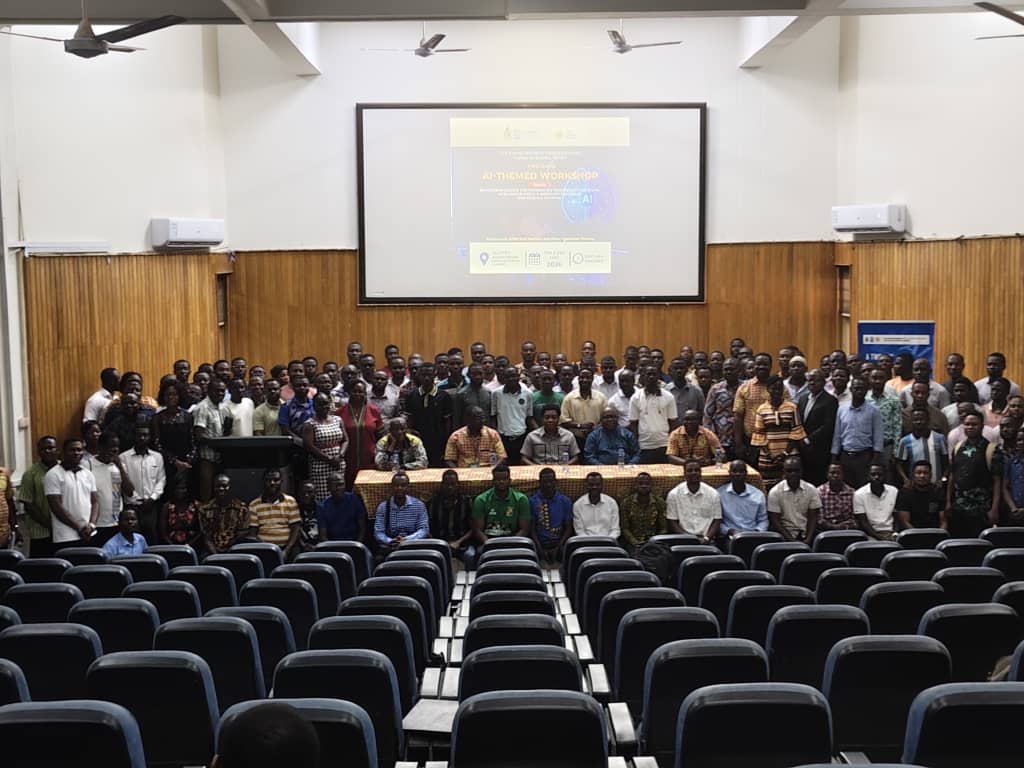
Teachers at secondary schools in the Ashanti region expressed optimism about the future of education after attending a two-day artificial intelligence (AI) workshop aimed at equipping educators with digital tools to improve teaching, lesson preparation and student engagement.
Organized by the Ghana Science Society at the Kwame Nkrumah University of Science and Technology, the training introduced participants to various AI-powered platforms including ChatGPT, Grok, Canva, Wolfram Alpha, Claude, and Wayground.
Participants said the workshop helped dispel concerns that AI would replace teachers, and instead demonstrated how technology can support classroom instruction, assessment, and lesson planning.
Sarah Afi Collier, general science teacher at St. Michael’s High School, said the workshop exposed teachers to a wide range of AI tools beyond ChatGPT.
“While we are familiar with ChatGPT, we learned that there are many other applications that can support education,” she said.
She says tools like Gemini and Canva can make science lessons more interactive by generating diagrams, flashcards, and presentation slides.
“Gemini helps generate photos and diagrams for science lessons, especially for topics that require illustrations,” she explained. “Canva also allows you to create PowerPoint presentations with visuals that make your lessons more engaging.”
Afi-Korye added that teachers were particularly impressed with Wayground’s ability to automate assessment and grading.
“This app helps you generate questions and create an online classroom for your students. As students answer questions, the system automatically grades the questions and provides scores and rankings,” she said.
“It makes teaching much easier than traditional methods of manually setting and grading questions.”
Kwame Adarkwa-Yadam, a chemistry teacher at Collins High School, admitted he was initially skeptical about the use of AI in education.
“At first, it felt like cheating to use AI,” he said. “But this training introduced me to tools that can truly support teaching and learning.”
He noted that platforms such as Canva AI and Wolfram Alpha can help simplify abstract chemical concepts through simulations, images, and 3D visualization.
“Chemistry can be abstract and requires a lot of imagination, but these tools provide simulations and visual representations that make lessons more interesting,” he said.
“Students are more likely to be interested in science when lessons are practical and engaging.”
Yiadom also highlighted the time-saving benefits of AI in preparing lessons.
“Previously, teachers had to research several books and type long notes before preparing a lesson,” he says. “These tools will help you prepare quality materials more efficiently.”
Agona High School teacher Kini Selassie said the workshop changed perceptions about AI and addressed concerns about technology replacing teachers.
“We have all heard about AI and wondered if it would take our jobs,” he said. “But we realized that it was already part of the system and we needed to learn how to use it effectively.”
He said the workshop was timely and necessary for Ghanaian teachers to remain globally competitive.
“AI is here to stay. It is not there to replace us, it is there to support us so that we can keep pace with the global community,” he added.
For Esi Kosema Debra, a biology teacher at Munsell Girls’ High School, the training highlighted how AI can be used responsibly in education, despite concerns about student misuse.
“A lot of people criticize AI because some students are abusing it,” she says. “However, this workshop showed that AI can also be actively used in teaching, learning and assessment.”
Debra said she plans to incorporate some of the newly introduced tools into classroom activities to improve students’ understanding of science.
“Students will understand that AI can be used not only to find answers, but also collaboratively to improve learning outcomes,” she added.
Facilitator Dr Benjamin Tay Party said the workshop was designed to help secondary school teachers effectively utilize AI tools in lesson preparation and classroom teaching.
“My observation is that many of these tools are underutilized,” he said. “There are tools to help teachers take notes, deepen understanding, and teach concepts more effectively.”
He called on teachers to guide students towards the responsible use of AI.
“We encouraged participants to help leverage AI for learning, rather than just looking for answers,” Dr. Partey said. “Some of these tools can also teach programming step-by-step in a way that promotes understanding.”
Dr. Partey noted that participants wanted to extend the duration of the workshop due to the growing interest in AI education, and called for an increase in the frequency of training sessions.
“The positive impact of AI can be huge if we learn how to use it properly,” he said. “If you ignore these tools, you risk being left behind technologically.”
Dr. Ama Larbi, Treasurer of the Ghana Science Society, KNUST, said the society hopes to expand this initiative across the country.
“We want all STEM teachers to be able to understand and apply AI in their work,” she said.
“We started in Kumasi, but we want to expand this program across the country so that more teachers can benefit.”
Organizers believe that expanding the introduction of AI in classrooms could help transform science and mathematics education in Ghana by making lessons more interactive, reducing teacher workload, and preparing students for an increasingly digital future.
Disclaimer: The views, comments, opinions, contributions and statements made by readers and contributors on this platform do not necessarily represent the views or policies of Multimedia Group Limited.
Disclaimer: The views, comments, opinions, contributions and statements made by readers and contributors on this platform do not necessarily represent the views or policies of Multimedia Group Limited.
Source link

