
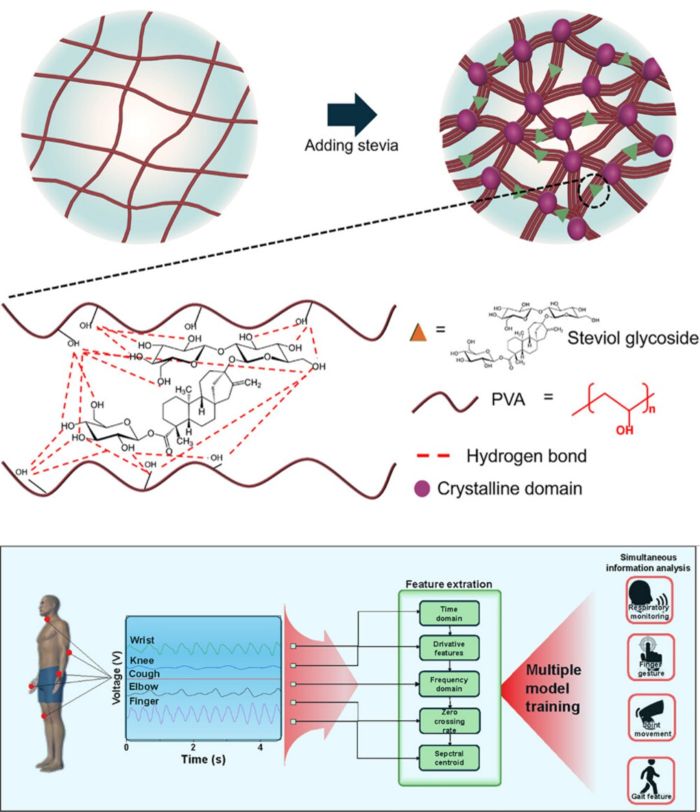
Professor Kyungwho Choi’s team from Sungkyunkwan University’s School of Mechanical Engineering (co-first authors: Thien Trung Luu and Bui Minh Quang), in collaboration with Professor Jinsoo Kim’s team from Kyung Hee University’s School of Chemical Engineering, proposed a strategy to simultaneously overcome the limitations of traditional hydrogel-based triboelectric nanogenerators (TENGs): low power performance, poor mechanical strength, and insufficient transparency. Biomimetic Stevia.
By blending Stevia with polyvinyl alcohol (PVA), the abundant hydroxyl groups (-OH) simultaneously strengthen the crosslinked structure and crystalline domains created by hydrogen bonds, dramatically improving mechanical strength and ionic conductivity.
As a result, the stevia PVA hydrogel TENG (S-TENG) exhibited approximately 2–5 times higher mechanical strength and 3–8 times higher electrical output compared to conventional TENGs based on 2D materials, biomaterials, and transparent materials, while maintaining visible light transmittance above 70%. The tensile strength exceeded 25 MPa (hydrated state) and the elongation at break exceeded 510%.
Additionally, the research team demonstrated that the S-TENG maintains a stable output (approximately 800V) through 16,000 contact separation cycles and confirmed no reduction in electrical output even after 30 days of storage at room temperature. Stevia hydrogel can also be recycled through a water-based dissolution and regelation process and maintains a high output voltage of approximately 600 V after recycling, demonstrating its potential as an environmentally friendly material.
Furthermore, the research team attached S-TENG to various parts of the body, such as wrists, elbows, knees, fingers, and throat, and used it as a self-powered sensor to detect various movements of the human body. The response to finger bending had a fast rise time of 13 ms, and among the 11 machine learning models evaluated for motion classification, the XGBoost algorithm achieved the highest classification accuracy of 95.29%.
Professor Kyung-wha Choi, corresponding author, said, “It is significant that we have succeeded in developing a biomass-derived stevia-derived hydrogel electrode that simultaneously improves transparency, mechanical performance, and electrical output while ensuring recyclability.We will continue our research to apply this technology to a wide range of fields such as IoT-based wearable devices, rehabilitation monitoring, and intelligent human-machine interfaces.”
This research was supported by the 4th BK21 Human-Centered Fusion Machine Solutions Education and Research Center and the Korean Government (MSIT). This result was published in Advanced Materials (IF 26.8, JCR top 3%) in April 2026. This paper was also selected for the inside cover of Advanced Materials.


