
overview
- Corning Incorporated has partnered with Nvidia as an optical connectivity partner for AI infrastructure, forming a significant commercial and strategic alliance.
- The partnership includes Nvidia buying stock from Corning and promises to increase optical connectivity production and new manufacturing plants in the U.S. tenfold.
- Corning’s Springboard growth plan has been updated, with management projecting up to $40 billion in revenue by 2030 due to increased demand for AI-driven optical connectivity.
- Despite positive analyst upgrades and a strong growth trajectory, Corning’s high valuation is making investors wary.
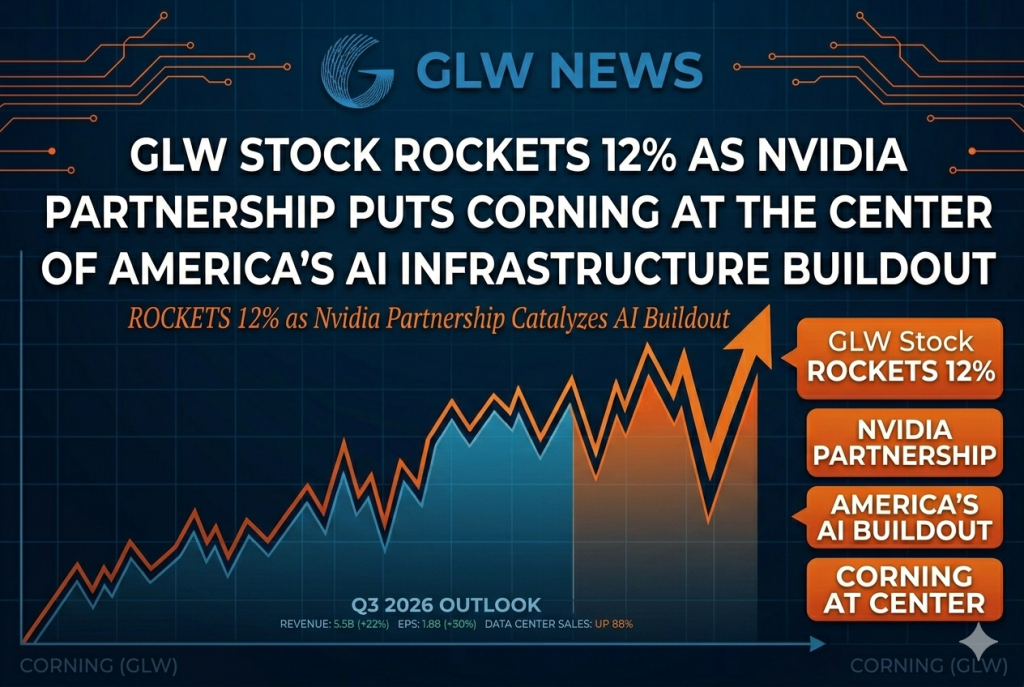
Corning Inc. (NYSE: GLW) has been inventing things the world didn’t need for 175 years, including low-loss optical fibers, Gorilla Glass, and LCD display panels. The company added a new chapter Wednesday as the designated optical connectivity partner for Nvidia’s AI infrastructure buildout.
Nvidia chooses Corning as optical partner
The partnership, established on May 6, is both a commercial supply agreement and a strategic capital alliance. Nvidia will buy 3 million shares from Corning at a token price, with an option to buy an additional 15 million shares at $180 per share, giving Jensen Huang’s company a direct financial stake in Corning’s assets. In return, Corning is promising significant production capacity increases. This means a 10x increase in optical connectivity production in the U.S., a more than 50% increase in fiber production, and three new advanced manufacturing plants in North Carolina and Texas that will employ more than 3,000 people.
Mr. Huang explained this relationship broadly as follows: “AI is powering the greatest infrastructure development of our time and represents a once-in-a-generation opportunity to revitalize American manufacturing and supply chains.” The timing couldn’t be better for a company whose devices literally move data through glass at the speed of light.
Why is optical connectivity now a critical infrastructure?
To understand why this deal matters beyond the headline statistics, it helps to know how fiber performs in AI data centers. Modern AI training and inference workloads require thousands of Nvidia GPUs working closely together to transfer large amounts of data between chips, servers, and racks at speeds and distances that cannot be sustained cheaply with copper cables. As AI factories grow larger and more tightly interconnected, fiber optics is moving from a nice-to-have to a basic requirement.
The reason Nvidia is aggressively locking up its fiber optics and fiber supply chain partnerships is precisely because the bottleneck is not just manufacturing GPUs, but transferring data between those GPUs. Corning, the originator of low-loss optical fiber and one of the world’s leading innovators in optical physics, is a natural anchor partner for that plan.
This isn’t Corning’s first large-scale AI infrastructure deal either. In January, Corning won a $6 billion, multi-year contract to help Meta expand its data centers. The deal helped strengthen the company’s bona fides as a hyperscaler supplier even before Nvidia’s announcement.
Corning’s Springboard Plan Gets Meaningful Upgrade
The relationship with Nvidia is a big boost to Corning’s Springboard growth plans. Management now expects annual revenue to reach $20 billion by the end of 2026, exceeding previous expectations, and has high confidence that it will reach $27 billion by 2028, with an internal stretch goal of $30 billion. The strategy has also been extended to 2030 with a high-confidence target of $35 billion and an internal target of $40 billion.
These are not incremental changes. This reflects a fundamental reassessment of Corning’s addressable market as the demand for AI-powered optical connectivity expands from a niche market in data centers to a major infrastructure requirement. Management expects growth to accelerate significantly starting in 2027 due to AI-related demand through enterprise networking and photonics products.
This path is already set in the recently announced Q1 2026 results. Revenue was $4.35 billion, beating expectations of $4.29 billion, and EPS was $0.70, beating consensus of $0.69, with optical communications being the standout driver. The company also announced that it will pay a quarterly dividend of 28 cents per share on June 29.
Analysts raise price targets for Corning stock, but valuation requires caution
In response to NVIDIA’s cooperation, Wolfe Research raised its price target from $185 to $230 and maintained an Outperform rating. The company raised its 2028 revenue forecast to $27.5 billion and EPS forecast to $5.75, citing reduced competitive, technological and supply chain risks as the potential size of its data centers increases, warranting a higher multiple. Five experts raised their profit forecasts ahead of the next fiscal year.
Recent analyst moves include Citigroup raising its target to $175, Susquehanna raising its target to $180, and Bar Cap raising its target to $149. Broad confidence in the growth trajectory is reflected in the consensus rating of Buy.
Warning flags are evaluations. Corning’s P/E ratio of 86.84 is high for a company in an industry with real AI tailwinds: infrastructure. InvestingPro’s fair value analysis finds the company to be overvalued at current levels. The $200 psychological barrier level is expected to elicit profit-taking as the stock approaches from below. The RSI is neutral at 52.63, indicating that the momentum rally has not yet entered technically overbought territory, which could allow for further extension before consolidation.
What Corning Investors Should Watch Next
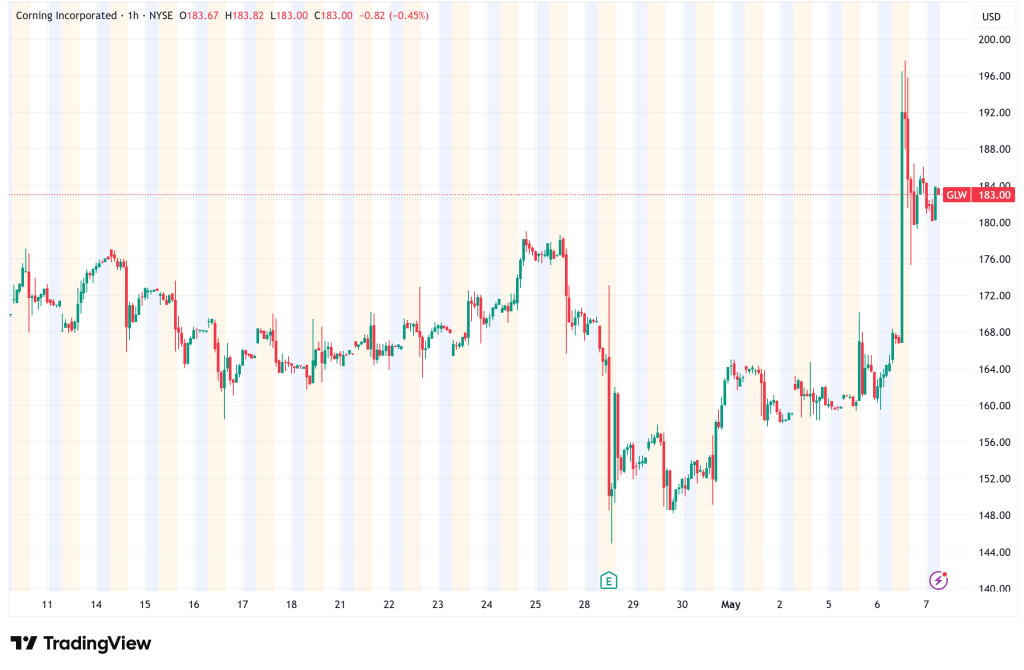
Corning’s 12% rise to an all-time high is not a speculative pop, but a natural reappraisal. The partnership with Nvidia has strategic, financial and operational implications. Three new factories, 3,000 jobs, and a tenfold increase in production capacity are more than press release abstractions. The previous meta-agreement strengthens Corning’s position as a critical optical infrastructure for two of the companies most aggressively investing in building AI data centers.
For traders, the $158-$162 zone currently serves as important medium-term support, with $200 being the psychological resistance to watch for now. Wolfe Research’s $230 target serves as a directional anchor for long-term positioning. The risk is that high valuations make the stock sensitive to weakness in AI capex sentiment, but for now the momentum and underlying story are consistent.

Arslan Butt
Lead Market Analyst – Multi-Asset (FX, Commodities, Crypto)
Arslan Butt serves as Principal Commodity and Index Analyst and brings a wealth of expertise to this area. With an MBA in Behavioral Finance and actively progressing towards a PhD, Arslan has a deep understanding of market dynamics. His professional background includes significant roles as a senior analyst at a major brokerage firm, complementing his extensive experience as a market analyst and day trader. Adept at educating others, Arslan has a commendable track record as an instructor and speaker. His incisive analysis, especially in the area of cryptocurrencies and foreign exchange markets, has been featured in reputable financial publications such as ForexCrunch, InsideBitcoins, and EconomyWatch, solidifying his reputation in the financial community.


