
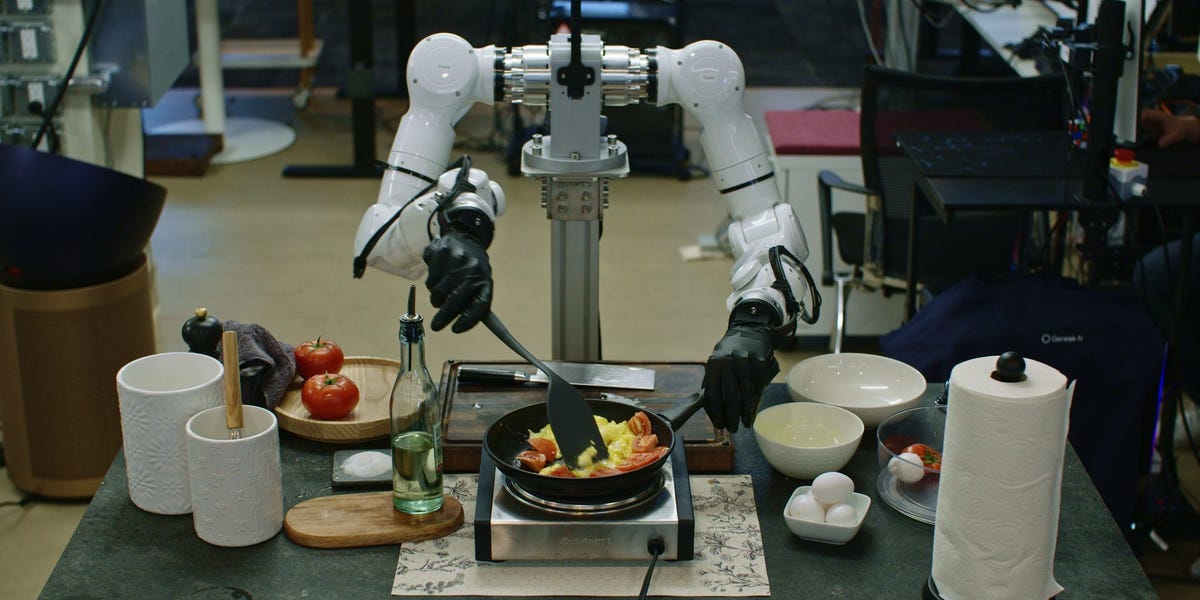
Manipulation is considered one of the most difficult problems in robotics. What makes humanoid robots truly useful in the real world is their ability to precisely grasp, move, disassemble, and assemble objects.
A startup backed by venture capital firm Eclipse and former Google CEO Eric Schmidt said it needed to take a big leap to solve the problem.
Genesis AI, a French startup with an R&D center in Silicon Valley, said Wednesday it is close to achieving “human-level capabilities” in operations, showing recorded demonstrations of robots playing the piano, cracking eggs and working with wires.
One video showed a robotic hand moving to a piano piece that moved at about 130 beats per minute. The startup also demonstrated how the robot could crack eggs with one hand and use wires.
Genesis AI said the demo ran autonomously, meaning the robot was not controlled remotely by a human and was displayed at 1x speed.
The demo was not an example of zero-shot execution. Robots still required training for specific tasks, such as playing specific music. Genesis AI CEO Zhou Xian told Business Insider in an interview that his team of about 60 people taught a robot to play a new song on the piano in an hour.
Xian said cooking demonstrations would require “hundreds of trajectories” or recorded examples of related tasks to train a robot to crack eggs or chop tomatoes.
He said a 30-second “complex skill” like the one seen in the cooking demo requires hours of human data and less than 30 minutes of data from the robot performing the task.
The robot still failed on several subtasks in the cooking demo. Most steps reached around 90% to 95% success, but things like cracking an egg with one hand or moving chopped tomatoes with a knife during filming were closer to 50% to 60%, Xian said.
“I think these are probably the most complex tasks ever performed by a robot in a very human-like way, with efficiency, speed and performance similar to humans,” Xian said, adding that the robots have shown speeds about 60% to 70% of humans.
Genesis aims to build general-purpose robots that can perform a variety of tasks in a variety of environments. Unlike model-focused companies like Physical Intelligence, this startup develops the entire stack: AI models, robot hands, training gloves, simulators, and eventually the robot itself.
Chou said that even after 10 years, he still doesn’t understand why factory robots are fundamentally different from household robots.
“I think the advantage of being a full-stack company is that we know exactly what we need when we design the hardware,” Xian says.
Genesis makes hands that closely resemble human shapes. Xian said the startup’s robotic hand has 20 degrees of freedom and 20 motors are directly built into it. This differs from tendon-driven hands, where the motor is placed in the forearm and cables or tendons move the fingers.
Rather than relying solely on video data and remote control, the startup uses a combination of internet data and raw human data collected through a proprietary training glove that captures signals like hand movements and tactile forces.
Xian said his company is in talks with several industry partners to potentially have employees wear training gloves for data collection while on the job. Genesis also uses an in-house simulator to test models trained on real-world data across many virtual environments. This allows the system to be evaluated more quickly than running each test on a physical robot, Zhou said.
The CEO didn’t make bold claims that manipulation was solved, but said Genesis’ approach was an “important step” in taking robot manipulation to the next level.
“We are certainly an ambitious company,” Xian said. “I’m just not satisfied with the status quo.”, And we want to move this field forward. ”


