
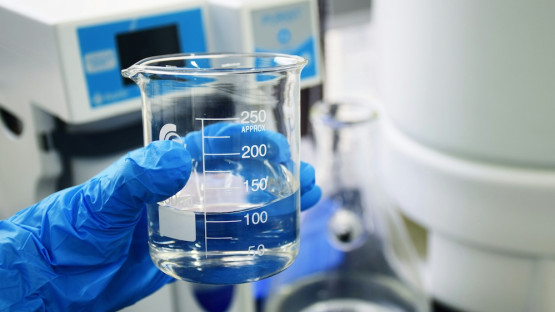
According to chemist Robert Distasio, there are multiple ways to describe water molecules, especially when communicating with machine learning (ML) models. You can input the structural information of the molecule into the algorithm, that is, two hydrogen atoms on either side of an oxygen atom with a bond of a certain length and a certain bond angle.
Alternatively, we can use the quantum mechanical information of molecules. That is, if we can package this complex information in a compact way that ML algorithms can understand. Chemists at Cornell University have just discovered how. Their new method, semilocal density fingerprinting (SLDF), can predict molecular properties with up to 100 times more accuracy than currently the most common methods for modeling molecules and materials.
In their quest to use ML to predict the properties of molecules, DiStasio, an associate professor of chemistry and chemical biology in the College of Arts and Sciences, and members of his lab discovered a way to encapsulate quantum mechanical information in molecules. This allows more than simple structural information, such as the identity and position of atoms, to be input into ML algorithms, resulting in orders of magnitude higher accuracy than using density functional theory (DFT) alone, the most common method today.
DiStasio is the corresponding author of “Learning Molecular Conformational Energies using Semi-Local Density Fingerprints,” which was published Dec. 17 in the Journal of Physical Chemistry Letters.
Read the full article on the Faculty of Letters and Science website.


