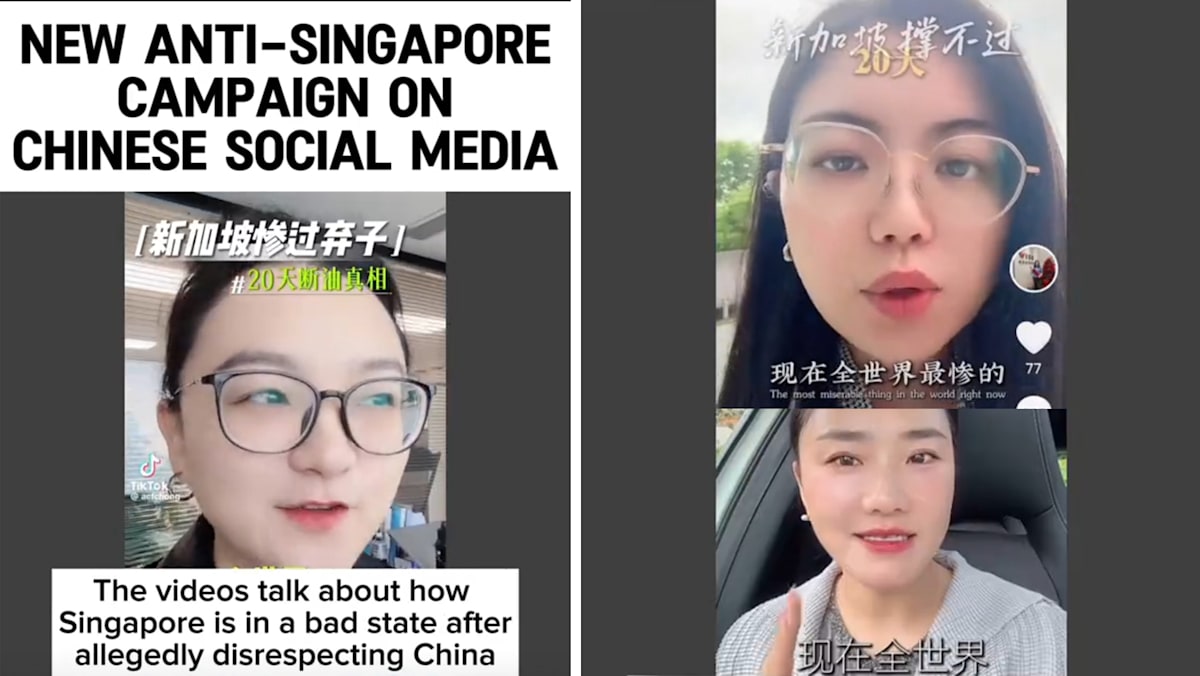
At first glance, it looks like a typical talking head explainer video.
Different people and different settings talk about Singapore’s economy and its relationship with global powers.
But after watching a few videos in a row, something starts to feel…off.
As it turns out, many of these clips contain the exact same script. And who are the “people” among them? They may not be real at all.
Recently, TikToker @damnlouisa reported an influx of AI-generated videos circulating on Chinese social media platforms such as Douyin and WeChat.
In her video, ““A new anti-Singapore campaign on Chinese social media,” she points out, and how these seemingly natural-looking clips start to look less so when compared side-by-side.
Same lines for different “speakers”.
Some people appear to be reusing the same AI-generated face, with only minor adjustments to clothing and background.
So what do these videos actually say?
In short, boring things about Singapore.
The message is much the same, painting a rather bleak picture for the country’s future while claiming that Singapore has been “disrespecting” China.
A recurring script claims that Singapore has become overly dependent on the United States, only to be “abandoned” in the end.
It also makes the bold claim that Singapore’s oil and energy reserves are “less than 20 days old”, suggesting that Singapore’s key industries, including high-tech engineering, are vulnerable or dependent on outside goodwill.
China’s Hainan Free Trade Port has also been mentioned repeatedly, with some suggesting it could eventually replace Singapore’s role in certain areas.
To be clear, these are claims made in the video and are not verified facts.
According to @damnlouisa, it’s like an AI-powered disinformation campaign, in which “convincing but fabricated content” is churned out “to spread false narratives and manipulate public opinion.”
“The intention behind these stories is to sow discord and mistrust between nations and groups,” she wrote.
And if you’re not actively comparing multiple videos, you might not notice anything unusual at all.
Each clip itself looks polished and believable, but nothing immediately screams “AI”.
As AI tools become more sophisticated, detecting such content may become even more difficult.
So the next time a video feels oddly familiar, it might be worth asking, “Is this a real opinion or is it the same script?”