

Today, most machine learning purchasing decisions rely on demos, vendor descriptions, and analyst perspectives. To ground this in real-world experience, we analyzed 500 verified user reviews from teams that have been implementing and operating ML software for a long time. This approach reveals where ML brings value, where it falls short, and how it impacts measurable business outcomes. Here’s what the data shows:
According to G2’s analysis of 500 machine learning reviews, buyers take an average of 3.33 months to go live and 10.28 months to realize ROI. This is a nearly 7-month gap between feature deployment and measurable benefits.
Machine learning software is no longer a niche investment. Budgets are in place, tools are in place, and expectations are high. Vendors promise seamless integration, easy deployment, and innovative AI outcomes. G2 analyzed 500 buyer reviews in the Machine Learning category and tested these promises against what buyers actually said after months of real-world use.
Reality: What G2 Review Data Really Shows About Machine Learning
Machine learning software has a reputation for being difficult to implement and slow to see results. Across 500 G2 reviews, buyers give the machine learning software an average star rating of 4.47 out of 5 stars. Of those, 92% of reviewers gave it 4 stars or higher. Only 2% rated it 3 stars or less. The remaining 6% rated it 3.5 stars.
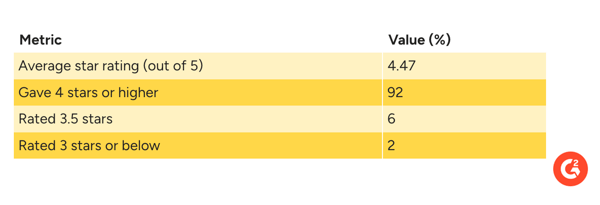
These numbers show that the tool is working. But star ratings are what buyers feel at the end of their journey. Reviews have shown that reaching that satisfaction is more difficult, time-consuming, and expensive than most vendor demos suggest.
What Vendors Promise and What Buyers Experience
Vendors in this category consistently market their platforms around four core promises: seamless integration, ease of use, rapid deployment, and transformative business outcomes. G2’s review data tests each of these against what buyers actually write after using the product.
Here are some examples of what buyers said, good and bad, in their own words.
positive feedback
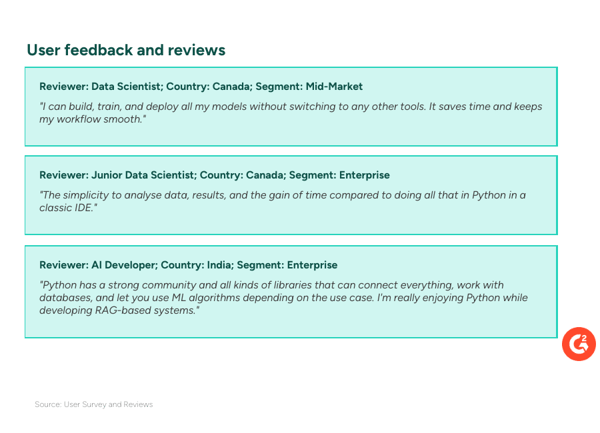
The pattern that buyers celebrate is consistent. It’s not a single feature. Rather, the key requirement is the ability to build, train, and deploy in one place without switching tools. This is a more modest claim than what vendors typically make, but buyers always check it.
G2 review data shows 68% of ML buyers score 9 or 10 points out of 10 For the “Likely to Recommend” question, the average recommendation scores across all 500 reviews are: 8.95 out of 10. It is not the satisfaction that comes from low expectations. In other words, buyers who have real value and want their colleagues to know about it.
This time on the other side
.png?width=600&height=433&name=user-testimonials%20(1).png)
What’s interesting is that both reviewers rate the same tool highly. The frustration isn’t that ML tools fail. Making them work takes more time, money, and patience than the buyer expected.
What the hype isn’t enough about: What vendor pitch decks won’t tell you
The most obvious data point comes from G2’s ROI survey data. Buyers were directly asked, “How long did it take you to get up and running? And how long did it take you to see a return on investment?”
3 months left until the live show. 10 months to ROI. This is a seven-month period for the tool to be deployed and people to use it, but the business case is still being built. This period is where most of the internal pressure on ML projects arises, not from technical failures but from the gap between expectations and tangible benefits.
On the other side of that gap, a 92% satisfaction rating shows that the investment has paid off. ROI data tells you what it will cost to get there. Both numbers belong to the same conversation. Vendor promises tend to show only one of them.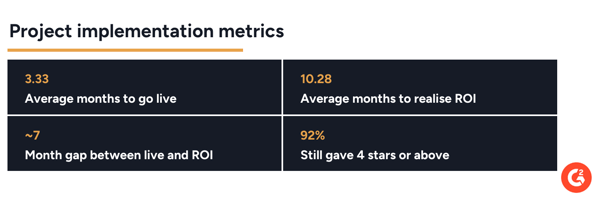
What this means for buyers
ML software delivers results, but not on the timeline most buyers expect when they sign a contract. The path from a signed contract to its evaluation is longer and more difficult than most vendors allow. Here’s what to expect and how to prepare
- Satisfaction is real, but it comes with friction, not the other way around. G2’s analysis of 500 machine learning reviews shows that the average star rating is 4.47, with 92% of buyers rating 4 stars or higher, confirming that real value is being provided. However, G2 ROI data shows that it takes buyers an average of 10.28 months to realize the benefits. This means that satisfaction is not an immediate result, but rather a result of persistence.
- Action items for buyers: Set expectations in your mind before you go live, not after the irritation starts. Create a 12-month stakeholder roadmap that defines what success looks like in months 3, 6, and 10. Buyers writing 4- and 5-star reviews came in knowing it would take time, and from day one, they met those expectations and brought in stakeholders.
- The adoption gap is the actual adoption risk for that category. According to G2 data, it takes ML buyers 3.33 months to go live and 10.28 months to realize ROI. This represents a nearly seven-month gap between feature adoption and measurable revenue, a period of greatest internal pressure to invest in ML, and is largely undocumented in vendor-side documentation.
- Action items for buyers: The 7-month period from go-live to ROI cannot be managed naturally. Plan and identify two or three metrics you want to achieve, such as faster workflows, cleaner data, or less manual work. These aren’t ROI yet, but they prove your investment is moving in the right direction. Without these, the business case will quietly collapse before any results can be seen.
Even struggling buyers were not disappointed with the software. They were disappointed by the gap between what they expected and the actual implementation costs.
Data doesn’t lie. Provided by ML. The question is whether your deployment plan is as ready as your software.
The right machine learning platform exists. G2 makes it easiest to find it in the process.


