

There are growing concerns that rapidly evolving artificial intelligence (AI) will automate routine tasks and take some jobs away from people. However, we need to focus on mastering the technology rather than simply fearing AI replacement. By appropriately engaging and collaborating with AI, both individuals and companies can become stronger. Ricoh aims to solve social issues and achieve the Sustainable Development Goals (SDGs).
Improve meeting quality and leverage insights
More and more companies are integrating AI into their business processes. This move frees up staff from tasks that are often performed inefficiently. This new technology will usher in an era of evolution in the way we work, bringing about changes that will unlock greater creativity.
In September 2025, Ricoh opened a next-generation AI-powered conference space at a co-creation base near Shinagawa Station in Tokyo. This project is a collaboration with our client company. Everything you say is recorded by a microphone and automatically processed, categorizing your posts by topic and displaying your comments as digital sticky notes organized in a list format. Autonomous AI agents also generate new ideas and summarize discussions on request.
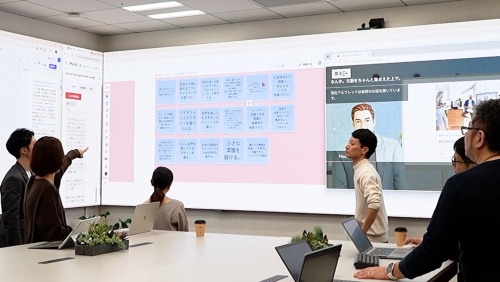
Next-generation meeting space at Ricoh Business Innovation Lounge Tokyo (Minato-ku, Tokyo)
Loud voices tend to dominate meetings, but this technology ensures everyone’s opinions are heard equally and encourages meaningful and lively discussions. When used to identify issues in a workshop, its ability to automatically organize conversations and visualize topics helped deepen discussions about issues. As a result of this assistance, session times were reduced from the usual three hours to just 30 minutes. This means improved meeting quality and productivity while saving time.
The benefits of AI go beyond increased efficiency. It also helps companies better leverage the expertise they have within their organizations. Until now, daily reports for sales and production departments were often written on paper, making it difficult to utilize the information effectively. Ricoh has developed and provides companies with a multimodal large language model (LLM) that can interpret analog information such as charts and images. Ricoh aims to meet customers’ needs to make the most of the expertise of its veteran employees, especially in Japan, where the workforce is rapidly aging due to population decline.
In contrast to large enterprises, small and medium-sized enterprises are lagging behind in AI adoption. This is due to both financial and operational concerns, such as implementation costs and staffing uncertainties. The price of Ricoh’s newly built system is several million yen (lower tens of thousands of dollars), one third of the cost of conventional servers, and we provide hands-on support for installation and operation. Improving the accessibility of AI and making technology accessible to everyone is a key role for information technology (IT) companies.
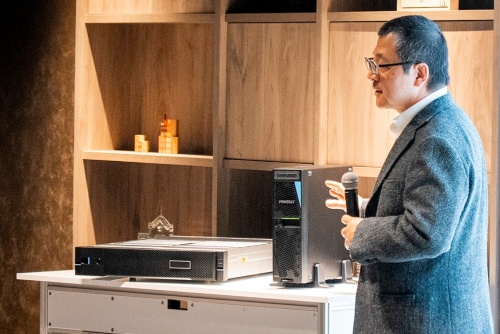
An affordable AI system that runs on a compact server so that even small and medium-sized businesses can easily use it (December 2025 presentation)
AI can also help free people from the dangers of dangerous work. Ricoh Group’s PFU (Kahoku City, Ishikawa Prefecture) has developed a system to detect lithium-ion batteries mixed in household and business waste, and will begin providing it in October 2025. Using X-ray images, AI pinpoints the location of the battery and provides information to staff. This system was created to prevent fires frequently caused by lithium-ion battery explosions at waste treatment facilities.
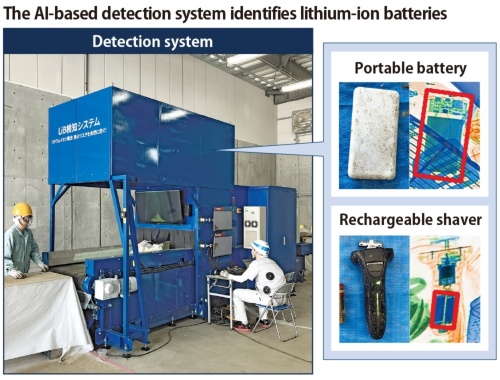
AI automatically detects lithium-ion batteries mixed in waste (image detection by AI engine)
Technological innovation is essential to address Japan’s major social challenges of population decline and aging. The extent to which AI is leveraged will increasingly determine the competitiveness and sustainability of growth for both businesses and nations.
Passive work habits can be changed through equal learning opportunities

Akira Oyama
Ricoh Co., Ltd. Representative Director, President and CEO
I use generative AI to identify perspectives that my ideas may be lacking. It provides direct and unfiltered criticism. Additionally, the process may take some time as it compares the responses of various AI engines and searches while checking the sources of information.
Routine and repetitive tasks may be replaced by AI and gradually become extinct. What we will need in the future is people who are proactive and independent in tackling problem-solving on their own. The ability to incorporate AI-generated insights into workflows to create new value will become increasingly important.
Waiting idly for instructions is not an innate behavior; such a habit develops over time. That’s why people can change of their own will. It’s much more rewarding to spend eight hours actively working than eight hours passively. It’s important to support and encourage your employees to change their thinking and behavior. In fact, companies should take this responsibility directly.
Ricoh’s mission and vision emphasizes “fulfilment through work.” We believe that a sense of accomplishment and fulfillment from work leads to true satisfaction. One of Ricoh’s roles is to support all people, including customers and employees, to engage in creative work while experiencing a sense of accomplishment.
In many companies, the experience and know-how accumulated by employees remains dormant as tacit knowledge. This hidden knowledge can be a source of competitive advantage that differentiates your company from all its competitors. In the future, it will be urgent to convert this tacit knowledge into explicit and active knowledge using AI. From there, it is up to people to combine this deep knowledge with their own knowledge to create new knowledge.
It is important that all employees have an equal opportunity to benefit from Al. We also carry out voluntary education and training programs.


