
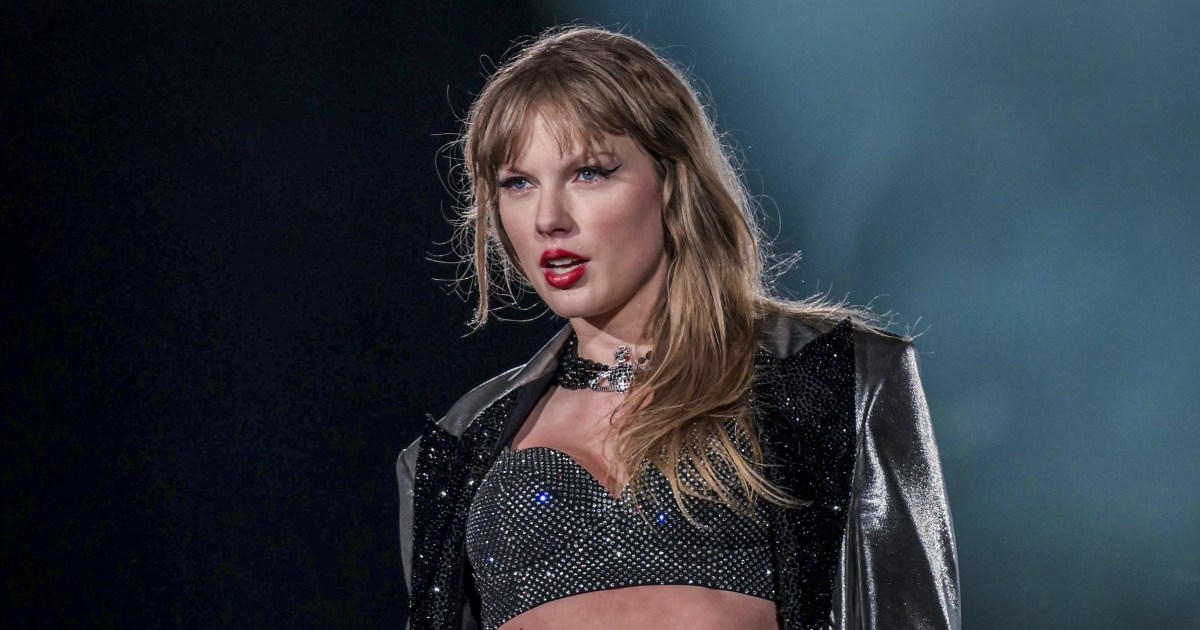
Taylor Swift is taking new steps to protect her voice and likeness from AI abuse.
Subscribe to read this story without ads
Get unlimited access to ad-free articles and exclusive content.

The global pop superstar filed a trademark application Friday for two audio clips featuring his voice. In one of them she says: “Hello, I’m Taylor Swift. My new album, The Life of a Showgirl, is available on demand on Amazon Music Unlimited.”
On the other, she said in a low register, “Hi, I’m Taylor. My new album, ‘The Life of a Showgirl,’ is coming out on October 3rd. Click and save to listen on Spotify.”
Swift also filed for a third trademark to protect her image of herself on stage wearing her signature glittery bodysuit and strumming a pink guitar.
The Grammy Award winner has been the target of numerous deepfakes in recent years. Fake clips of her promoting a cookware brand fooled fans online, sexually suggestive deepfakes of her went viral on social media, and even President Donald Trump shared a doctored photo of her endorsing his candidacy.
Swift is one of many high-profile names facing this issue as AI content generation tools become increasingly sophisticated, even as AI companies add guardrails to prevent harmful uses of their models.
In January, Matthew McConaughey became the first A-lister to apply for a series of trademarks that include his images, videos, and audio to protect his likeness as AI-generated deepfakes become increasingly realistic and easy to create.
AI experts have suggested that individual trademarks for celebrities like Swift could become even more common as people look to gain stronger legal standing to sue if their likenesses are copied without explicit permission.
Soundmarks, or distinctive audio cue trademarks, have historically been filed to protect iconic brand sounds such as MGM’s lion’s roar, NBC’s chimes, and the Pillsbury Doughboy’s laugh.
00:41
Matthew McConaughey trademarks himself to fight AI
00:0000:00
But trademark attorney Josh Gerben, who first reported on Swift’s new trademark application, said in a blog post that “the attempt to register a celebrity’s speaking voice is a new use of trademark registration that has never been tried before in court.”
“Historically, singers have relied on copyright law to protect their recorded music. However, AI technology has enabled users to generate entirely new content that mimics an artist’s voice without having to copy existing recordings, creating a gap that trademarks could help fill,” Garven wrote. “By registering specific phrases associated with her voice, Swift could challenge not only identical reproductions, but also ‘confusingly similar’ imitations, a key standard in trademark law.”
Swift has applied for hundreds of trademarks throughout her career, most of them aimed at protecting her name, lyrics, products, and other elements of her brand identity. This appears to be the first example of Swift pursuing soundmark protection.
Rebecca Leibowitz, the attorney listed on the filing, did not respond to a request for comment.
A spokesperson for Swift also did not respond to a request for comment.
Celebrities continue to warn against misuse of AI, with some calling for stronger protections.
In 2023, Scarlett Johansson’s lawyer demanded that AI apps stop using her likeness in advertising. The actor also accused OpenAI in 2024 of using a voice “eerily similar” to hers for the GPT-4o chatbot, even though OpenAI denied the company’s request to provide her voice. OpenAI later announced that it would no longer use voice, but did not say why.
In 2024, Tom Hanks denounced “multiple ads on the Internet that misrepresent my name, likeness, and voice to promote miracle cures and miracle drugs.”
“Breaking Bad” star Bryan Cranston raised similar concerns last year about OpenAI’s Sora 2 product and its ability to copy his and other celebrities’ likenesses without permission. (OpenAI announced last month that it would be shutting down its Sora video creation app).
In January, more than 700 creators, including Johansson, Cate Blanchett and Joseph Gordon-Levitt, endorsed the ‘Stealing Is Not Innovation’ campaign.

Sponsored by a coalition called The Human Artistry Campaign (comprised of unions representing creators, artist rights groups, and industry organizations), the movement is calling on tech companies to stop training their generative AI tools on copyrighted works without explicit permission from creators.
As image rights protection increases the interest of celebrities, some companies appear eager to partner on the issue.
Last week, YouTube announced deals with multiple talent agencies to open up its proprietary deepfake detection tools to celebrities and entertainers, making it easier to request unauthorized portraits be removed from the platform.
AI seems to be making its way into celebrities, and as the technology becomes more mainstream, some are cautiously leaning towards it.


