

AI developers and engineers are being forced to make trade-offs they shouldn’t have to make: move fast and relinquish control with managed AI services, or build on raw infrastructure and absorb all the costs of complexity.
This is becoming one of the critical bottlenecks for AI adoption in enterprises.
Enterprise spending on generative AI has more than tripled year over year, and demand for token usage and inference is growing at an unprecedented rate. According to McKinsey, token usage on Gemini alone will increase 50 times, and inference is expected to account for more than half of all AI computing by 2030. At the same time, research from companies like Deloitte consistently points to the same limitations. In other words, the most difficult part of deploying AI at scale remains the gap between experimentation and production.
Although teams can create prototypes quickly, turning those prototypes into reliable, cost-effective, and managed systems remains time-consuming, expensive, and operationally complex. For businesses, the challenge is further complicated by the need to meet sovereignty and compliance requirements without sacrificing performance.
The result is a structural mismatch. Model capabilities are accelerating. Sovereignty and compliance concerns continue to grow while advances in enterprise infrastructure and tools have not kept pace.
For engineering teams, that mismatch manifests itself in very real ways.
- Environments designed for CPU workloads are not cost-effective for GPU workloads.
- Hardware costs and rates of change mean you have to compromise on performance, or worse, the value you get from AI.
- Instead of shipping features, we spent weeks piecing together infrastructure and maintaining rapidly evolving AI tools, dependencies, hardware, and models.
- Limited flexibility of managed platforms that do not match operational requirements
- Inference costs that scale faster than the value you generate
As AI moves from experimentation to core business systems, this tradeoff will no longer be acceptable.
And it signals a deeper change. AI services are all about how quickly and reliably you can deploy, operate, and improve models in production. The question is no longer how to access AI. The key is how to deploy it without compromise and seamlessly integrate with enterprise compliance and security while addressing new business requirements every day.
Dedicated infrastructure changes that equation. Deployments like Nvidia’s Vera Rubin platform demonstrate that it is possible to do both, operating within sovereign constraints while maintaining the performance required for production AI.
Traps set by most platforms
Most AI service platforms present engineering teams with a version of the same tradeoff: convenience at the expense of control, or control at the expense of time and development.
Both ultimately manifest themselves in token economics.
Fully managed platforms move fast. These often align well with how enterprises build, test, and deploy applications, abstracting infrastructure, simplifying API surfaces, compressing the distance between first call and first result, and incorporating governance and cost visibility. However, it limits model selection, limits customization, and creates structural dependencies on all deployment decisions that directly impact total cost of ownership.
That flexibility is often inconvenient for teams integrating AI into complex enterprise systems, where compliance varies by region and requirements evolve rapidly. This is an operational challenge with evolving location-specific expectations around data processes, storage, decision-making, and deployment. Without intentional design, it can create liability and business risk.
Alternatively, vertically optimize each layer for governance, security, sovereignty, and obviously performance, turning the problem into an accelerated path to value. Full flexibility, but at the cost of time and significant engineering investment. Governance, separation, and trust must be designed, not assumed.
Token economics deepens the challenge further.
As the amount of tokens continues to grow, teams are not only increasing what they put into these models, but also have high expectations for the value and quality of what comes out. Cost per useful output is becoming as strategically important as raw model functionality.
Platforms that are fast but expensive or affordable but unreliable fail the same test from different directions. This is a core failure mode for modern AI services, forcing compromises along every path.
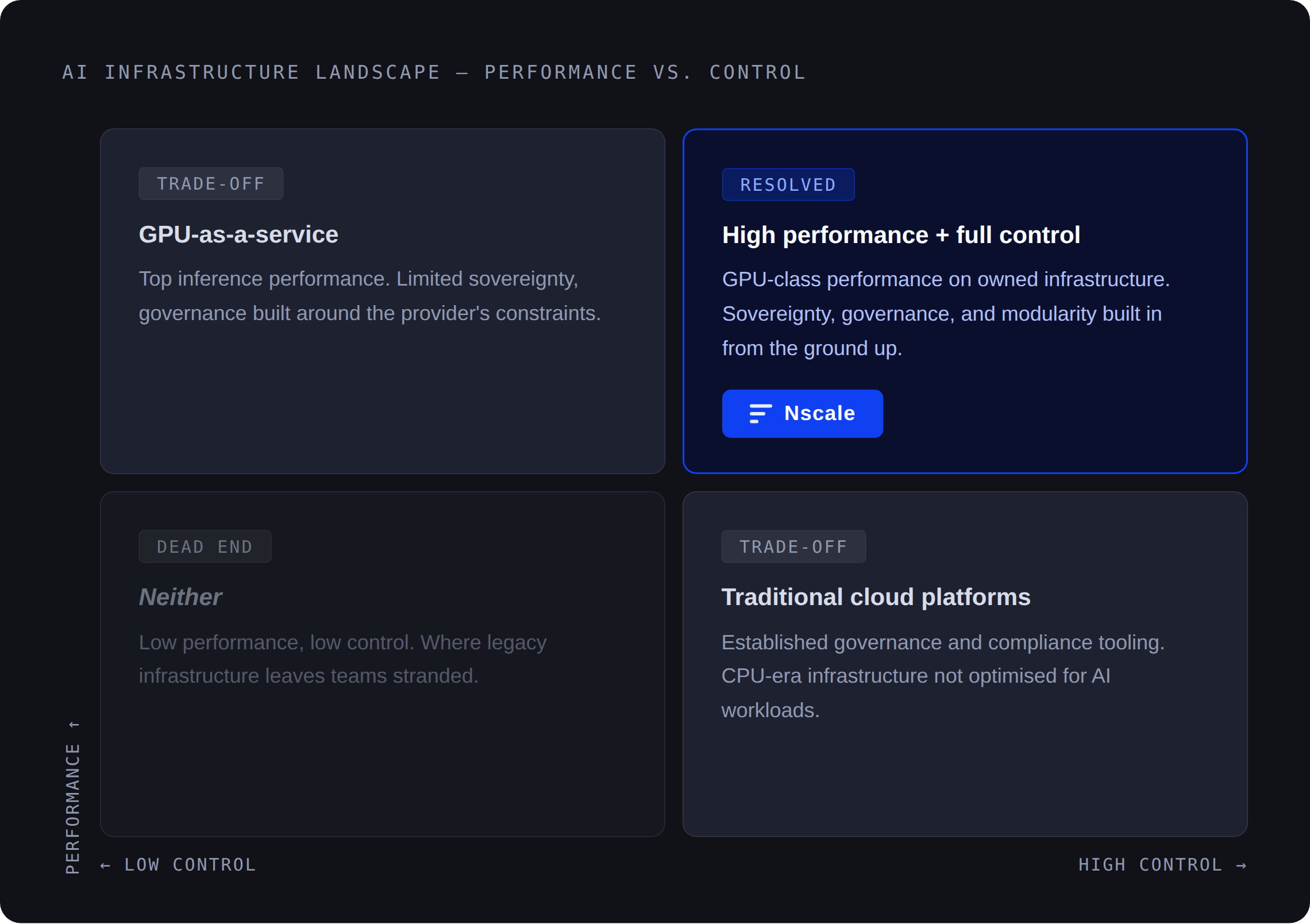
Building blocks, not black boxes
This trade-off is not inevitable. The solution is a different design philosophy. Build the foundation, recognize sovereignty, design components and the seams between them to be configurable by design and optimized for best performance, and allow your engineering team to configure accordingly.
Most platforms force you to choose between convenience and flexibility, but Nscale removes that constraint by exposing modular, interoperable building blocks. Because clients have different needs, their approach is to provide a flexible set of core building blocks that allow customers to work quickly and tailor solutions in the best way.
This way, speed and control are no longer contradictory forces. Teams can move quickly without being tied to predefined workflows and maintain architectural flexibility without having to rebuild their infrastructure. This allows both experienced AI engineers and AI novices to work from the same interface. It provides the ability to drill down to the lowest level of control while also providing easy-to-use abstractions.
Nscale’s AI services portfolio is structured around this principle. Three current core services form the foundation: Inference, Tweak, and Prompt Workbench.
Together, we aim to build systems that span the entire lifecycle from experimentation to production, without creating friction between stages.
- Inference provides access to open source models across text, multimodal, and image generation workloads.
- Fine-tuning enables domain-specific adaptation, allowing models to be tailored to enterprise data without requiring complete retraining.
- Prompt Workbench introduces a structured layer of evaluation, allowing teams to test and validate configurations before going live.
Rather than choosing between speed and control, teams can iterate quickly, systematically validate decisions, and deploy with confidence.
Nscale also applies these building blocks internally to operationalize and optimize deployment workflows in real-world situations. Previously, teams had to sift through large amounts of logs to determine where issues were occurring. Now, that process is handled by AI, which analyzes data and creates fault reports, reducing debugging time from 10-30 minutes to about 1 minute.
Inference performance is a system issue
Resolving tradeoffs requires rethinking how inference is designed.
Key-value (KV) caches store intermediate attention states, allowing models to handle long contexts without recomputing previous tokens, reducing both latency and, most importantly, overall time and cost. For most providers, this is a background optimization. With Nscale, design constraints determine routing, scaling, and cost.
The KV cache is treated as a core, first-class component within the system.
That design manifests itself in three ways:
- KV cache-aware routing avoids unnecessary recalculations
- KV cache offloading maintains performance for long-running workloads.
- Separated inference separates prefill and decoding, allowing independent scaling.
The system delivers strong latency performance even at high throughput, but that alone does not determine its overall value. Its economic viability ultimately depends on the underlying infrastructure, with data centers converting inputs such as prompts and power into generated tokens.
Because Nscale owns its own data centers and energy supply, its systems are optimized for both performance and cost. The result is not only faster inference, but also more affordable inference at the critical unit level.
Total cost of ownership is a key consideration, with energy playing a central role. By securing power capacity in advance and planning for future expansion, the aim is to stay ahead of demand while maintaining a fair token price over the long term.
As inference scales, performance and cost become inseparable. In a fragmented system, they diverge. In an integrated system, they are compounded. This eliminates the conflict between performance and cost.
Frictionless security and sovereignty
Governance is often treated as a separate concern in AI infrastructure. In reality, this would be another version of the same tradeoff.
Acting quickly puts governance at risk. Maintaining control will slow down the deployment. There are real-world constraints to deploying enterprise AI, such as data location, compliance, and auditability. If these are not built into your system, you are at fault.
This approach is the same as for performance and management, making governance part of the foundation. Nscale’s serverless inference is designed with strict tenant isolation by default.
For regulated organizations, this removes an entire class of architectural work. Governance is not something that teams have to design. It is already in force. Security and sovereignty are at the heart of Ncale’s value proposition, with a focus on working closely with customers to understand their unique governance requirements and building those needs directly into our products.
Governance shouldn’t slow down your team. This should help them move with confidence. In systems with multi-layered governance, speed and compliance are in tension. In systems where it is included, they are extended together.
Foundation for gaining speed
Deploying AI reliably, cost-effectively, and with good governance requires infrastructure thinking alongside model thinking.
The teams that move the fastest are not the ones that choose the most opinionated platforms. With the right foundations in place, these are production-ready, modular, well-designed systems.
Platforms that force trade-offs will continue to slow teams down. Next-generation AI services eliminate these tradeoffs by design and create compound impacts.


