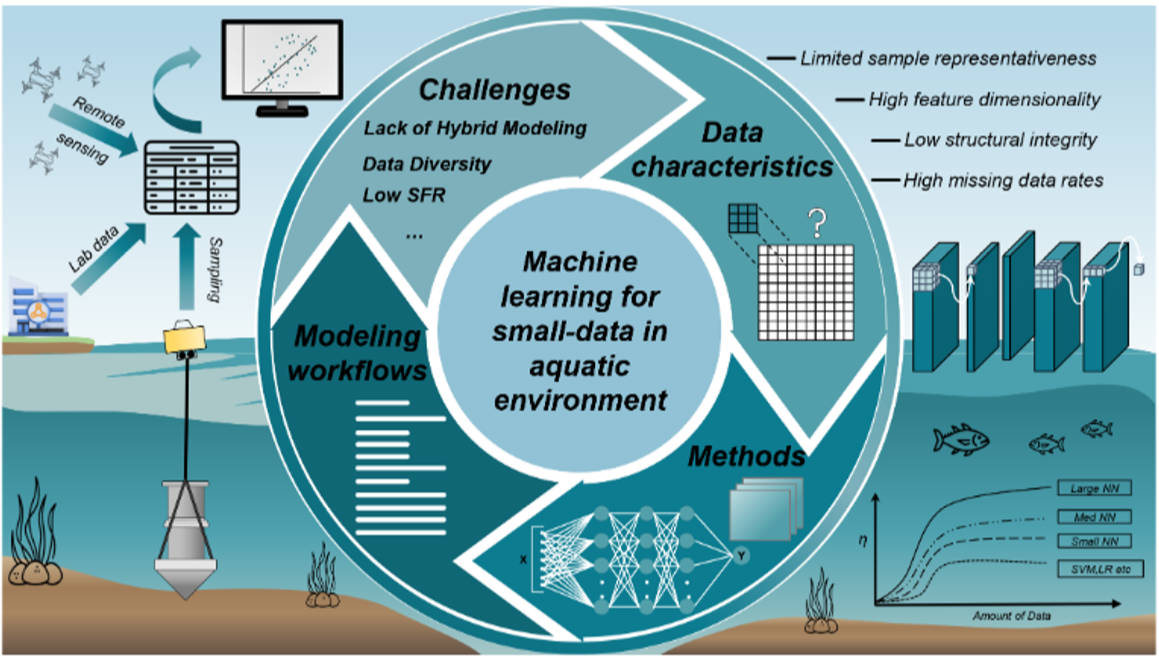
Newswise — Aquatic environments are increasingly affected by climate change and human activities, resulting in complex pollution sources and nonlinear processes. Traditional modeling techniques have difficulty handling the high dimensionality and variability of environmental datasets. Machine learning (ML), with its ability to identify patterns and interactions in large and complex datasets, offers a promising alternative. However, challenges remain, especially in the context of small data, where the number of observations is limited and the data exhibit structural inconsistencies. Based on these challenges, in-depth research is required to develop models that can effectively handle small-scale data problems.
The review was published at (DOI: 10.1007/s11783-026-2186-9). engineering environment On March 17, 2026, researchers from Beijing University of Civil Engineering and Architecture and the Chinese Academy of Sciences investigated how ML can be applied to small-scale data conditions in aquatic environments. This review systematically evaluates current approaches, comparing their adaptability and robustness in different aquatic research applications. This study provides insights to overcome the limitations of small-scale data in environmental modeling and guides future efforts in intelligent water governance and policy making.
This study provides an in-depth evaluation of ML techniques, with a particular focus on supervised, unsupervised, and deep learning techniques. This highlights the challenges posed by high feature dimensionality, small sample sizes, and incomplete data commonly found in aquatic environmental studies. This paper outlines several methodological advances that hold promise to overcome the limitations of small datasets, such as data augmentation and transfer learning. This review highlights the importance of problem-oriented workflows tailored to aquatic systems and suggests that integrating data preprocessing, model building, and evaluation can increase confidence in predictions. This holistic approach is essential for improving the robustness of ML models under low data volume conditions.
Dr. Yulin Chen, one of the study authors, said, “ML has the potential to transform environmental modeling, especially in areas where traditional methods have been difficult. By addressing small-scale data challenges, we can improve predictive models that support more informed, real-time decision-making in water management and environmental policy.”
This study provides a foundation for developing more accurate and reliable ML models tailored for aquatic environmental monitoring. The results, which can be used in a wide range of applications from water quality prediction to pollutant classification, have significant implications for real-time environmental governance. The ability to accurately model water systems, even with limited data, is critical to managing water resources and reducing environmental risks. Future research will focus on refining these models, increasing their scalability, and increasing their interpretability to support informed policy making.
###
References
Toi
10.1007/s11783-026-2186-9
Original source URL
https://doi.org/10.1007/s11783-026-2186-9
Funding information
This research was supported by the National Natural Science Foundation of China (No. 32530070), the International Partnership Program of the Chinese Academy of Sciences (No. 322GJHZ2022035MI), and the STS Project of Fujian CAS (No. 2023T3018).
About engineering environment
engineering environment is an international journal in the field of environment jointly sponsored by the Chinese Academy of Engineering, Tsinghua University, and the Higher Education Press. This journal is dedicated to the promotion and dissemination of cutting-edge theoretical discoveries, innovations in engineering technology, and practice of technology applications in the environmental field. The journal adheres to the principle of integrating scientific theory and engineering technology, and emphasizes the fusion of environmental protection and One Health, climate change response and sustainable development. Particular emphasis is placed on the promise of new technologies and new challenges, the practicality of solutions, and interdisciplinary innovation.