
The grammar of video advertising is quietly but fundamentally changing. What was once a one-to-many broadcast medium is now inching toward something more intimate, responsive, and dynamic. in Frequently asked questions 10th edition! Digies Digital Awards and Conferences Held at the Westin, Gurgaon on March 26, 2026. AI, data, and personalization: A game changer in video advertising We investigated this change in detail.
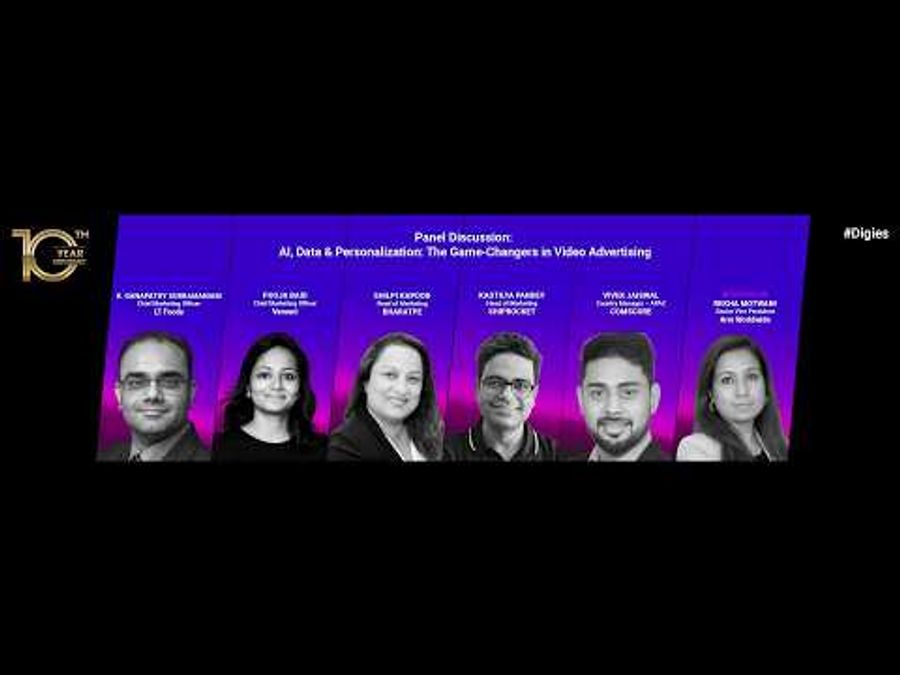
moderator Rekha MotwaniThis discussion from Arm Worldwide Senior Vice President brings together marketers across the industry navigating this change. The consensus was clear. AI doesn’t just power video ads. We are redefining its very purpose.
What was covered in the session was K Ganapathy SubramaniamChief Marketing Officer, LT Foods. Kautilya PandeyHead of Marketing, Shiprocket. Pooja VaidCMO, Versuni. shilpi kapoorMarketing Head, BharatPe. and Vivek JaiswalAPAC Country Manager, Comscore.
Together, they revealed how AI, data and evolving consumer expectations are reshaping everything from creative production to targeting, trust and measurement.
If there’s one thing that ran consistently throughout the discussion, it’s that the consumer remains the fastest-moving variable.
Pooja Vaid put it bluntly: “Consumers don’t care about brands at all. If brands want business, they are expected to deliver.” She explained that AI and data enable a more accurate understanding of evolving behavior in real time. “We’re no longer second-guessing. We actually have behavioral data to support our hypotheses.”
Shilpi Kapoor echoed this from a fintech perspective, where expectations are skyrocketing. “What can you do for me that no one else does?” she asked, pointing to a world where consumers are flooded with similar messages across apps.
Kautilya Pandey has taken it a step further and reimagined the very relationship between brands and consumers. “Customers don’t want to be advertised. They’re watching the conversation,” he said. “Speak the language I want, understand what I need, and fill in the gaps.”
So the changes aren’t just about better advertising. It’s about a fundamentally different relationship.
While the most visible impact of AI is in content, the committee argued that AI’s real power lies deeper, in enabling decision-making.
Baid sums up this change succinctly: “We used to tell a story. Now we let one audience at a time make decisions.” For categories like consumer electronics, this means using data to map behaviors and drive consumers’ lifestyle journeys rather than pushing products out.
Ganapathy Subramaniam described a similar approach in food. The challenge, he said, is not just familiarity, but choice. “The eternal question is, ‘Aaj Kya Banega?’ Can we help you make that decision better?” he asked, explaining how AI can help decipher context, opportunity, and intent to provide relevant recommendations.
Mr. Kapur added that in a sensitive category like fintech, this decision-making has to be handled carefully. “There’s a very fine line to walk. You have to make sure you’re adding value without making users feel like they’re being watched,” she says. Education, life stage relevance, and contextual nudges are key here.
The idea is consistent in all categories. AI enables brands to move from broadcasting stories to driving choices.
The potential for AI-driven personalization is enormous, but it also comes with its own set of tensions.
Ganapathy Subramaniam emphasized his ambition: “Consumers will eventually expect not just customization, but personalization based on their current needs.” But he also emphasized the responsibility of marketers to deliver this “profitably”.
Mr. Kapur pointed out the risks of sameness in an AI-driven world. “While we’re chasing lookalike audiences, everything is starting to look the same,” she said. The challenge is differentiation in hyper-personalization.
Pandey provided a practical lens for D2C and e-commerce. He said video is evolving into a personalized touchpoint. “It’s like a handwritten note that comes in your package. It’s like an effort,” he explained. By leveraging AI, brands can now create hundreds of variations from one master film and tailor delivery based on where users are in the funnel.
As a result, the itinerary is shortened. “Discover, recognize, consider, buy, retain. It’s all rolled into one,” Pandey said.
But as several panelists suggested, it’s important to make sure this personalization feels intuitive and not intrusive.
While creativity, targeting, and personalization are rapidly advancing, measurement is struggling to keep up.
Pandey said directly, “The slowest thing that changes is measurement.” In a rapidly evolving ecosystem, marketers often end up taking a gamble due to the lack of a robust framework.
Vivek Jaiswal widened this gap further. “Marketers are still focused on surface-level metrics,” he said, adding that traditional metrics like CTR and VCR are inadequate in an AI-driven landscape.
He pointed to the need for cross-platform deduplicated measurement across digital, AI platforms and connected TV. As the behavior of audiences, especially Gen Z, changes rapidly, understanding true reach and impact is critical.
“When it comes to AI, the intent and engagement is much higher,” Jaiswal said. “How you measure it is the real source of truth.”
Until then, measurements remain the weakest link in an accelerating system.
As the discussion drew to a close, the focus shifted from technology to marketers.
Mr. Kapur emphasized going back to first principles. “What do you want to solve for consumers?” she asked. “Once you figure that out, everything else will follow.”
Baid cautioned against getting lost in terminology. “Be clear about your purpose. Be firm. If you’re pulled in different directions, you’re not going to get anywhere,” she said.
Pandey advocated action over theory. “Pick one use case and commit to unlocking it using AI in the next seven days. You have to start doing it yourself,” he said.
Jaiswal brought it back to relevance. “Let your ads follow consumers in a way that is relevant, not intrusive.”
And Ganapathy Subramaniam perhaps sums it up best. “Be the voice of the consumer within your organization. And don’t get caught up in the data. Have fun. It’s still an art.”
AI is making video ads much more dynamic than their broadcast origins. This enables conversation, compresses the funnel, and pushes personalization to unprecedented levels.
But as the panel made clear, technology is not the only solution. The real challenge lies in balancing intelligence and intuition, scale and sensitivity, and innovation and intention.
Because at the end of the day, even the most advanced systems need to answer simple questions. Does it make sense to the viewer?
We would like to thank all our partners.
Presenting partner: creative fuel
Gold partner: sociocloud
Collaborative partner:
Apptrove, Comscore, Lemma, Clinically, Roshan Space
Entertainment partner: miss marini


